May 27: Hormuz Talks, Canada’s Defense Pivot, Digital Sovereignty, and Washington’s Secrecy Push

– 2 min read

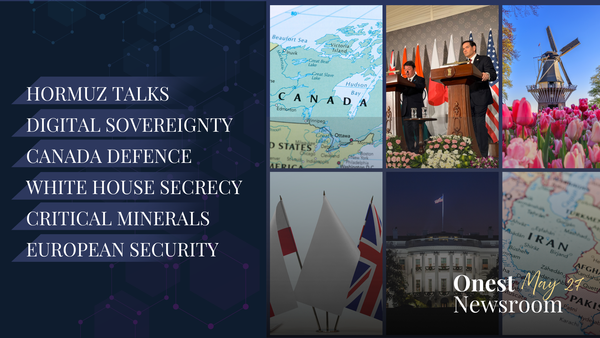
1. The U.S.-Iran Hormuz talks are not settled.
Iranian state media reported a possible framework to reopen commercial shipping through the Strait of Hormuz, lift the U.S. naval blockade, withdraw U.S. forces, and potentially formalize the deal through a UN Security Council resolution. The White House rejected Tehran’s version as false, and Reuters reported that the talks remain inconclusive. Read more.
2. U.S. military pressure is continuing around the Strait.
U.S. forces carried out two self-defense strikes in southern Iran after officials said Iranian activity threatened U.S. ships and aircraft, including reported mine-laying attempts and missile-site activity near Hormuz. Read more.
3. Canada is moving toward Saab’s GlobalEye surveillance aircraft.
Prime Minister Mark Carney announced negotiations to procure Saab’s GlobalEye airborne early warning and control aircraft, built on the Canadian-made Bombardier Global 6500. The project is projected to support 3,000 Canadian aerospace and defense jobs and strengthen Arctic surveillance. Read more.
4. The Netherlands blocked a U.S. takeover of a Dutch cloud provider tied to DigID.
The Dutch government stopped Kyndryl’s acquisition of Solvinity, which manages infrastructure connected to the national digital ID system used for public services, tax filings, and health records. The decision reflects growing European concern over digital sovereignty and foreign control of critical data systems. Read more.
5. The Trump administration is pushing federal employee NDAs.
OPM proposed a governmentwide nondisclosure agreement for federal workers, saying it would reinforce existing rules on nonpublic information. Critics warn the broad language could chill whistleblowing, press disclosures, and protected speech. Read more.
6. A UFC arena is being built on the White House lawn.
A temporary octagon arena is under construction for a June 14 UFC event tied to Trump’s birthday and America’s 250th anniversary celebrations. Reporting says the event has been scaled to roughly 5,000 seats, with major fights planned.
7. The Quad launched a critical minerals framework.
The U.S., Japan, Australia, and India announced a plan to mobilize up to $20 billion for secure critical minerals supply chains, including mining, processing, recycling, and investment coordination. China criticized the Quad’s approach as "bloc politics". Read more.
8. The UK and Poland are signing a major defense treaty.
The agreement will deepen cooperation on Russia, cyber threats, hybrid attacks, air defense, border security, organized crime, and European security. It follows similar UK treaties with France and Germany. Read more.
Today’s ONEST Newsroom is also available as a six-part video briefing.
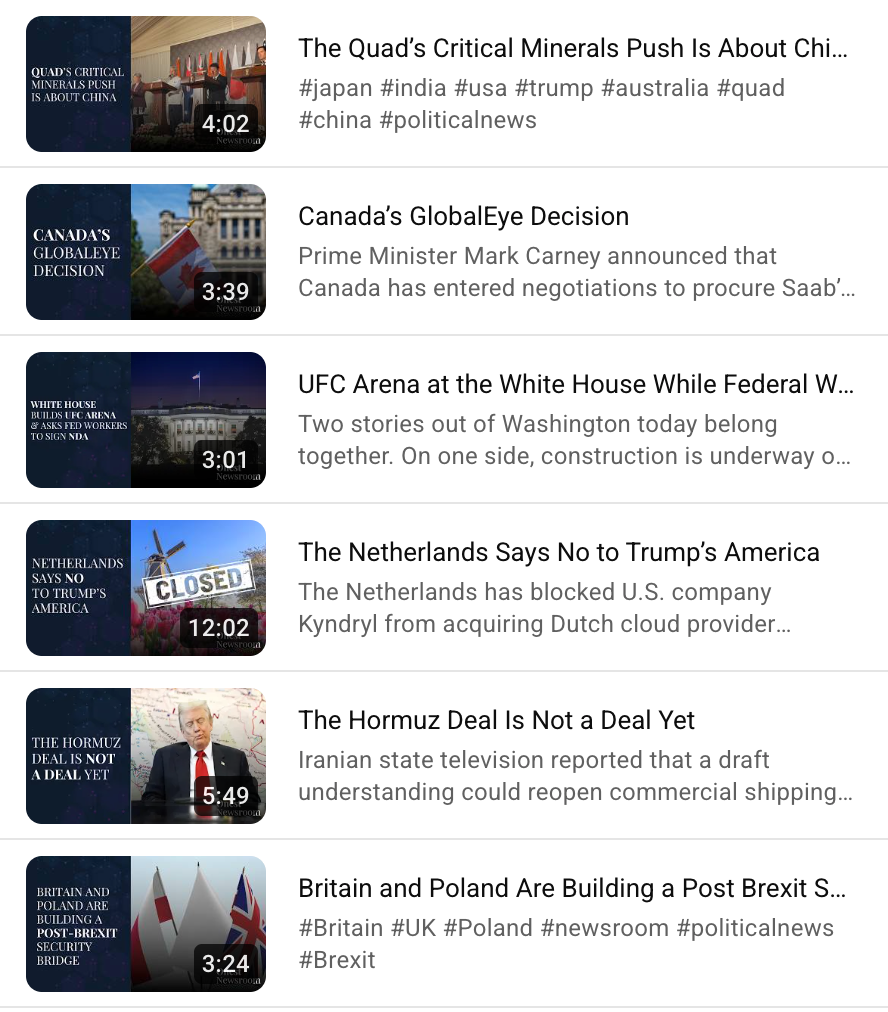
You can watch the breakdown of all stories in under 30 minutes right HERE
The common thread today is control — and the reshaping of resilience.
Countries are reassessing who controls straits, data, supply chains, airspace, government information, and defense production. The world is not only becoming more divided. It is becoming more strategic.
Governments are no longer asking only who their partners are. They are asking what they must still be able to protect, produce, and control when the next crisis comes.