Ukraine and European Partners Launch Joint Anti-Ballistic Missile Program
The Coalition of the Willing also agreed to expand air defense support, coordinate operations against Russia’s shadow fleet and test a multinational force designed to operate in Ukraine after a ceasefire.
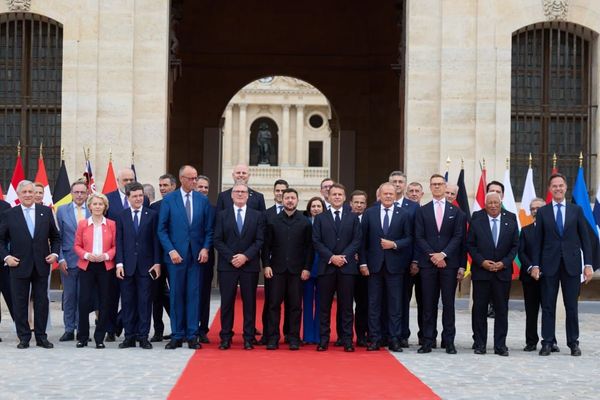
Coalition of the Willing "Family Photo" | Credit: The Office of the President of Ukraine
Ukraine and nine European partners launched a joint program Monday to develop a new anti-ballistic missile system, placing defense production at the center of the Coalition of the Willing’s continued support for Kyiv.
The agreement was announced following the Coalition’s 15th meeting in Paris, attended by representatives of 40 countries. Moldova and North Macedonia joined the group, expanding a format first convened in February 2025.
Ukraine, Denmark, France, Germany, Italy, the Netherlands, Norway, Spain, Sweden and the United Kingdom established the Integrated Anti-Ballistic Missile Coalition. Its first project, named FREYJA, is intended to combine Ukrainian battlefield experience with European technology and industrial capacity to produce a more affordable system at scale.
Ukrainian President Volodymyr Zelenskyy said the partners aim to develop the system and interceptor missile over the next 12 months.
“The reality in Ukraine right now is that sometimes we do not have the missiles needed to intercept ballistic missiles,” Zelenskyy said. “That is a fact, and it is the truth.”
Representatives from Fire Point, Thales, Diehl Defence, Saab, Kongsberg Defence & Aerospace, Weibel, Leonardo, Sener, MBDA, Eurosam, Safran and Destinus participated in the inaugural meeting.
No budget, procurement volume or binding production schedule was announced. The 12 month timeline represents the program’s development objective, not a confirmed date for operational deployment.
From supplying interceptors to building a system
Ukraine currently depends largely on US-made Patriot systems and the Franco-Italian SAMP/T to defend against ballistic missiles. Those systems are effective but available in limited numbers, while their interceptors are expensive and production remains constrained.
IRIS-T systems supplied by Germany strengthen Ukraine’s broader air defense network, but most versions were not designed primarily for intercepting ballistic missiles.
Zelenskyy said the growing demand on American systems — from Ukraine, US forces and bases, and allies confronting threats from Iran — made a larger European production base necessary.
The FREYJA program is intended to bring together components, missiles, sensors and industrial expertise already available across Ukraine and Europe instead of relying on a single existing system.
The joint Coalition statement described the project as part of an integrated European missile-defense architecture that would complement existing and planned systems.
The participating countries did not specify which companies would manufacture the interceptor, how responsibilities would be divided or how the program would be financed.
France grants production licenses
France also agreed to grant Ukraine licenses to manufacture ASTER interceptors used by the SAMP/T air defense system and SCALP long-range cruise missiles.
The licensing decisions could allow Ukraine to move beyond receiving finished weapons and participate directly in their production. The announcement did not include the location of production facilities, initial quantities or a timetable for manufacturing to begin.
French President Emmanuel Macron also said France was prepared to provide Ukraine with additional air defense systems and missiles this year.
The partners collectively agreed to increase deliveries of air defense systems, interceptors and long-range capabilities, although the Coalition did not publish national commitments or delivery totals.
The meeting also welcomed US President Donald Trump’s decision to grant Ukraine licenses to manufacture interceptor missiles for Patriot systems.
UK gains access to EU-financed defense contracts
The United Kingdom announced a separate agreement allowing British defense companies to compete for contracts financed through the European Union’s €90 billion Ukraine Support Loan.
Of the total, €60 billion is allocated to Ukrainian defense capabilities and procurement during 2026 and 2027.
Britain’s financial contribution will be proportional to the value of contracts awarded to British companies. The agreement remains subject to a Council implementing decision and is expected to receive final confirmation this summer.
The arrangement expands Ukraine’s potential pool of suppliers while bringing the British defense industry into an EU financing mechanism despite the UK’s departure from the bloc.
It was announced during Keir Starmer’s final Coalition of the Willing meeting as British prime minister. Starmer said his successor would continue the UK’s support for Ukraine.
More coordinated action against Russia’s shadow fleet
The Coalition also agreed to move toward more systematic and coordinated action against vessels used to transport Russian oil and circumvent sanctions.
France has conducted five operations involving suspected shadow fleet vessels since the beginning of 2026, according to Macron.
Under Monday’s agreement, participating countries will develop dedicated coordination mechanisms, share intelligence and establish common operational approaches to support boarding operations and inspections conducted under national authority.
The statement specified that those actions must comply with international law, including the UN Convention on the Law of the Sea.
This distinction matters. The Coalition did not authorize a multinational force to seize ships collectively. It agreed to coordinate information and assistance for operations undertaken by individual participating states within their legal jurisdiction.
The European Union’s 21st sanctions package against Russia is expected to be adopted shortly, with restrictions on the shadow fleet among its central components. Because the package had not yet been formally approved at the time of the meeting, it remains an anticipated measure rather than a completed result of the Paris summit.
Post-ceasefire force to hold exercises
Coalition members also reviewed plans for the Multinational Force for Ukraine, which would operate at Kyiv’s request after a credible cessation of hostilities.
The force is intended to help regenerate Ukraine’s military and provide reassurance on land, at sea and in the air. The Coalition said it is ready to operate and will conduct exercises in the coming months to demonstrate its capabilities.
The force would not deploy under present wartime conditions. Its activation remains tied to a ceasefire and the political and legally binding security guarantees developed by Coalition members.
Those guarantees are intended to prevent a renewed Russian attack after an agreement, rather than replace Ukraine’s armed forces or immediately establish a foreign combat deployment.
The Coalition also reiterated three conditions for negotiations: Ukraine must participate fully in any peace agreement; European security arrangements cannot be decided without European consent; and Russian assets will remain immobilized until Moscow ends its aggression and compensates Ukraine for the damage.
The next Coalition meeting will be held in Ukraine.
Preparing Ukraine for another winter
Leaders also agreed that preparations to protect Ukraine’s energy system during the coming winter must begin immediately.
German Chancellor Friedrich Merz said Berlin would provide the necessary assistance to the energy sector, while Coalition members broadly agreed to support winter preparations.
No funding level, equipment list or delivery schedule was announced.
Russia has repeatedly targeted Ukraine’s electricity generation, transmission networks and heating infrastructure. Air defense and energy resilience are therefore increasingly treated as connected priorities: interceptors protect the grid, while spare equipment and decentralized generation reduce the damage when missiles get through.
Olena Zelenska highlights damage to education and cultural heritage
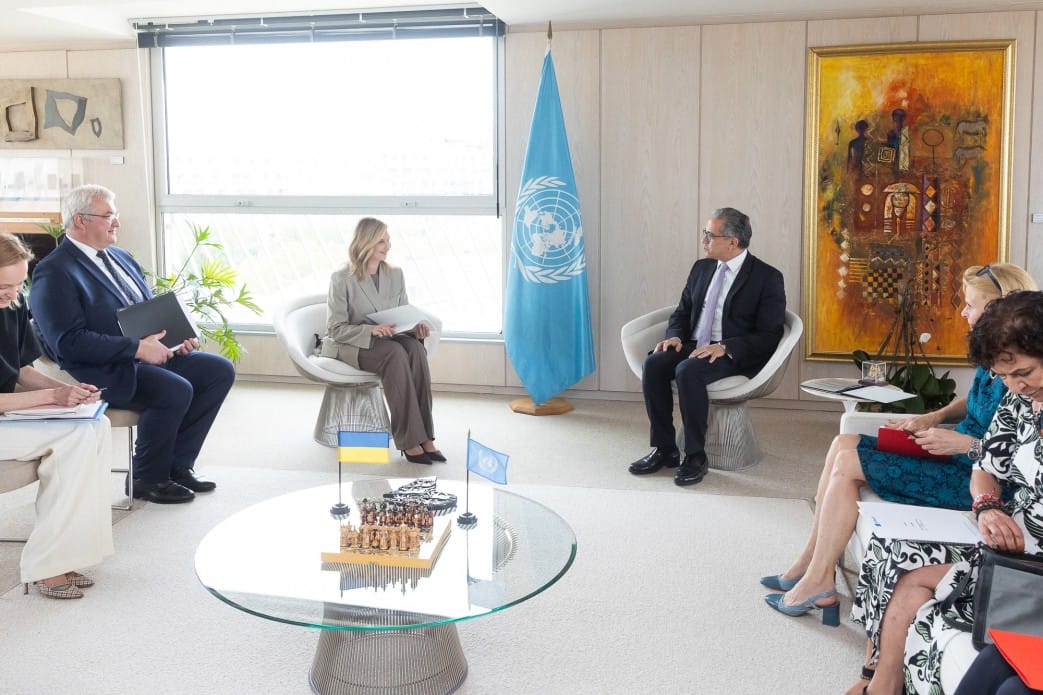
First Lady of Ukraine Olena Zelenska meeting with UNESCO Director-General Khaled El-Enany in Paris | Credit: The Office of the President of Ukraine
During a parallel visit in Paris, Ukrainian First Lady Olena Zelenska met UNESCO Director-General Khaled El-Enany to discuss education and the protection of Ukrainian cultural heritage.
Zelenska said more than 4,000 educational institutions in Ukraine had been damaged or destroyed since Russia launched its full-scale invasion.
She highlighted the “One Desk. Two Marks” installation unveiled at UNESCO headquarters on July 8. The installation represents children whose education has been disrupted by the war and is expected to travel to the Parliamentary Assembly of the Council of Europe in Strasbourg and the UN Office at Geneva.
Zelenska said Russia had also damaged or destroyed approximately 2,000 cultural heritage sites and more than 2,500 cultural infrastructure facilities.
She later visited the “Heritage in Resistance: From Timbuktu to Odesa” exhibition at the Cité de l’Architecture et du Patrimoine, which examines the destruction and protection of cultural landmarks during armed conflict.
The Ukraine section documents damage while presenting work by Ukrainian and international institutions to preserve museum collections, historic buildings and natural heritage.
The Paris meeting produced several concrete steps — but its most important decision will require money, industrial coordination and speed that Europe has repeatedly struggled to deliver. What FREYJA changes, why Ukraine is becoming a defense developer rather than only an aid recipient, and where the commitments still fall short are examined in today’s ONEST Take.
Continue reading with ONEST+
ONEST Take
The Coalition of the Willing was originally assembled around a postwar question: what security guarantees could prevent Russia from attacking Ukraine again after a ceasefire?