UN Counter-Terrorism Conference Turns to AI, But the Bigger Question Is Governance
United Nations Headquarters | New York

– 4 min read

United Nations Headquarters | New York
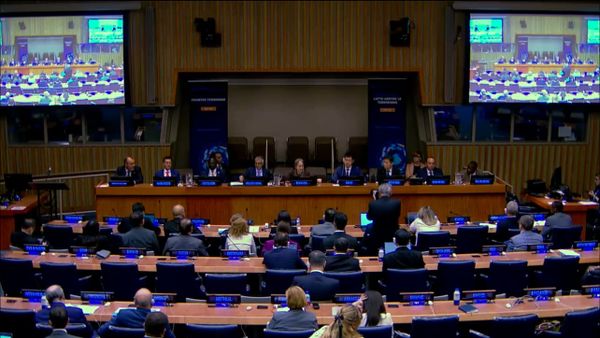
The fourth UN High-Level Conference on Counter-Terrorism opened this week with a broad warning: terrorist threats are evolving across regions, while instability continues to create space for extremist groups.
On the first day, UN Secretary-General António Guterres framed the conference around prevention, human rights, and the need to strengthen global counterterrorism cooperation ahead of the Ninth Review and the 20th anniversary of the UN Global Counter-Terrorism Strategy.
That matters because this conference is not only a diplomatic exchange. It helps shape what Member States may prioritize next.
Guterres warned that Al-Qaida and Da’esh affiliates continue to persist across Africa, South Asia, and the Middle East. The first day also emphasized that effective counterterrorism cannot be separated from human rights, prevention, and the conditions that allow extremist groups to exploit instability.
The second day moved from the broader threat landscape to one of the fastest-moving parts of it: artificial intelligence and emerging technologies.
The timing was notable. Recent reporting has shown that Chinese AI models are narrowing the cybersecurity gap, while cheaper and more accessible AI systems are raising new concerns about access, misuse, and security. Reuters has also reported Anthropic’s allegation that Alibaba-linked operators used millions of Claude interactions to extract capabilities.
Inside the UN conference room, the discussion reflected a growing consensus: AI is no longer a future counterterrorism concern. It is already changing how extremist groups spread propaganda, recruit, organize, and exploit vulnerabilities.
But the larger debate was not only about AI.
It was about who gets to define security, what limits should govern state responses, and whether international cooperation can keep pace with the technologies now reshaping both terrorism and counterterrorism.
The UN warned that laws and countermeasures are not moving fast enough. Officials stressed that technological change is outpacing legal frameworks, creating a widening gap between threat and response.
The UN Office of Counter-Terrorism also emphasized that isolated national efforts will fail. Because AI-enabled threats are transnational, collective action is the only viable response.
Saudi Arabia and the United Arab Emirates emphasized investment, preparedness, and institutional capacity. Their remarks positioned counterterrorism as an operational challenge requiring sustained resources and state capability.
China framed the issue through state-led governance. Its representative referenced President Xi Jinping’s Global Security Initiative and spoke about systematic countermeasures, legal control, suppression, and development as part of counterterrorism policy. China also argued that underdeveloped countries are more vulnerable to exploitation by terrorist groups.
Japan, speaking immediately after China, presented a different model. It emphasized technological advantage, including facial recognition, secure applications, drones, AI, and education. Japan also described itself as a peaceful nation able to provide trusted technological assistance to other countries, while warning that states sponsoring proxies and terrorist groups must be confronted.
Kenya warned that AI is shifting the balance by enabling terrorist groups to exploit infrastructure and increase their capabilities. It also stressed that AI used outside lawful frameworks undermines security.
South Korea focused on institutional adaptation. Its counterterrorism center was established in 2016, but officials said constant technological innovation now requires new structures, including an AI management center, a future AI control tower, and counter-drone systems. South Korea also emphasized that technology must remain under human control.
Spain highlighted AI’s role in propaganda and potential biological-weapons-related risks, while stressing judicial safeguards, due process, replicable evidence, and fundamental rights. Spain argued that AI should remain at the service of human beings.
Uzbekistan focused on preventing algorithmic manipulation while allowing people to use AI without compromising their rights.
Uruguay made a similar point, saying technology should complement human judgment, not replace it.
Hedayah, drawing on research and programming experience, said AI increases the speed of propaganda and terrorist recruitment. It warned that radicalization may begin on one platform while recruitment and organization continue on another, showing how online activity can create offline consequences.
The Organization for Security and Co-operation in Europe made a related point: AI does not create terrorist intent, but it amplifies recruitment. OSCE called on parliaments to study and adapt legal tools to detect and prosecute technology-enabled threats while protecting fundamental rights and public debate. It also highlighted media literacy, including school-based initiatives, as a permanent need.
During the closing session, the Chef de Cabinet emphasized that women, young people, and civil society organizations should be prioritized because they are often the first to feel, identify, and report emerging dangers.
The UN also pointed to donor-supported work helping Member States respond to AI-related threats, naming Germany, South Korea, Saudi Arabia, the UAE, Japan, and Spain among supporters of this capacity-building effort.
Facts tell you what happened. ONEST Take connects the dots and explains why it matters.
🎧 Listen | 📖 Read