Follow China’s Money. A New Global Order Is Taking Shape.
From ports and mines to railways, power grids, factories and critical minerals, mapping where China is investing, building and financing in 2026 — and what Beijing’s expanding footprint reveals about the global balance of power.
When the United States dismantled most of USAID’s foreign assistance apparatus in 2025, one prediction appeared almost immediately:
China would move in.
Hospitals previously supported by Washington would acquire Chinese funding. Beijing would take over American development projects. Wherever an American flag came down, a Chinese one would go up.
That is not really what happened.
China generally did not replace USAID program for program. It did not suddenly assume responsibility for the enormous American portfolio of HIV treatment, maternal health, famine prevention, independent media, democracy programming, education and humanitarian relief.
In much of the world, those programs simply disappeared or contracted.
By early 2025, the Trump administration had moved to terminate nearly 5,800 of roughly 6,200 reviewed USAID awards, representing about $54 billion in multi-year commitments. Programs from Sudan to South Africa, Bangladesh to Colombia were disrupted.
Researchers watching China soon reached a counterintuitive conclusion: Beijing was unlikely to become the new USAID because China does development differently.
American assistance was heavily grant-based and concentrated in public health, humanitarian relief, education, governance and civil society.
Chinese overseas finance overwhelmingly favors infrastructure, trade, energy, transport, industrial capacity and projects with economic or strategic returns. In a set of 20 countries recently profiled by AidData, loans represented 94% of Chinese official financing between 2000 and 2022; grants represented only 6%.
So the important question is not:
Where did China replace USAID?
It is:
What happens when the United States abandons one model of global engagement while China accelerates another?
By August 2026, we have enough evidence to begin answering it.
And the answer is visible on a map.
First, something extraordinary happened in 2025
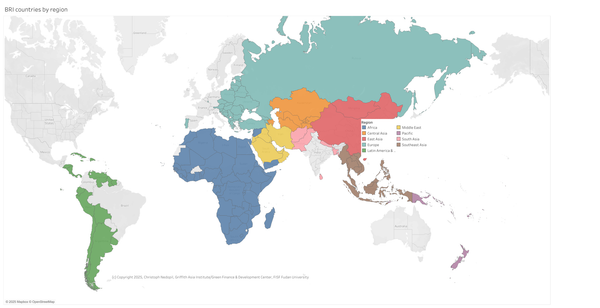
The Belt and Road Initiative was supposed to be slowing down.
For several years, that appeared true.
China had become more cautious after spectacular early BRI projects generated debt problems, political backlash and enormous financial exposure. Beijing increasingly talked about smaller, safer, “small and beautiful” projects rather than enormous prestige infrastructure.