Kremlin Reveals Trump-Putin-Xi Summit Document: What Russia, China and US Agreed On
The Kremlin's four-point document covers energy cooperation, the International Criminal Court, UN reform and nuclear security. The benefits for Moscow are apparent. What did Trump secure for Washington?
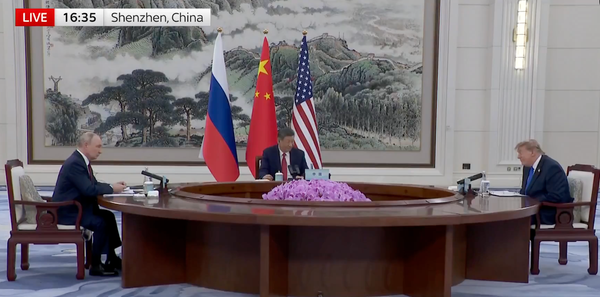
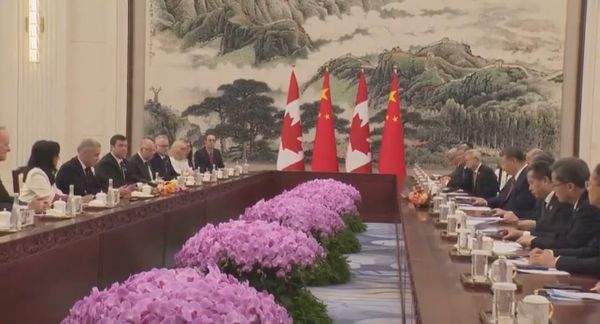
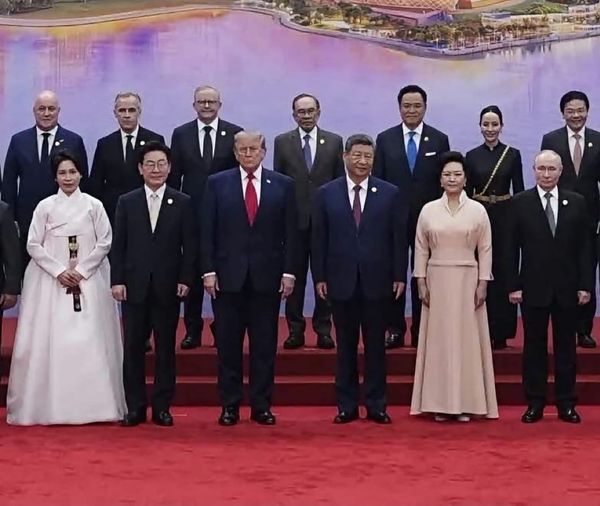
Trump, Putin and Xi meeting in Shenzhen. Photo: Screenshot from the official broadcast.
President Donald Trump opened his bilateral meeting with Vladimir Putin by praising their longstanding relationship.
“He's my friend,” Trump said. “We've had a great relationship for many years.”
Trump also patted Kremlin spokesperson Dmitry Peskov on the shoulder, telling him he was “doing a great job.”
Editorial journalists were excluded from the Trump-Putin bilateral meeting, with Russian officials guarding the entrance.
The trilateral summit with Chinese President Xi Jinping subsequently concluded without public closing statements.
The Kremlin then published a four-point document covering UN reform, energy cooperation, international criminal justice and nuclear security.
1. UN Reform: Three Veto Powers Want to Shape the Rules
Russia, China and the United States call for reforming the United Nations to "strengthen international peace and security".
All three hold permanent seats and veto powers on the UN Security Council.
For years, other countries have pushed for Security Council reform, including proposals to restrict veto powers that allow permanent members to block action even when they themselves are implicated in international crises.
Russia has used its veto to shield itself from Security Council action over its invasion of Ukraine. China faces serious allegations of repression and human rights abuses. The United States faces scrutiny over its military operations against Iran and the seizure of Nicolás Maduro.
Now these three governments propose reforming the institution whose rules already give them extraordinary power.
Reforming what, exactly?
The document offers no proposals to limit veto powers, expand accountability or prevent permanent members from blocking action concerning their own conduct.
For Putin, the benefit is clear: a seat at the table shaping UN reform, with no stated commitment to surrender any of the power Russia already holds. All while he continues waging war against Ukraine and killing Ukrainians.
The significance is not a concrete UN reform proposal, but the alignment of three veto-holding powers. Their joint position signals an intention to present a united front in future discussions on UN reform, particularly the Security Council, where other countries have long sought to curb the unchecked powers Russia, China and the United States possess.
2. Energy Cooperation
The document calls for increasing production and supplies of refined petroleum products and ensuring stable energy markets.
For Putin, the benefit is direct.
Russia's energy sector remains a major source of government revenue, helping finance its invasion of Ukraine.
China continues purchasing Russian oil, providing Moscow with a crucial export market despite Western sanctions. These purchases, often made at discounted prices, help sustain Russia's war economy.
Meanwhile, Trump has granted sanctions waivers, and Washington is now participating in a trilateral framework addressing energy production and supplies alongside Moscow and Beijing.
Does this signal further sanctions waivers, their eventual removal, or a broader accommodation of Russian energy exports? The document does not specify. But it raises the question of how the proposed cooperation would operate alongside existing restrictions.
And there is a larger question.
In his opening remarks, Trump indicated that Russia's war against Ukraine would be discussed.
What exactly was discussed about Ukraine if the published outcome includes provisions supporting energy cooperation with the country financing its invasion?
The Kremlin's document offers no explanation.
3. International Criminal Court
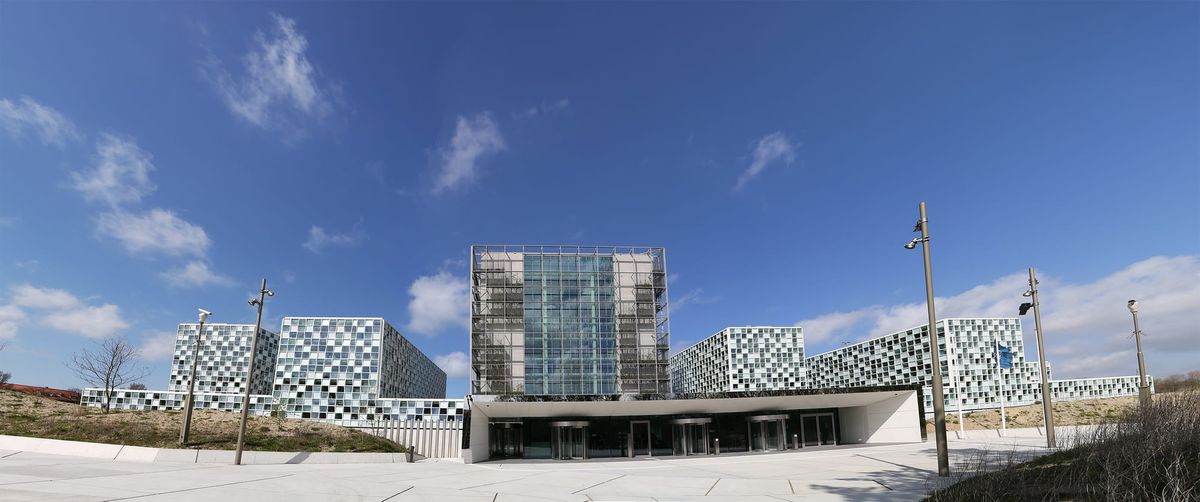
The three leaders emphasized state sovereignty, the immunity of government officials and "the need to prevent the International Criminal Court and similar institutions from abusing their powers".
This provision is particularly consequential for Putin.
The ICC issued an arrest warrant for the Russian president in March 2023 over the alleged unlawful deportation and transfer of Ukrainian children.
The warrant complicates his travel to ICC member states, which generally have obligations to cooperate with the court.
Trump also stated in his opening remarks that he intended to suggest ways to protect the three countries from the ICC.
The provision directly aligns with Washington's declared campaign to dismantle the ICC.
Washington has pursued a campaign to dismantle the court, pressuring member states to withdraw, threatening consequences for countries refusing to cooperate, and imposing sweeping financial sanctions designed to cripple its operations.
On October 9, 2026, Secretary of State Marco Rubio went further: “Either the ICC will end its threats, or we will end the ICC.”
What Washington has been pursuing through sanctions, diplomatic pressure and financial threats now appears in a joint political position with Moscow — whose president remains wanted by the very court they seek to undermine.
Read ONEST's earlier reporting on Washington's campaign to dismantle the ICC.
The three countries affirmed that nuclear war cannot be won and must never be fought. They also committed to dialogue on reducing nuclear risks and preventing proliferation.
I predicted that nuclear security would feature in the trilateral outcome, including the precise principle that nuclear war cannot be won and must never be fought.
China has long resisted trilateral nuclear negotiations. Now the issue appears in a non-binding statement, with no concrete commitments.
For Trump, it saves face. He gets the language he wanted, but no actual agreement.
The question is: What did it cost him?
Who Benefits?
Putin: A role in shaping UN reform despite Russia's invasion of Ukraine, language undermining the ICC pursuing his arrest, and energy cooperation that could help finance his war.
Xi: A seat at the table shaping global governance despite China's repression of Uyghurs, alongside energy cooperation and no binding nuclear commitments.
Trump: A non-binding nuclear statement he can present as a diplomatic achievement.
Three powers with deeply contested records on international law now propose shaping the rules of global governance.
This is ONEST's initial assessment of the document published by the Kremlin. A fuller analysis of the summit and its implications for Ukraine, Europe and global security will follow later today.
Olga Nesterova is a journalist and founder of ONEST Network, a reader-supported platform covering U.S. and global affairs. A former White House correspondent and UN diplomat, she focuses on international security and geopolitical strategy.