Saudi Arabia, Türkiye and Pakistan Just Created a New Defense Bloc. What Does It Actually Mean?
Saudi wealth, Pakistani nuclear weapons and NATO’s second-largest military are now connected by a mutual-defense pact — raising difficult questions for Israel, Iran, NATO and the United States.
Saudi Arabia, Türkiye and Pakistan have just connected three very different sources of power.
Saudi Arabia brings enormous financial resources, energy leverage and one of the world's largest defense budgets.
Pakistan brings a large military — and something neither of the other two possesses: nuclear weapons.
Türkiye brings a major conventional military, an increasingly powerful domestic defense industry and membership in NATO.
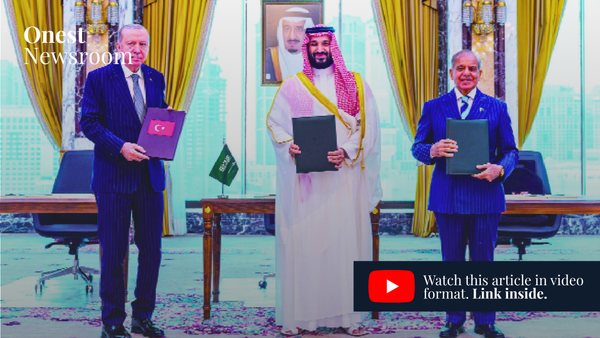
On August 7, Saudi Crown Prince Mohammed bin Salman, Turkish President Recep Tayyip Erdoğan and Pakistani Prime Minister Shehbaz Sharif signed the Makkah Joint Defence Agreement.
0:00
/1:51
Its central provision is remarkably simple:
An armed attack against one of the three countries will be considered an attack against all three.
Turkish Foreign Minister Hakan Fidan went further on Saturday, describing the arrangement as “technically” equivalent to NATO's Article 5 collective defense clause. He said the pact had been under negotiation for more than two years and will establish a ministerial committee and a permanent secretariat headquartered in Saudi Arabia. Egypt has already been identified as a possible future participant.
That makes this considerably more than another vague declaration of friendship.
But it does not mean Saudi Arabia, Pakistan and Türkiye have suddenly created another NATO.
And it certainly does not mean Riyadh and Ankara now have Pakistani nuclear weapons at their disposal.
Understanding the difference is crucial.
The symbolism was difficult to miss
The setting was extraordinary for a defense agreement.
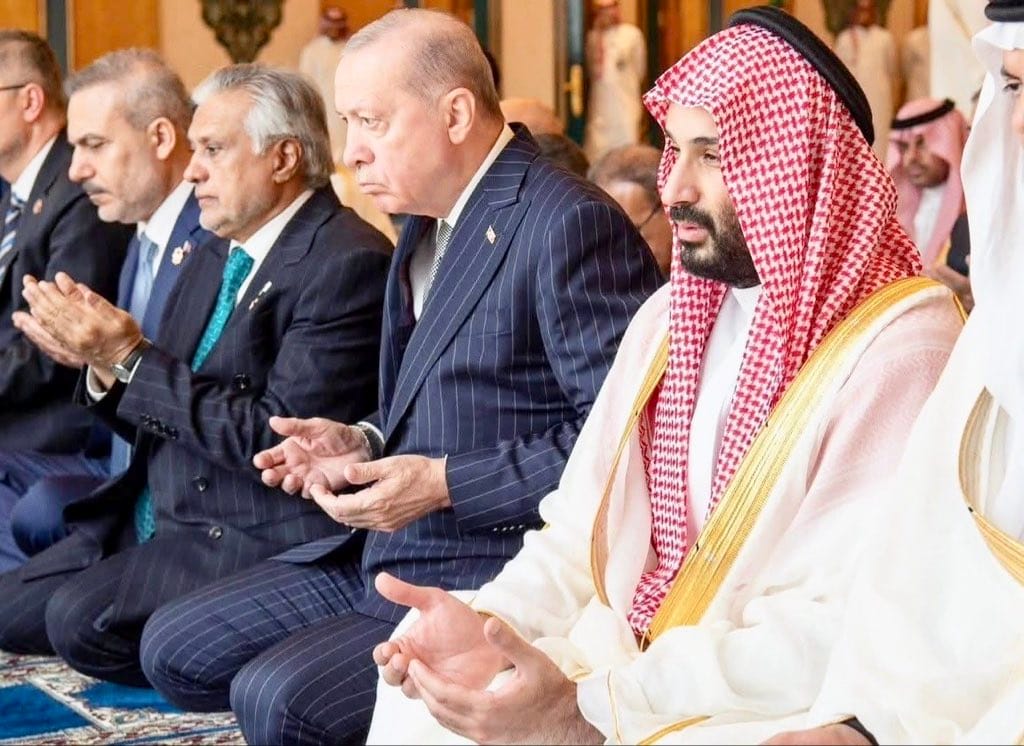
The three leaders and their delegations gathered in Makkah, Islam's holiest city, and offered Friday prayers together before signing a pact that bears the city's name.
Yet all three governments insist the agreement is defensive, directed against no particular country and is not intended to establish a sectarian alliance.
Those two facts can coexist.
The agreement does not declare the creation of an Islamic military alliance.
But choosing Makkah for its launch gives the arrangement a political and religious symbolism that an ordinary signing ceremony in Riyadh, Ankara or Islamabad would not have carried.
And Pakistan's defense minister has already publicly suggested something broader. Following the signing, Khawaja Asif called for Muslim countries to overcome their divisions and build a wider collective security structure rather than an “exclusive club.”
The pact may therefore be more useful to understand as the beginning of a security architecture than as a finished military alliance.
What exactly did they agree to?
The most important language is collective defense.
If one is attacked, all three treat it as an attack against them.
That is deliberately similar to NATO's central principle.
But NATO is much more than Article 5.
It has an integrated military command structure, common operational standards, standing headquarters, decades of joint planning and exercises, interoperability among national forces and detailed procedures for responding to crises.
The new trilateral pact does not yet have anything comparable.
Public reporting also does not establish precisely what each country must do when another is attacked. The agreement establishes the obligation of collective defense, but its detailed operational commitments have not been publicly disclosed.
That distinction matters.
Even NATO's Article 5 does not literally say that every member must declare war if another is attacked. Each ally must assist, but NATO's treaty allows each government to take whatever action it “deems necessary,” which may or may not involve armed force.
So “an attack on one is an attack on all” sounds simple.
What happens afterward is where alliances become complicated.
Saudi Arabia brings the money — and the motive
Saudi Arabia is the economic heavyweight.
It possesses enormous sovereign financial resources, immense influence over global energy markets and has spent decades buying some of the most sophisticated American and European military equipment available.
But Riyadh's most important contribution may be the reason it wants this pact in the first place:
insurance.
For decades, Saudi security rested heavily on an assumption that, in an existential crisis, the United States would ultimately protect the kingdom.
Riyadh increasingly appears unwilling to place its entire security architecture on that assumption.
This did not begin this week.
In September 2025, Saudi Arabia and Pakistan signed their own Strategic Mutual Defence Agreement, similarly declaring that aggression against either would be considered aggression against both.
And that relationship moved beyond paper.
During this year's war with Iran, Pakistan deployed approximately 8,000 troops, a fighter squadron and an air defense system to Saudi Arabia under the bilateral arrangement, according to Reuters reporting based on Pakistani security and government officials.
The new Makkah agreement effectively adds Türkiye to an existing Saudi-Pakistani security relationship.
That does not mean Saudi Arabia is abandoning Washington.
It means Riyadh is building layers of security relationships rather than relying on one dominant security guarantor.
Saudi Arabia still wants the United States.
It increasingly does not want to need only the United States.
Pakistan brings the most sensitive ingredient: nuclear weapons
Pakistan is the only nuclear-armed state among the three.
The Federation of American Scientists currently estimates that Pakistan possesses a military stockpile of approximately 170 nuclear warheads.
This immediately raises the obvious question:
Does Saudi Arabia — and now Türkiye — effectively receive a Pakistani nuclear umbrella?
The answer is not publicly clear.
Nothing disclosed about the new trilateral agreement establishes that Pakistan has transferred nuclear weapons, shared nuclear command authority or formally promised to use nuclear weapons on behalf of Türkiye or Saudi Arabia.
But there is an important history here.
When Saudi Arabia and Pakistan signed their bilateral pact last year, a senior Saudi official was asked specifically whether Pakistan would be obligated to provide the kingdom with a nuclear umbrella.
The answer was that the agreement was comprehensive and encompassed “all military means.”
That was not an explicit nuclear guarantee.
It wasn't exactly a denial either.
The distinction is critical:
Saudi Arabia and Türkiye have not become nuclear powers.
There is no public evidence that either has acquired control over Pakistani nuclear weapons.
But an adversary contemplating an existential attack on Pakistan's treaty partners now has to consider whether Pakistan's nuclear arsenal could eventually become relevant.
That uncertainty can itself contribute to deterrence.
Türkiye brings something neither of the others can buy
Türkiye contributes a different form of strategic power.
It belongs to NATO.
It fields the alliance's second-largest military by personnel and has spent years building an increasingly capable domestic defense industry producing drones, missiles, armored vehicles, warships and aircraft.
For Saudi Arabia and Pakistan, that makes Ankara exceptionally valuable.
But Türkiye's membership also creates the pact's most interesting problem.
Türkiye now belongs to two collective-defense systems.
One connects Ankara to the United States, Canada and European NATO members.
The other connects it to Riyadh and Islamabad.
Those commitments can coexist perfectly well.
Until somebody goes to war.
What does this mean for Israel?
Israel should take the pact seriously.
But not because three countries have suddenly combined their armed forces into one military capable of attacking Israel tomorrow.
They haven't.
The more important change is strategic depth and deterrence.
Saudi Arabia can provide financing, infrastructure and energy leverage.
Türkiye offers substantial conventional military power, geographic reach and a sophisticated defense industrial base.
Pakistan provides military capacity and nuclear ambiguity.
Those capabilities do not automatically become interchangeable.
Saudi money does not buy control of Pakistani nuclear weapons.
Pakistani nuclear weapons do not become Turkish weapons.
And Turkish NATO membership does not extend NATO protection to Saudi Arabia or Pakistan.
But political calculations change once the three states formally promise to treat an attack on one as an attack on all.
A future Israeli-Turkish confrontation, for example, could become much more difficult to isolate.
An Israeli strike against Saudi Arabia could potentially implicate Türkiye and Pakistan.
And an Israeli attack on Pakistan would theoretically become a Saudi and Turkish security issue.
That widens Israel's escalation map.
There is another important caveat.
The agreement is defensive.
Nothing publicly disclosed obligates the three countries to join one another in an offensive war against Israel.
If Türkiye decided to attack Israel, that would not automatically mean Saudi Arabia and Pakistan were treaty-bound to participate.
The same distinction applies in the opposite direction.
Who attacked whom first could become extraordinarily important.
And what does it mean for Iran?
Iran may have even more immediate reason to pay attention.
Geographically, Tehran now sits between three states formally promising collective defense.
Türkiye lies to Iran's northwest.
Pakistan lies to its southeast.
Saudi Arabia sits across the Persian Gulf.
And the pact was signed after Iranian missile attacks on Gulf states during this year's war dramatically exposed the vulnerability of regional energy infrastructure.
Türkiye and Pakistan have both maintained relationships with Tehran and have emphasized that the new pact is not directed against Iran.
Fidan explicitly said Saturday that it is not aimed at any particular country.
Iranian officials are nevertheless paying attention. An Iranian lawmaker has already publicly dismissed the arrangement as a “paper agreement” incapable of guaranteeing Saudi security.
The strategic calculation has plainly changed.
Imagine Iran launches another major attack against Saudi Arabia.
Previously Tehran had to calculate Saudi retaliation, possible American intervention and assistance from Riyadh's partners.
Now it must also calculate the potential responses of Pakistan and Türkiye.
That does not mean either would automatically bomb Iran.
But deterrence does not require certainty.
It requires convincing an adversary that the potential cost of attacking you has increased.
And Pakistan's nuclear arsenal adds an extreme — if deliberately undefined — variable to that calculation.
Then there is the NATO problem
This is where the arrangement gets genuinely complicated.
Suppose Saudi Arabia is attacked.
Türkiye assists Saudi Arabia under the Makkah pact.
That does not automatically trigger NATO's Article 5.
Saudi Arabia is not a NATO member.
Pakistan is not a NATO member.
NATO's collective defense commitment also has defined geographical limits.
But consider what could happen next.
Türkiye deploys aircraft or troops under the Makkah agreement.
Those forces become involved in combat.
The conflict escalates.
Eventually the opposing state strikes Turkish territory itself.
Now NATO has a problem.
A NATO ally has suffered an armed attack.
Ankara could seek consultations or potentially collective defense assistance.
But the circumstances would matter enormously.
There is a fundamental difference between Türkiye being attacked and Türkiye entering somebody else's war and subsequently being attacked.
NATO describes Article 5 as collective self-defense, grounded in Article 51 of the UN Charter. Whether an incident qualifies as an armed attack covered by Article 5 is assessed case by case, and an attacked ally must request or consent to collective action.
There is no magic Article 5 button that Erdoğan can press to automatically order the United States and Europe into a war.
But the political crisis could be enormous.
What if Saudi Arabia, Pakistan and Türkiye attacked Israel?
This is the scenario that most clearly demonstrates the contradictions created by the new arrangement.
Start with something frequently misunderstood:
The United States does not have a NATO-style mutual defense treaty with Israel.
Washington's relationship with Israel is extraordinarily deep. The United States provides military aid, weapons, intelligence cooperation and missile defense support, and American forces have directly helped defend Israel from regional missile and drone attacks.
But Israel is not a NATO member.
Türkiye is.
Now imagine Türkiye, Saudi Arabia and Pakistan initiate an attack on Israel.
The Makkah pact would not itself require that offensive action because it is framed around defense against aggression.
And NATO certainly would not be obligated to participate.
Türkiye's NATO membership does not give Ankara the right to initiate a war and then turn that war into a NATO operation.
The United States would almost certainly push aggressively for de-escalation.
It could also be expected to provide Israel substantial defensive support — particularly missile defense, intelligence and weapons resupply — given the depth of the existing U.S.-Israeli security relationship.
But whether Washington would actually attack Turkish forces is a much higher threshold.
That would mean the United States exchanging fire with the military of its own NATO ally.
The resulting crisis could become existential for NATO itself.
Now reverse it: what if Israel attacked Türkiye first?
That is much more dangerous for Washington.
Türkiye's territory is explicitly covered by NATO's treaty.
If Israel carried out an unprovoked armed attack against Türkiye, Ankara would have a substantially stronger basis for seeking Article 5 collective defense.
That still would not automatically require the United States to attack Israel.
Article 5 requires allies to assist the attacked member, but each government determines what action it considers necessary. NATO explicitly says that assistance “may or may not involve the use of armed force.”
Washington could theoretically provide intelligence, air defense, logistics or other assistance while desperately trying to stop both governments from escalating further.
But politically, the United States would find itself in an extraordinary position:
Its treaty obligations would point toward Türkiye.
Its decades-old strategic relationship would point toward Israel.
Preventing that situation from developing would almost certainly become the overwhelming American priority.
So, is this an “Islamic NATO”?
Not yet.
But dismissing the comparison entirely is becoming harder.
The Turkish foreign minister himself has now compared its collective defense mechanism directly to NATO Article 5.
Pakistan's defense minister is publicly talking about expanding collective security among Muslim countries.
Egypt is already being discussed as a potential participant.
And the pact is establishing institutions rather than merely issuing a joint declaration.
Still, NATO's power does not come from one sentence in a treaty.
It comes from 77 years of military integration, joint planning, exercises, common standards, command structures, infrastructure and the enormous conventional and nuclear capabilities of its members.
Makkah has nowhere near that architecture.
At least not yet.
And perhaps the most important thing about the agreement is not what these three countries gain.
It is what they inherit from one another.
Saudi Arabia brings its confrontation with Iran and vulnerability to regional missile attacks.
Pakistan brings its enduring confrontation with India.
Türkiye brings its increasingly difficult relationship with Israel — and the complications of NATO membership.
The pact therefore doesn't merely aggregate their power.
It aggregates their risks.
A Pakistan-India crisis can potentially become a Saudi and Turkish question.
A Saudi-Iran crisis can potentially become a Pakistani and Turkish question.
A Türkiye-Israel crisis can potentially become a Saudi and Pakistani question.
And because Türkiye remains inside NATO, at the extreme end of escalation, any one of those crises could eventually become a question for Washington and the rest of the alliance.
That is the real significance of the Makkah agreement.
Saudi wealth, Pakistani nuclear power and Turkish conventional military strength have not suddenly fused into a single fighting force.
But three security theaters that were once largely separate — the Gulf, South Asia and NATO's southeastern flank — have now been formally connected.
And in a region already struggling to contain one war from spilling into the next, those new connections may prove every bit as important as the weapons behind them.
Olga Nesterova is a journalist and founder of ONEST Network, a reader-supported platform covering U.S. and global affairs. A former White House correspondent and UN diplomat, she focuses on international security and geopolitical strategy.