ONEST Brief: Foreign Troops in Lebanon, Türkiye-Saudi-Pakistan Military Pact, Ukraine’s Drones Beat U.S. Forces in Training

– 7 min read

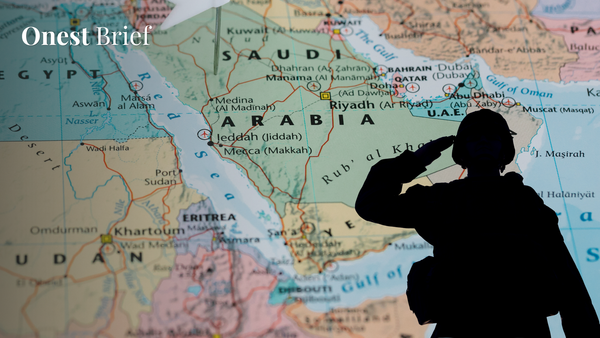
The security architecture of the Middle East is shifting quickly.
Israel and Lebanon are discussing foreign personnel to verify Hezbollah’s disarmament — but cannot yet agree on who would command them. Türkiye, Saudi Arabia and Pakistan are moving their new mutual-defense pact from political declaration toward actual military coordination. And in Germany, Ukrainian drone operators gave the U.S. Army a very practical demonstration of how much modern warfare has changed.
Elsewhere, Iran and the United States are both claiming control over the Strait of Hormuz while commercial traffic tells a different story; Washington is preparing to finish its military withdrawal from Iraq; Kuwait says it stopped an ISIS-linked drone plot; and the Pentagon is quietly spelling out what its new Indo-Pacific strategy actually means.
Here is what matters.
The negotiations over Hezbollah’s disarmament are beginning to expose a much larger question about what comes after the current fighting in Lebanon.
Britain, Italy, Switzerland and Indonesia have been discussed as possible contributors to an international mechanism that could help verify Hezbollah’s disarmament as Israeli forces withdraw.
But Lebanon subsequently disputed reports that it had formally agreed to that specific shortlist, saying "negotiations with Washington remain underway".
The bigger issue is the structure.
The proposed mechanism would not necessarily operate as a conventional UN peacekeeping mission. Washington and Israel reportedly oppose placing the operation under the United Nations, while European governments have reservations about an alternative proposal involving President Trump’s Board of Peace.
Its command structure, mandate and legal authority therefore remain unsettled.
That matters because verification could involve considerably more than observing a ceasefire.
International personnel could eventually be asked to determine whether Hezbollah has removed weapons, dismantled infrastructure and fulfilled the conditions required for further Israeli withdrawals.
Israel, meanwhile, says it will not completely withdraw until Hezbollah is disarmed. Hezbollah says disarmament cannot be discussed while Israeli forces remain.
The proposed verification mechanism is effectively supposed to bridge those two positions: Hezbollah disarms as Israel withdraws, with a third party determining whether both sides have actually fulfilled their obligations.
That makes the debate over who controls the mission almost as consequential as which countries contribute personnel.
The trilateral defense agreement signed last week in Mecca is already moving beyond symbolism.
Türkiye’s Defense Ministry said Thursday that Türkiye, Saudi Arabia and Pakistan will create political and military mechanisms to coordinate implementation of the agreement.
That includes high-level coordination among defense and foreign-policy officials and military commanders, along with joint military exercises across land, air, sea and cyber domains.
The three countries also intend to expand cooperation in unmanned systems, electronic warfare, artificial intelligence and defense manufacturing, including joint production and technology transfer.
This is significant because the original agreement already contains a mutual-defense commitment under which an attack against one member is treated as an attack against all three — language Turkish officials have compared technically to NATO’s Article 5.
Each country brings something different.
Saudi Arabia brings enormous financial resources and regional influence.
Pakistan brings one of the region’s largest militaries — and nuclear weapons.
Türkiye brings NATO’s second-largest military, an increasingly sophisticated domestic defense industry and significant battlefield experience.
Officials insist the arrangement is defensive, does not target a particular country and does not replace members’ existing alliances. Pakistan has also said the pact could eventually admit additional states.
But Türkiye’s NATO membership makes the next stage especially important.
A political agreement is one thing.
Permanent military coordination, joint planning, interoperability and weapons production would begin creating something far more institutional.
The question is therefore no longer simply whether three important regional powers signed a defense pact.
It is how much military infrastructure they now build underneath it.
At a military exercise in Germany earlier this year, American soldiers went up against Ukrainian drone units.
The Ukrainians won — decisively.
During Combined Resolve, Ukrainian operators reportedly located and defeated U.S. troops and armored vehicles using reconnaissance drones, bomb-dropping drones and first-person-view attack drones.
American units improved as the exercise continued, including by dispersing forces and becoming better at concealment.
But the initial performance exposed a larger problem.
The United States pioneered sophisticated long-range unmanned aircraft and has invested billions in new drone and counter-drone programs.
Ukraine has spent years learning something different: how to integrate cheap drones into ordinary battlefield operations at enormous scale and extraordinary speed.
Those are not the same capabilities.
The exercise suggests that battlefield adaptation may currently be happening faster than procurement systems and traditional military doctrine can absorb it.
And Ukraine is increasingly becoming not simply a recipient of Western military expertise, but a source of it.
ONEST tracks the developments shaping global affairs — and explains what changes beyond the headline. Sign up free to receive our reporting and briefings directly in your inbox.
The information war surrounding the Strait of Hormuz is becoming almost as striking as the military confrontation itself.
President Trump has claimed that the United States controls the strategic waterway.
Iranian officials are making essentially the opposite argument, publicly asserting Iranian control over the strait.
But commercial shipping provides a much less triumphant picture.
Only six ships passed through Hormuz on Monday, according to Reuters — compared with roughly 130 to 140 vessels per day before the war.
Iran has halted most traffic while Washington maintains its own blockade of Iranian-related shipping and ports.
Iran has also demanded control over inbound shipping and oversight of outbound vessels as part of proposals for reopening the waterway.
So the operative reality is not straightforward American control or Iranian control.
It is a strategic chokepoint where military pressure from both sides has made normal commercial transit extraordinarily difficult.
And that distinction matters considerably more to global energy markets than either government’s rhetoric.
Iraq says the withdrawal of the remaining U.S.-led anti-ISIS coalition forces will be completed by September 30.
American officials have confirmed that the withdrawal remains on schedule.
Most coalition forces have already departed, but a remaining contingent continued operating largely from Iraq’s Kurdish region.
The end of that mission is important for another reason.
Baghdad has also set September 30 as a deadline for bringing armed groups outside state control under government authority — a potentially much harder objective given the power of Iran-aligned militias.
For years, some of those groups have cited the American military presence as justification for retaining their weapons.
With that presence ending, Baghdad loses one excuse for postponing the much more difficult internal question:
Who is allowed to carry weapons in Iraq?
One of the more revealing statements this week came not from a major policy announcement, but from an on-the-record Pentagon briefing.
"Under Secretary of War for Policy" Elbridge Colby said the United States is pursuing stronger military relationships throughout Southeast Asia while deliberately reducing some of the confrontational rhetoric Washington has traditionally used toward China.
The Pentagon’s emphasis, he said, is on actual military capability: access, intelligence and surveillance, foreign military sales, training and the ability of regional states to defend their own territory.
He also offered an unusually explicit explanation for the administration’s decision to rename INDOPACOM as PACOM.
It does not, Colby said, signal diminished importance for India or the Indian Ocean.
Instead, he said the terminology reflects the military’s principal strategic focus on the first island chain and Western Pacific, extending into Southeast Asia.
That is useful because it strips away some of the branding surrounding Washington’s Indo-Pacific policy.
The Pentagon is effectively saying where it expects the central military problem to be.
Kuwaiti authorities say security services have arrested a citizen accused of preparing an ISIS-linked attack against critical infrastructure.
According to Kuwait’s Interior Ministry, the suspect had received training in explosives and drone operations and had built a drone intended for use against a vital facility.
Authorities say the plot was stopped before an attack could take place.
The details are notable because they demonstrate how commercially accessible drone technology continues changing the terrorism threat.
Capabilities that once required sophisticated weapons networks can increasingly be assembled from relatively inexpensive components — dramatically lowering the technological barrier for attacks on infrastructure.
Sudan’s war is increasingly becoming a drone war as well.
Drone attacks struck the Khartoum area for a second consecutive day Thursday after a broader wave of strikes hit Khartoum, Atbara and the strategically important city of al-Obeid.
The Sudanese military says its air defenses intercepted several drones over Omdurman.
The attacks follow renewed fighting around al-Obeid, where drone strikes killed at least two people Wednesday.
The Rapid Support Forces have suffered territorial losses but continue controlling large areas of Darfur while Sudan’s military controls much of the east.
The renewed drone campaign demonstrates that the conflict is not simply moving geographically.
Its methods are evolving too.
Hungary’s parliament has elected former Supreme Court chief András Baka as president, another major institutional change since Péter Magyar replaced Viktor Orbán as prime minister.
The presidency is largely ceremonial, but the symbolism is unusually strong.
Orbán’s government removed Baka as head of Hungary’s Supreme Court in 2011 after he criticized judicial reforms. Years later, the European Court of Human Rights ruled that his removal violated his rights.
Now he is Hungary’s head of state.
Fidesz lawmakers walked out before the vote, accusing the governing Tisza party of using its majority to dismantle institutions associated with the previous government.
Baka, meanwhile, warned against replacing one political order with another based on retaliation, telling parliament that Hungary’s transformation should not be built on revenge.
That may become important.
Hungary is not merely changing governments.
It is attempting to rewrite institutions constructed during sixteen years of Orbán rule — including through work on an entirely new constitution.
Baka may therefore occupy what is formally a limited office at an unusually consequential moment.
The stories above may appear geographically disconnected — Lebanon, Pakistan, Türkiye, Ukraine, Iraq, Southeast Asia.
But there is a common thread.
Governments are reconsidering who provides security, who builds the weapons, who guarantees agreements and how military power is organized.
Some of that is happening because the United States is transforming its relationships with traditional allies and partners.
Some is happening because war has demonstrated the value of entirely new technologies.
And some is happening because regional powers increasingly want security arrangements that do not depend exclusively on the institutions built after World War II.
That does not mean those institutions are disappearing.
But parallel structures are appearing around them.
The interesting question is no longer whether the international security system is changing.
It is what replaces the pieces that no longer work.