The formal leaders’ session and final summit declaration will come tomorrow. Today’s public program has centered on the defense-industry forum, bilateral meetings and arrivals, followed tonight by a leaders’ dinner and separate ministerial meetings with Ukraine, Indo-Pacific partners and Gulf countries. This is therefore a useful point to assess the first day before those evening discussions begin.
And the divide is difficult to miss.
Trump and Erdoğan: Ukraine Is Nearby, but Barely in the Conversation
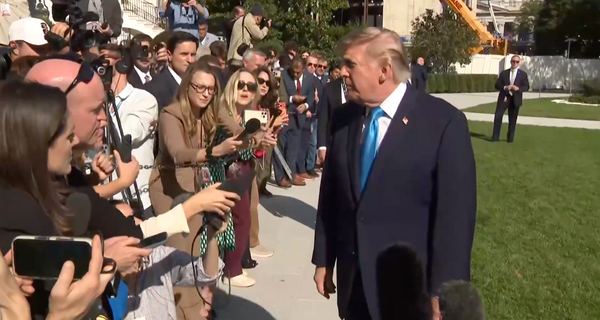
Sitting beside Turkish President Recep Tayyip Erdoğan, President Donald Trump praised Türkiye, bilateral trade and his relationship with the Turkish leader. He said discussions would include Iran and signaled that Washington was prepared to reconsider restrictions on Türkiye’s access to American military technology.
Asked about the possible sale of F-35 fighter jets, Trump said:
“Many people wonder why wouldn’t we do that, so that is certainly something we will consider.”
Trump also announced that he would lift sanctions imposed on Türkiye under the Countering America’s Adversaries Through Sanctions Act, or CAATSA.
Those sanctions were imposed after Türkiye acquired Russia’s S-400 air-defense system. Ankara was subsequently removed from the F-35 program because Washington argued that operating the Russian system alongside the American aircraft could expose sensitive F-35 technology.
When Trump was asked about the danger of sensitive technology passing into third-party hands, he appeared to avoid the substance of the question and instead emphasized the strength of his relationship with Erdoğan.
That is not a peripheral issue. It is the central security question surrounding Türkiye’s possible return to the F-35 program.
Trump said that when Türkiye purchases an American aircraft, the United States remains responsible for maintenance and engine work. He also praised Türkiye for not joining the recent fighting involving Iran and Israel, suggesting that Erdoğan may have stayed out “because of me.”
At the same meeting, however, Ukraine — a Black Sea neighbor of Türkiye and the country fighting NATO’s primary identified military threat — received far less attention.
That absence was especially striking because Türkiye’s relationship with Ukraine is not abstract or limited to diplomatic mediation.
Erdoğan’s son-in-law, Selçuk Bayraktar, chairs the board of Baykar, the Turkish company whose TB2 drones became one of the most recognizable weapons of Ukraine’s resistance during the early phase of Russia’s full-scale invasion.
Ukraine awarded Bayraktar the Order of Merit, Third Class, in 2022 for his contribution to Ukrainian–Turkish cooperation. The decoration was presented by Andriy Yermak, now former head of the Ukrainian presidential office.
Baykar has also pursued plans for a factory, training center and joint production in Ukraine, including cooperation involving Ukrainian aircraft engines. Ukrainian officials have described that industrial relationship as a key element of the strategic partnership between Kyiv and Ankara.
In other words, the Turkish defense industry surrounding Erdoğan has direct experience of Ukraine not merely as an aid recipient, but as a military partner, technology producer and source of battlefield-tested expertise.
That makes Trump’s dismissal of Ukraine’s drone capabilities — while discussing expanded American weapons sales to Türkiye — even more disconnected from the industrial reality surrounding the meeting.
Trump said he had held a “very good talk” with Russian President Vladimir Putin, whom he said also respects Erdoğan.
“Both Russia and Ukraine want to make a deal. They both want it settled. All I do in my life is deals. Hopefully we settle it soon.”
Asked whether Putin was prepared to make concessions, Trump turned instead to the cost of American support, stressing that the United States now sells equipment "rather than giving it away".
He then described the war as geographically remote and said it does not affect the United States.
“It doesn’t affect the United States … I’ve seen the battlefields. They send me pictures. I actually want to say, ‘Don’t send them to me.’ Pete Hegseth sends me pictures. I say, ‘Pete, you know what? It doesn’t help the look.’”
Iran is geographically farther from the United States than Ukraine. Yet Iran was presented as a matter requiring direct American involvement, while Russia’s war against a European democracy was described as distant and largely disconnected from US interests.
Trump also returned to Greenland, arguing that it should be controlled by the United States rather than Denmark, and suggested Washington could remove its forces from Europe.
Speaking in Ankara, Danish Prime Minister Mette Frederiksen responded that she expects NATO allies to respect Denmark’s sovereignty and accept that Greenland is not for sale.
The exchange means that a NATO summit intended to demonstrate collective defense has instead opened with the American president renewing a territorial demand against another founding member of the alliance.
He questioned why the United States had invested trillions of dollars in NATO when, in his description, allies were not helping America. He also claimed that British Prime Minister Keir Starmer was “gone” because he had not wanted to help the United States.
Starmer is not gone. He is attending the summit.
The comments were not merely complaints about burden-sharing. They amounted to a renewed challenge to the underlying logic of the alliance: that European and North American security are inseparable.
Rutte Warns NATO Is Out of Time as Alliance Unveils $50 Billion in Defense Deals
NATO Secretary General Mark Rutte presented an almost opposite assessment from President Trump’s.
Speaking at the NATO Defence Industry Forum, Rutte warned that Russia has placed its economy on a war footing while China, North Korea and Iran are increasingly supporting one another.
“We don’t have the luxury of time. We need the capabilities now to ensure we remain ready.”
Rutte said Russia is directing almost half of its national budget toward its war machine, with not only its defense industry but much of the broader Russian industrial base supporting the war.
He also warned that China continues to modernize its armed forces and expand its nuclear capabilities without transparency, while North Korea is enlarging its nuclear program and supplying Russia.
“These countries are increasingly working together,” Rutte said. “And that should concern us all.”
NATO then used the first day of the Ankara Summit to announce defense-industry agreements and initiatives valued at at least $50 billion.
The largest component is approximately $40 billion in investment in drones, counter-drone capabilities and drone training — reflecting one of the clearest lessons from Ukraine and recent conflicts across the Middle East.
The alliance also announced the acquisition of MQ-4C Triton long-range surveillance aircraft from the American company Northrop Grumman and a new airborne warning-and-control fleet involving aircraft produced by Sweden’s Saab.
The Saab acquisition replaces NATO’s previously planned purchase of Boeing E-7 Wedgetail aircraft and represents a significant European defense-industry win.
Allies will also expand strategic airlift and aerial-refueling capacity through additional Airbus A400M transport aircraft and A330 Multi Role Tanker Transport aircraft.
A separate multinational initiative will focus on securing the critical raw materials required for defense production, while NATO has issued a call for governments and financial institutions to increase private investment in the sector.
Together, the announcements show that the summit’s defense-spending debate is moving beyond headline percentages.
The question is no longer simply how much NATO countries allocate. It is whether they can convert that money into aircraft, ammunition, drones, industrial capacity and resilient supply chains quickly enough to match Russia’s war economy.
But that threat assessment also requires context.
Russia’s ability to sustain its war cannot be separated from energy revenues and the wider international market. China’s expanding influence cannot be separated from an American foreign policy that increasingly treats allies as paying clients rather than strategic partners. And Ukraine cannot be described only as a recipient of Western assistance when its military is producing and deploying some of the world’s most tested drone technology.
Zelenskyy: NATO With Ukraine Is the Alliance for the Future
Ukrainian President Volodymyr Zelenskyy used his appearances in Ankara to argue that Ukraine is not a burden NATO must carry, but a military and technological asset the alliance needs.
“Ukraine belongs in NATO. Because NATO with Ukraine is the alliance for the future.”
At the Defence Industry Forum, Zelenskyy focused on what he described as Russia’s last major strategic advantage: ballistic missiles.
He said Europe urgently needs the ability to mass-produce its own affordable anti-ballistic systems and interceptors rather than waiting until 2030 or beyond.
“Europe needs affordable, mass-produced anti-ballistic systems as soon as possible. In fact, today.”
Zelenskyy praised the Patriot system but said current production is insufficient to meet the demand created by modern warfare. Ukraine has therefore discussed obtaining Patriot production licenses from the United States and is asking European partners to support that effort.
His broader argument was that Europe’s defense-industrial strategy must now be shaped by what Ukraine has learned in combat.
Ukraine, he said, has eliminated the concept of a secure Russian strategic rear. Ukrainian drones are now reaching military production sites and oil facilities deep inside Russian territory, including in Siberia.
“There is no major oil refinery left in Russia that has not been struck by Ukraine.”
In an interview with the Financial Times, Zelenskyy argued that the war will move closer to an end when Russia’s political and economic elite can no longer experience it as something happening far from Moscow and St. Petersburg.
“When not one hundred drones but a thousand start reaching Moscow,” he said, Putin and those around him will be forced to confront the reality of the war.
Zelenskyy also said Ukrainian forces are eliminating approximately 30,000 Russian soldiers each month, adding that Ukraine takes no pride in the number.
The contrast with Trump’s remarks was stark.
Trump described distance from the battlefield as a reason the United States should feel less affected by the war. Zelenskyy argued that Russia has continued the war precisely because its leadership has been protected from its consequences by distance.
Zelenskyy reinforced that argument during a meeting with Finnish President Alexander Stubb.
The two leaders discussed Ukraine’s successful long-range strikes inside Russia, operations in occupied Crimea and the diplomatic opportunities Kyiv believes those military successes could create.
Zelenskyy said Ukraine is prepared to share its combat experience and drone technology with its partners.
“We need strong friends, a strong NATO that needs us as well. We are doing everything we can. Our Drone Deals and our experience — we will, of course, share them with our partners.”
Stubb echoed that position:
“I believe that NATO needs Ukraine just as much as Ukraine needs NATO.”
The two presidents also discussed a proposed bilateral Drone Deal and wider cooperation through the Nordic–Baltic Eight format.
The meeting added substance to Zelenskyy’s central message in Ankara: Ukraine is not simply asking to be protected by NATO. It is offering the alliance capabilities, technology and direct experience from a war NATO is preparing itself to deter.
Zelenskyy also signed a Drone Deal framework agreement with Dutch Prime Minister Rob Jetten.
The agreement covers security, defense-industrial cooperation, military expertise, cybersecurity, research and development, technology and the exchange of battlefield experience.
The Netherlands has committed to provide Ukraine with €9 billion in military support through 2029.
Zelenskyy said the agreement would support exports, joint production and the exchange of Ukrainian combat experience with Dutch partners.
The two leaders also discussed Ukraine’s shortage of air-defense missiles, plans to develop European anti-ballistic capabilities and Kyiv’s effort to obtain US licences for Patriot production.
The meeting produced a second concrete example of Zelenskyy’s argument in Ankara: Ukraine is seeking support, but it is also offering NATO allies technology, industrial partnerships and knowledge developed under combat conditions.
The Netherlands additionally provided €23 million in grant assistance for imported gas and further equipment as Ukraine prepares for winter.
Zelenskyy also met Norwegian Prime Minister Jonas Gahr Støre to discuss urgent air-defense needs, joint production and a prospective Ukraine–Norway Drone Deal.
Zelenskyy pressed for the fastest possible delivery of Patriot interceptor missiles as Ukraine faces continued Russian missile and drone attacks and prepares for winter.
The two leaders also discussed financing Ukrainian military technologies, expanding joint Ukrainian–Norwegian defense production and advancing the proposed drone agreement through their respective teams.
Energy cooperation was another central part of the meeting. Zelenskyy thanked Norway for providing the largest amount of grant assistance for Ukrainian gas purchases last winter, and the two leaders agreed to work on the next stage of support.
Together with the signed Netherlands agreement and the developing Finnish arrangement, the Norwegian talks show Ukraine building a network of bilateral defense-industrial partnerships around drones, air defence and battlefield technology.
Canada Turns Support Into Ammunition, Vehicles and Joint Production
Canada used the first day of the summit to announce approximately $925 million in specified new military assistance for Ukraine as part of its broader $2.8 billion commitment this year.
The package includes:
- $475 million for ammunition;
- nearly $400 million to build 35 Canadian-made armored vehicles;
- $50 million for critical technology and engineering equipment.
Prime Minister Mark Carney said some components of the package are already on their way.
Canada has also extended Operation UNIFIER, its military training and capacity-building mission for Ukraine, until 2029.
Carney and Zelenskyy discussed expanding industrial cooperation, particularly the joint development of drones. The Canadian statement explicitly described Ukraine as possessing world-leading expertise in the field — a notable recognition that assistance can flow in both directions through technology, knowledge and combat-tested innovation.
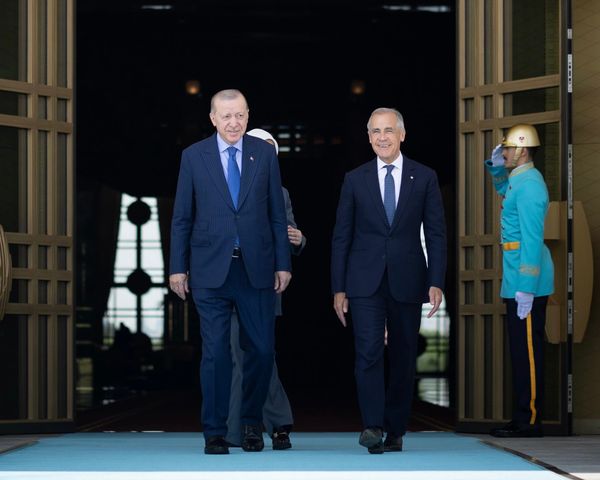
Carney also met Erdoğan. The two leaders discussed Ukraine, defense production, critical minerals, energy and aerospace, while announcing the launch of negotiations toward a comprehensive Canada–Türkiye free trade agreement. Bilateral trade reached $4.3 billion in 2025.
Canada also used the summit to deepen its long-term strategic relationship with Germany and Norway.
Prime Minister Mark Carney, German Chancellor Friedrich Merz and Norwegian Prime Minister Jonas Gahr Støre issued a joint statement following Canada’s decision to join the German–Norwegian Type 212CD submarine cooperation.
The three leaders said the decision creates an opportunity to strengthen defense-industrial and military cooperation “for decades to come” and assume greater responsibility for transatlantic security.
The partnership will extend beyond submarine procurement. Canada, Germany and Norway said they intend to cooperate in investment, energy, artificial intelligence, space and critical minerals.
Carney and Merz separately announced the launch of negotiations toward a broader Canada–Germany Strategic Partnership Agreement.
Germany is Canada’s largest trading partner in the European Union, with bilateral trade valued at more than $34 billion, giving the proposed agreement a substantial existing economic base.
The proposed agreement is intended to serve as a flexible framework for directing cooperation and investment across security and defense, technology, artificial intelligence, space, supply chains, critical minerals, energy and investment.
The two governments want to finalize the agreement before the end of the year.
Taken together, the announcements show Canada using the Ankara summit to build an integrated network of long-term European partnerships rather than pursuing individual procurement deals in isolation.
Submarine cooperation requires decades of shared maintenance, training, supply chains and operational planning. The wider Canada–Germany agreement would then connect that defense relationship to the technologies, energy systems and raw materials required to sustain it.
Eight Countries Join Canada’s Defense Bank Initiative
Canada also announced that eight countries have formally committed to supporting its proposed Defense, Security and Resilience Bank, or DSRB:
Albania, Belgium, Greece, Latvia, Luxembourg, Romania, Türkiye and Ukraine.
The institution is intended to mobilize public and private capital for defense production, supply chains, infrastructure and dual-use technology.
Its proposed tools include long-term loans, financing guarantees and lower cost capital for governments and smaller defense companies that often struggle to finance rapid expansion.
Participating countries will now help define the initial policies and operating structure of the bank. Canada has been selected to host its headquarters, and Ottawa wants the institution operational in 2027.
The model reflects a growing recognition across NATO that announcing higher defense budgets will not by itself resolve the alliance’s production shortage. Governments must also create reliable multiyear demand, finance new factories and help smaller manufacturers scale.
Canada says the bank will complement existing national and multilateral institutions rather than duplicate them.
US, Japan and South Korea Launch Nuclear-Energy Partnership
The United States, Japan and South Korea have signed a new agreement to accelerate the deployment of small modular nuclear reactors in third countries, initially focusing on the Indo-Pacific.
At the signing ceremony, US Secretary of State Marco Rubio directly linked the initiative to the current instability around the Strait of Hormuz, describing energy security as one of the world’s most urgent challenges.
“One of the most important issues in the world today, as we’re reminded of even now with events happening in the Strait of Hormuz and in other places, is energy security.”
Rubio said the agreement was intended to turn the three countries’ diplomatic coordination into a concrete deliverable and argued that small modular reactors could become a major part of future energy generation because of their potential safety, efficiency and lower costs.
Japanese Foreign Minister Motegi Toshimitsu placed the agreement within a wider trilateral agenda that already includes critical mineral supply chains and North Korean cyber threats.
South Korean Foreign Minister Cho Hyun described the SMR partnership as one of several areas in which the three countries could jointly respond to global challenges.
The memorandum establishes a framework for the three countries to coordinate their civil nuclear industries, streamline licensing, strengthen supply chains and develop reactor fleets that can lower project risks and attract private investment.
The United States is committing more than $10 million through the State Department’s Foundational Infrastructure for Responsible Use of Small Modular Reactor Technology program. The funding will support SMR project development in Indo-Pacific countries and establish a regional training hub to develop a qualified nuclear workforce.
The three governments also announced an industry initiative involving GE Vernova, Hitachi, Samsung C&T and SGE to advance deployment of the BWRX-300 small modular reactor across Europe.
That makes the agreement wider than its initial Indo-Pacific focus. It connects American reactor technology, Japanese industrial experience and South Korean construction capacity to potential projects across both Europe and Asia.
The announcement also illustrates how the Ankara summit is moving beyond conventional defense.
Reliable energy supplies, industrial control, technological standards and the ability to finance major infrastructure are increasingly being treated as elements of collective security. A country that builds and maintains another country’s reactors can establish a strategic relationship lasting for decades.
Meanwhile, the IOC Begins Reintegrating Russia
As NATO leaders met in Ankara to discuss increasing pressure on Moscow, the International Olympic Committee provisionally lifted the suspension of the Russian Olympic Committee.
The IOC suspended Russia’s committee in 2023 after it incorporated sporting organizations from the occupied Ukrainian regions of Donetsk, Luhansk, Kherson and Zaporizhzhia — a move the IOC said violated the territorial integrity of Ukraine’s Olympic committee.
The IOC now says the formal reason for that suspension has been removed because those organizations are no longer included in the Russian committee’s membership structure.
The decision clears a path for Russian athletes to return to international competitions and qualification events for the 2028 Los Angeles Olympics.
It does not yet guarantee a full return under the Russian flag. The IOC has not announced whether Russian athletes will be permitted to compete with national colors, symbols and anthem, while individual international sporting federations may retain separate restrictions.
But politically, the direction is clear: even as NATO warns that Russia has placed nearly its entire economy behind the war, another major international institution has begun the process of normalizing Russia’s return.
Other Developments
Türkiye and the United Kingdom are preparing to sign a new defense partnership agreement.
The agreement is being compared to the 2021 France–Greece defense pact, although officials have not confirmed whether it contains a mutual-defense clause.
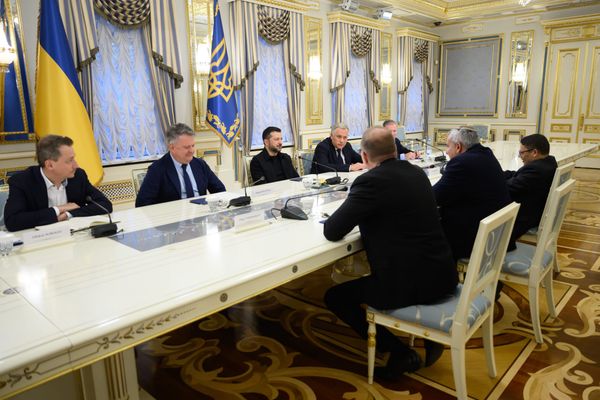
EU High Representative Kaja Kallas is attending the summit and will participate tonight in the defense ministers’ reception and the NATO–Ukraine Council dinner at the foreign minister level.
Tomorrow, leaders will move into the main summit sessions. Carney is also scheduled to meet Danish Prime Minister Mette Frederiksen and Latvian President Edgars Rinkēvičs before departing Ankara for Jeddah, Saudi Arabia.
ONEST Take
The first day exposed a fundamental contradiction.
NATO’s secretary general says Russia’s war economy, China’s military expansion, North Korea’s nuclear program and their increasing cooperation demand urgent collective action.
Ukraine is demonstrating how modern wars are fought, asking to manufacture air-defense systems in Europe and offering combat-tested drone expertise to its allies.
Canada is turning defense commitments into ammunition, armoured vehicles, joint drone production and a new financing institution.
The American president, meanwhile, is asking why the United States needs the alliance, describing Russia’s war as too distant to matter and openly threatening to withdraw American forces from Europe.
At the same time, he is preparing to lift sanctions on Türkiye and reopen the sale of the F-35 without publicly resolving the security issue that led to Türkiye’s removal from the program: its possession of a Russian S-400 system and the resulting risk to sensitive allied technology.
The US–Japan–South Korea nuclear agreement shows what an alliance strategy can look like when it moves beyond demanding payments: combine complementary industries, offer partners a competitive alternative and convert technological cooperation into decades of strategic influence.
This is no longer simply a debate about whether European countries spend enough.
Most are now spending more. The emerging question is whether NATO can build a coherent strategy while its most powerful member treats collective security as a series of individual transactions.
Trump says the United States does not need anyone.
But the only country ever to benefit from NATO’s Article 5 collective-defense guarantee was the United States.
After the September 11 attacks, NATO declared that the attack on America was an attack on every ally. European and Canadian forces then deployed alongside US troops in Afghanistan, where many were killed or seriously wounded.
NATO was never created because America was incapable of defending itself alone. It was created because allies increase one another’s security — and because preventing a war is less costly, in lives, influence and money, than entering one after collective deterrence has already collapsed.
Recommended reading
The Pre-NATO Summit Brief: What leaders brought to Ankara, the disputes already surrounding the meeting and what to watch as the formal sessions begin.
Coming up today
The Middle East Brief: Iran, Russia, the United States, Japan and the wider consequences of the latest regional realignment.
Support independent reporting like this by joining ONEST+ or making a donation in any amount.