Washington Pulls Back — Then Calls Allied Adaptation a ‘Distraction’
The United States is reducing its physical commitments while asking allies to assume more responsibility. As Europe, Canada and Ukraine build mechanisms to fill the gaps, Washington is warning them not to become "too independent".
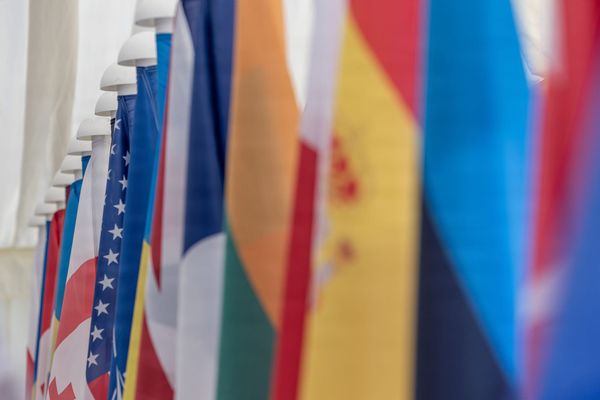
National flags of participating countries displayed during the opening ceremony of Sea Breeze 2026 in Portland, United Kingdom, on July 13, 2026. The US co-sponsored exercise focuses on interoperability among NATO maritime and ground forces operating in the Black Sea region. US Navy photo by Mass Communication Specialist 2nd Class Leon Vonguyen.
A senior US defense official has dismissed efforts by American allies to coordinate more closely and reduce their dependence on Washington — after US decisions forced those governments to begin doing exactly that.
In a seven-part statement Tuesday, Elbridge Colby — officially styled by the administration as Under Secretary of War for Policy — called the idea of a collective “middle powers” strategy a “distraction.”
Colby said Washington was seeing an “upsurge” in demand for US engagement and rejected suggestions that frustration with the United States could push allies toward other weapons suppliers.
“No alternative country or countries can compete with the US defense industrial base, either in quantity or quality,” he wrote. “If anything, access to the American DIB is a privilege, not a right.”
He said allies should invest in their own defense industries — but only “in ways that are collaborative with America’s rather than trying in vain to replicate or supplant it.”
Colby did not identify a particular country or initiative. But his statement followed two developments that put the “middle powers” argument into practice.
Both initiatives were created as American troops, weapons and political attention became less reliably available.
Immediate dependence is not a permanent strategy
Colby linked his argument to a Politico interview with German Air Force chief Lt. Gen. Holger Neumann, who warned that Europe does not currently have time to replace proven American weapons while facing an immediate threat from Russia.
“Developing our own capabilities takes time. Right now, we do not have time,” Neumann said.
But that is an argument for purchasing available US systems while Europe develops additional capacity — not for abandoning European production.
Germany’s current approach illustrates the distinction.
Berlin has agreed to purchase US-made Tomahawk missiles and Typhon launchers to fill an immediate long-range capability gap. At the same time, Germany is participating in European missile development, expanding its defense industry and contributing to the FREYJA anti-ballistic missile program.
The original plan called for a US battalion equipped with long-range missiles to deploy to Germany. That deployment was disrupted by the troop-reduction decision, leaving Berlin to negotiate the purchase and operation of the weapons itself.
Washington stepped back from the planned physical deployment. Germany adapted by arranging to acquire and operate the systems itself. Colby is now citing Germany’s continued need for American weapons as evidence that such adaptation is futile.
Physical commitments recede before the rhetoric does
Washington continues to speak publicly about supporting NATO and Ukraine. Its physical commitments, however, are becoming more limited and conditional.
In May, the Pentagon announced plans to reduce the US military presence in Europe by approximately 5,000 troops. The implementation has remained unclear amid conflicting announcements about deployments to Germany and Poland, but Washington has not formally reversed the planned drawdown.
President Donald Trump subsequently said the reduction could go further.
The administration has also warned European governments that weapons purchased under existing contracts may be delayed because US stockpiles are being used in the war with Iran. Baltic and Scandinavian countries were among those notified, despite their proximity to Russia.
Ukraine is experiencing the same pressure more directly.
Patriot interceptors are among the few available weapons capable of defending Ukrainian cities against Russian ballistic missiles. US inventories are now also required to protect American forces and bases in the Middle East.
At the NATO summit, Trump agreed to grant Ukraine a license to manufacture Patriot interceptors. The decision could become important over time, but defense experts estimate that production may take at least a year to begin.
A license does not intercept missiles approaching Kyiv today.
Trump presented the decision partly as a way to end complaints over insufficient American deliveries.
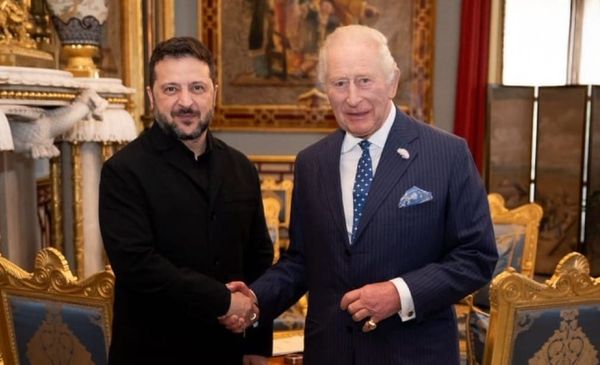
“This way, you can’t complain that we’re not giving ’em enough,” he told Ukrainian President Volodymyr Zelenskyy.
The shift is clear: the United States is moving from deploying forces and supplying weapons toward allowing allies to purchase or eventually manufacture American systems themselves.
That may still constitute cooperation. It is not the same level of material commitment.
Europe reorganizes around the gap
The Coalition of the Willing’s meeting in Paris reflected that changing reality.
Ukraine, Denmark, France, Germany, Italy, the Netherlands, Norway, Spain, Sweden and the United Kingdom established an Integrated Anti-Ballistic Missile Coalition.
Its first program, FREYJA, aims to combine Ukrainian battlefield experience with European radar, missile and manufacturing capacity to produce a more affordable anti-ballistic system at scale.
France also agreed to grant Ukraine licenses to manufacture ASTER interceptors for SAMP/T air defense systems and SCALP cruise missiles. Britain secured access for its defense companies to contracts financed through the European Union’s €90 billion Ukraine Support Loan.
The Coalition separately agreed to coordinate intelligence and national operations against Russia’s shadow fleet, conduct exercises for a future Multinational Force for Ukraine and increase support for Ukrainian air defense and energy infrastructure.
These decisions do not demonstrate that Europe can replace the United States tomorrow. They show that European governments are preparing for circumstances in which Washington may not provide the same forces, weapons or political certainty it previously supplied.
Colby’s message leaves allies with an impossible instruction: assume more responsibility, but do not build the independence required to exercise it.
Canada turns the “middle powers” argument into a bank
Colby’s reference to a collective “middle powers” strategy also follows Canadian Prime Minister Mark Carney’s call for countries outside the largest power centers to coordinate rather than compete for their favor.
Canada has now begun converting that argument into institutional capacity.
At the NATO summit, Carney announced that Canada and eight other countries — Albania, Belgium, Greece, Latvia, Luxembourg, Romania, Türkiye and Ukraine — had committed to establish the Defence, Security and Resilience Bank.
The Canada-based institution aims to mobilize up to £100 billion in lower-cost financing and loan guarantees for defense projects. It is intended to help participating countries expand production without requiring each government to carry the full financing cost individually.
The bank does not replace NATO or prevent members from purchasing American weapons. It creates an additional mechanism through which participating countries can finance their own priorities and expand their collective industrial capacity.
Colby’s assertion that middle powers lack a coherent basis for alignment arrived one week after nine countries identified one: the urgency and cost of financing their security.
A contrast with Trump’s Board of Peace
The defense bank also presents a sharp contrast with Trump’s attempt to create a US-led Board of Peace.
Trump invited approximately 60 governments to join the body, offered permanent membership in exchange for a $1 billion contribution and reserved extensive authority for himself as chairman.
Several major US allies declined or withheld support amid concerns about its governance, mandate and potential competition with the United Nations.
Canada’s invitation was withdrawn after Carney’s Davos speech calling for middle powers to act collectively in response to economic and political coercion by larger states.
The administration later abandoned its effort to establish the Board as an intergovernmental organization and recast it as an international nongovernmental organization.
The comparison is difficult to miss.
Trump’s proposed institution concentrated authority around one political leader and failed to secure broad support from key allies. Canada’s initiative distributes participation among its members and has already attracted eight partner governments around a defined financing function.
Yet Washington is describing the collective middle-power model — not its own failed effort to establish a new international body — as the distraction.
The Indo-Pacific Four are watching
The implications extend beyond Europe and Canada.
Japan, South Korea, Australia and New Zealand attended the NATO summit for the fifth consecutive year. During a meeting with NATO Secretary General Mark Rutte, the four countries discussed Russia’s war against Ukraine, China, North Korea and Iran and agreed to expand practical cooperation in defense production, cyber capabilities and technology.
Japan told the meeting that Euro-Atlantic and Indo-Pacific security were inseparable, citing the military relationship between Russia and North Korea.
The four countries are not observing Ukraine as a distant European conflict. They are studying what American commitments look like when several regions require the same troops, interceptors, technology and political attention.
Washington says demand for American military engagement demonstrates the strength of US leadership.
But allies can also interpret that demand as evidence of a dangerous dependency — particularly when access to the systems they need is described by a senior US official as a “privilege” that Washington can withhold.
Washington wants allies to carry more of the defense burden while remaining dependent on American weapons and political approval. What that contradiction means for NATO, Ukraine, Canada and US partnerships in the Indo-Pacific is examined in today’s ONEST Take.
Continue reading with ONEST+
ONEST Take
Washington’s response was not simply to warn that the transition would take time. That warning would be accurate. Colby instead described collective middle-power coordination as strategically incoherent and said allied industries should remain collaborative with America’s rather than attempt to replace it.
That exposes the difference between burden-sharing and dependency.