The Quad’s Critical Minerals Push Is About China — Even When It Doesn’t Say China

– 1 min read

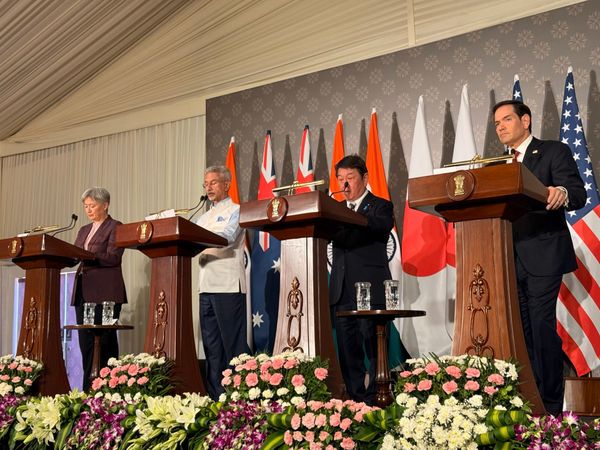
The United States, Japan, Australia, and India have announced a Quad Critical Minerals Initiative aimed at building more secure and diversified supply chains for minerals needed for advanced technology, industrial production, and defense.
The framework says the four partners intend to mobilize up to $20 billion in public and private support for mining, processing, recycling, and supply-chain development. It also calls for better investment coordination, regulatory alignment, national-security review tools, and cooperation on recycling and recovery from e-waste.
China is not the only reason this matters.
But China is the strategic context.
Critical minerals are now the foundation of everything from electric vehicles and batteries to military systems, semiconductors, and clean-energy technologies. The countries that control extraction, processing, and refining have enormous leverage over the global economy.
The Quad statement avoids turning the initiative into an explicit anti-China declaration. But Beijing clearly read it that way. China’s foreign ministry criticized the Quad framework as part of “exclusive cliques” and bloc confrontation, warning that cooperation should not target third parties.
At the same time, China is deepening its own diplomatic and strategic relationships. Xi Jinping met Pakistan’s Prime Minister Shehbaz Sharif in Beijing this week, praised Pakistan’s role in Middle East mediation, and called for closer China-Pakistan coordination against unilateralism and Cold War thinking.
So today’s picture is bigger than minerals.
The Quad is trying to build a supply-chain bloc without calling it a bloc. China is denouncing bloc politics while strengthening its own strategic partnerships. And countries like India and Pakistan are becoming increasingly important not only as regional actors, but as connectors in a multipolar system.
ONEST Take:
Critical minerals are the new energy security. The question is not only who has the resources. It is who can process them, finance them, protect them, recycle them, and move them without depending on a rival power. The Quad framework is a supply-chain strategy, but it is also a geopolitical signal: the next phase of competition will be fought through mines, ports, standards, financing, and industrial policy.