Diplomatic statements are written to sound boring.
They are designed to reveal just enough to signal policy to insiders, but not enough to explain what is really happening.
That is why mainstream media often misses the key points when covering them.
The real story is usually not in the headline. It is in the coded language, the carefully chosen omissions, and the policy areas placed next to each other.
So when Secretary of State Marco Rubio speaks with Philippine President Ferdinand Marcos Jr., and the official readout mentions the South China Sea, the Luzon Economic Corridor, energy challenges, and 75 years of alliance, this is not just a friendly anniversary call.
It is a strategic message.
Departments of State READOUT
“Secretary of State Marco Rubio spoke today with Philippine President Ferdinand Marcos, Jr. to discuss a range of bilateral economic and security priorities, including efforts to advance peace and security in the South China Sea. The Secretary reaffirmed U.S. commitment to developing the Luzon Economic Corridor and exploring ways to address the energy challenges in the region.
The Secretary emphasized the strength of the United States-Philippines Alliance and the continued close cooperation as the two countries commemorate 80 years of diplomatic relations and 75 years as Allies in 2026.”
Let’s dissect it.
The phrase “peace and security in the South China Sea” is the polite version of saying China.
China is not mentioned once in the statement.
That is often how diplomacy works.
Everyone knows what the conversation is about, so there is no need to say it explicitly.
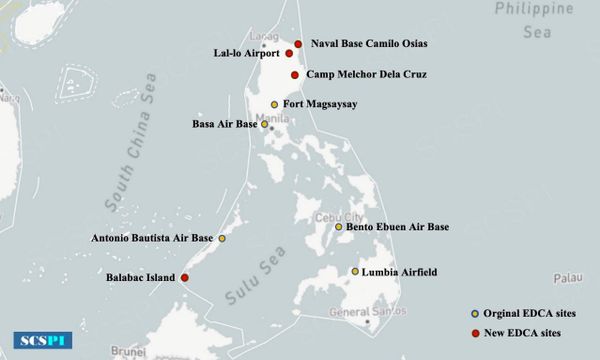
The Philippines has become one of the front lines of U.S.-China competition. Chinese vessels have repeatedly challenged Philippine ships in disputed waters, while Washington has expanded military cooperation, joint exercises, and access agreements with Manila.
The first sentence of the readout is therefore not really about peace.
It is about deterrence.
The second sentence is where things become more interesting.
“The Secretary reaffirmed U.S. commitment to developing the Luzon Economic Corridor…”
Most readers will skip over that line.
They should not.
Whenever diplomats start talking about corridors, infrastructure, energy, logistics, ports, rail, or supply chains, they are talking about power.
The Luzon Economic Corridor is presented as an economic development project.
It is also a strategic project.
Luzon sits closest to Taiwan. It is central to shipping routes, military logistics, semiconductor supply chains, and any future Indo-Pacific contingency.
In other words, the United States is not only strengthening military ties with the Philippines.
It is helping shape the economic and physical infrastructure that will underpin the alliance for decades.
Then comes the energy reference.
Again, it sounds technical.
It is not.
Energy security is national security.
A country that depends on others for critical energy infrastructure, fuel supplies, technology, or financing has less strategic freedom than one that does not.
And this is where the question becomes uncomfortable.
The United States is not only responding to China.
It is also trying to create a market in which China can compete — and in which U.S. alignment has to be purchased, maintained, and defended.
Because otherwise, why would smaller nations buy the more expensive option?
Why buy more expensive weapons, energy systems, infrastructure, and security commitments to withstand pressure from the giant neighbor next door, if the cheaper political option is to become that neighbor’s client and avoid confrontation?
That is the real competition.
Not democracy versus autocracy as a slogan.
But which great power can offer smaller states the better bargain: sovereignty with risk, or dependency with temporary calm.
And that brings us back to the ONEST Explained question.
There is a difference between strengthening allies and turning allies into clients.
If the Luzon Economic Corridor gives the Philippines more capacity, more resilience, more energy security, and more freedom to make decisions, then it strengthens sovereignty.
But if it locks the Philippines into U.S. contracts, U.S. security architecture, U.S. military planning, U.S. energy systems, and U.S. political expectations, then the alliance becomes something else.
It becomes dependency with a flag on it.
And that is the line to watch.
Because Washington is not trying to dominate the Luzon Economic Corridor the way it has historically tried to dominate major maritime chokepoints like Hormuz.
This is not the same geography, and not the same mechanism.
But the logic is related.
Control does not always mean owning the waterway.
Sometimes control means shaping the ports, roads, energy grids, contracts, supply chains, and military access around it.
That is what makes this readout important.
The South China Sea line is about China.
The Luzon line is about infrastructure.
The energy line is about dependency.
And the alliance line is about the bigger question:
Is the United States helping the Philippines become more sovereign — or simply making sure that, in the competition with China, the Philippines becomes America’s client first?