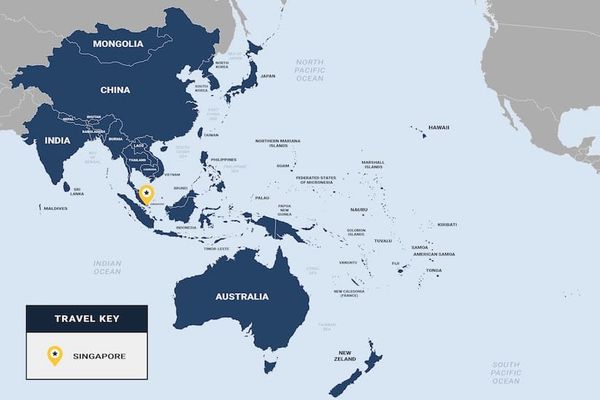
At the Shangri-La Dialogue in Singapore, the Trump administration delivered a carefully calibrated message to Asia.
On the surface, it was about China.
The United States does not want a Pacific dominated by Beijing. It does not want China to become the unquestioned regional hegemon. It wants Japan, South Korea, Australia, the Philippines, Singapore, India, Vietnam, Thailand, Malaysia, and other partners to build stronger militaries, contribute more to regional defense, and help preserve what Washington calls a “favorable balance of power.”
But underneath that message was another one.
America is no longer presenting alliances primarily as shared political commitments. It is increasingly presenting them as business relationships.
The language was partnership. The structure was procurement.
Secretary of Defense Pete Hegseth described the new U.S. vision as a move away from dependency and toward “true partnership.” He said the era of the United States “subsidizing the defense of wealthy nations” is over. He argued that America needs “partners, not protectorates,” and that alliances only work when everyone has “skin in the game.”
That may sound reasonable. And in some ways, it is.
China’s military expansion is real. The Indo-Pacific is strategically central. U.S. allies have their own national interests in preventing Beijing from dominating the region. A more capable Japan, Australia, South Korea, Philippines, and India does complicate China’s plans. It makes coercion harder. It creates more points of resistance. It reduces the risk that China can use speed, pressure, or intimidation to change facts on the ground before others can respond.
But this is where the deeper tension appears.
The United States is not only asking allies to become more capable. It is asking them to become customers.
What This Actually Means
The Shangri-La message was not simply “America is staying in Asia.”
It was: America is staying, but on different terms.
The U.S. is still presenting itself as the central military power in the Indo-Pacific. Hegseth said America remains able to project power “halfway around the world.” He emphasized that the Pacific remains central to U.S. planning, even as the administration focuses on the homeland and the Western Hemisphere.
But Washington is also making clear that allies must pay more, build more, buy more, and in some cases co-produce more.
This is the transactional version of deterrence.
In the older alliance model, the relationship itself carried strategic value. Allies were not only military contributors. They were political partners. The alliance was built on trust, predictability, institutions, shared planning, and the belief that security commitments had value beyond the immediate invoice.
In the new model, the alliance is increasingly measured by deliverables: defense spending, weapons purchases, industrial capacity, munitions production, shipbuilding, drones, missile systems, and whether a country can contribute to U.S.-led regional planning.
That does not mean the alliance disappears.
It means the emotional and political quality of the relationship changes.
An ally becomes less like a trusted strategic partner and more like a buyer inside a security marketplace.
Why This Goes Against China’s Plans
For China, the ideal Indo-Pacific is not necessarily one where every country openly chooses Beijing.
China’s more realistic goal is to make countries hesitate.
It wants Southeast Asian states to question whether the United States is reliable. It wants Taiwan to feel isolated. It wants the Philippines to feel exposed. It wants Japan and South Korea to doubt Washington’s staying power. It wants Australia to calculate the economic and military costs of standing too close to the United States. It wants India to remain independent enough not to fully align with a U.S.-led security framework.
In other words, China does not need every country to become pro-China.
It needs them to become uncertain.
That is why the Shangri-La message matters.
If U.S. allies and partners increase defense spending, build domestic military capacity, invest in munitions, expand maritime surveillance, deepen intelligence sharing, and coordinate with Washington, China’s room for maneuver narrows.
A more heavily armed and better coordinated Indo-Pacific makes it harder for Beijing to use pressure against one country at a time. It raises the cost of aggression against Taiwan. It complicates Chinese activity in the South China Sea. It gives the Philippines more backing. It makes Japan and Australia more central to any regional contingency. It gives India more space to balance China without formally becoming a U.S. treaty ally.
That is the part of the strategy that genuinely challenges Beijing.
China has spent years trying to weaken U.S. alliance networks and present Washington as unstable, self-interested, and declining. A region of stronger U.S.-aligned militaries undercuts that narrative — at least militarily.
But the problem is that Washington’s own language also helps China’s political argument.
Because if the U.S. sounds like it is telling allies, “Pay up or the relationship changes,” Beijing can point to that and say: America does not have partners. America has clients.
How Much Is Strategy — And How Much Is Posturing?
There is real strategy here.
The U.S. defense industrial base has been under pressure. Ukraine exposed how quickly modern wars consume ammunition, air defense interceptors, drones, artillery, and replacement parts. The Indo-Pacific would require even more complex logistics, especially if a crisis involved Taiwan, the South China Sea, or long-range maritime operations.
So when Hegseth talks about production lines, PAC-3s, Tomahawks, THAAD systems, drones, shipbuilding, and co-production, this is not just rhetoric. The United States is trying to reshape its military supply chain for a world where conflict is not theoretical.
The U.S. also knows that China has spent years building military capacity at scale. Deterring Beijing requires more than speeches. It requires distributed forces, resilient bases, stockpiles, drones, submarines, missiles, undersea capabilities, cyber capacity, and allied access.
But there is also posturing.
The language of “peace through strength” is designed for domestic politics as much as foreign policy. It allows the administration to sound tough on China while also softening the tone after recent U.S.-China engagement. It allows Washington to reassure allies without giving them everything they want. It allows the Trump administration to say it is not abandoning Asia, even while it demands that Asian allies carry more of the cost.
That is the balancing act.
The message to China is: We are strong.
The message to allies is: You need to pay.
The message to the American public is: We are no longer being taken advantage of.
And the message to the defense industry is: Demand is coming.
The Downgrade in Alliance Quality
This is the most important part.
The issue is not whether countries have legitimate security concerns. They do. The Indo-Pacific is more militarized. China’s pressure is real. North Korea remains a threat. Russia’s war in Ukraine has changed how governments think about vulnerability, supply chains, drones, missiles, cyberattacks, undersea cables, and maritime chokepoints.
But legitimate security concerns are not the same as turning alliances into purchasing requirements.
There is a difference between helping countries feel safer and telling them that the quality of the relationship depends on how much they spend, buy, produce, or contribute to America’s preferred military architecture.
That is where the downgrade begins.
Alliances depend on more than capability.
They depend on confidence.
A country buying more U.S. weapons may become more capable. But it may not feel more respected. A country signing co-production deals may become more useful to Washington. But it may also feel more like a subcontractor than a sovereign partner. A country increasing defense spending may satisfy a U.S. demand. But it may also wonder whether the next demand will be higher.
That matters because trust is also a military asset.
If allies believe U.S. commitments are conditional on payments, contracts, and political loyalty to the current administration, they may hedge. They may buy American weapons while also keeping diplomatic channels open with China. They may cooperate militarily while avoiding political alignment. They may increase spending while quietly preparing for a future in which Washington’s guarantees become less predictable.
That is not a stronger alliance system.
That is a more armed, more anxious one.
The Buyer Problem
The Trump administration’s approach creates a strange contradiction.
It wants allies to be stronger so they are less dependent on America.
But it also wants them tied more tightly to American defense production.
That means countries are being told to become sovereign, self-reliant actors — while also buying more U.S. systems, depending on U.S. supply chains, joining U.S.-led co-production models, and integrating their militaries around American platforms.
This is not independence.
It is managed dependence.
And it creates three problems.
First, America is asking allies to buy into a defense system that is already under strain. Washington is promising more missiles, more drones, more Patriots, more Tomahawks, more THAADs, more production lines, and more co-production. But the United States is also trying to supply Ukraine, sustain a war with Iran, sell to Gulf states, prepare for contingencies in the Pacific, and replenish its own stockpiles. Even Hegseth acknowledged that the defense industrial base now has to produce not only for America’s own operational plans, but also for allies “counting on us.”
That raises a basic question: if everyone is being told to buy more from America, can America actually deliver?
Second, the U.S. approach itself has efficiency problems. The wars of the last few years have shown that cheap drones can force expensive responses. If a low-cost Iranian drone is intercepted with a missile worth hundreds of thousands or even millions of dollars, that may work tactically in the moment, but strategically it creates an unsustainable cost curve. The issue is not whether American weapons are powerful. Many are.
The issue is whether the American model is affordable, scalable, and adaptable enough for the kind of conflicts now unfolding.
Third, if Washington turns alliances into a marketplace, it cannot be shocked when others compete in that marketplace.
What happens if China offers cheaper systems? What happens if China, or another power, offers faster delivery, fewer political conditions, or more flexible financing?
What happens if countries that do not want to choose sides decide to buy security the same way they buy infrastructure, technology, or energy — from whoever gives them the better deal?
That is the danger of replacing trust with transactions.
Markets work by market rules.
If America wants allies to behave like buyers, then those buyers may eventually shop around.
That does not make the China threat imaginary. It means the response to that threat is also economic. The Indo-Pacific is not only becoming a theater of deterrence. It is becoming a market — and once security becomes a market, loyalty is no longer guaranteed.
What China Will See
China will likely see three things at once.
First, it will see that the United States is still organizing the region against Chinese dominance. That is a problem for Beijing.
Second, it will see that U.S. allies are being pushed to spend more, coordinate more, and build stronger military capacity. That could complicate Chinese planning.
Third, it will see an opening.
If Washington turns regional security into a marketplace, Beijing can compete in that marketplace. China can offer cheaper systems, faster delivery, local production, financing, infrastructure tie-ins, and the argument that Asian countries should not have to depend on a distant power for their own security.
That is not just propaganda. It is a commercial and strategic opportunity.
China can present itself as the local, efficient, lower-cost alternative — not necessarily to replace the United States everywhere, but to buy its way into influence, access, and eventually alliance-like relationships. It can tell countries: you do not need to choose a bloc; you can choose the better deal.
That is the danger of America’s buyer-based alliance model.
Once security is treated as a market, China does not have to defeat the U.S. alliance system directly. It can compete for the customers inside it.
The Bottom Line
The Shangri-La message was not a retreat from the Indo-Pacific. It was a redefinition of America’s role there.
Washington is saying: We will remain powerful. We will deter China. We will project force. But allies must spend more, produce more, buy more, and carry more of the burden.
That may strengthen militaries.
It may also weaken the very leverage America is trying to preserve.
Because having allies is not a line item. It is power.
And America did not get that power by accident.
It came out of World War II, out of devastation, occupation, reconstruction, security guarantees, and choices that would have seemed impossible in 1945. Japan is the clearest example. The United States used nuclear weapons against Japan. And yet Japan still became one of America’s most important allies in Asia, anchoring U.S. power in the region for generations.
That is not normal.
That is not a simple business relationship.
That is the kind of leverage countries usually build only after major disasters — and only if they are trusted enough afterward to turn catastrophe into alliance.
Now America is asking that same ally to pay into the relationship as if the relationship itself has no memory, no history, and no strategic value beyond the next invoice.
Trust is not priced in dollars. Neither is leverage.
And when a country starts selling what made it powerful, others will learn to compete for it.
The question is whether America understands what it is putting on the market.
Because some forms of power are priceless until they are gone.