Diplomacy, Translated: Rubio Meets Kuwait’s Foreign Minister After Iran Targets Kuwait Airport

– 3 min read

Diplomatic readouts are short by design. They rarely explain the full context. That is why ONEST’s Diplomacy, Translated series looks at what governments say, what they mean, and why it matters.
Secretary Rubio’s Meeting with Kuwaiti Foreign Minister Sheikh Jarrah Jaber Al-Ahmad Al-Sabah
Readout
June 4, 2026
The below is attributable to Spokesperson Tommy Pigott:
Secretary of State Marco Rubio met today with Kuwaiti Foreign Minister Sheikh Jarrah Jaber Al-Ahmad Al Sabah. The Secretary reiterated the commitment of the United States to Kuwait’s security, to ensuring that Iran never acquires a nuclear weapon, and restoration of freedom of navigation through the Strait of Hormuz.
The Secretary also condemned Iran’s outrageous and unacceptable attacks targeting Kuwait International Airport and other parts of the country and expressed condolences for those killed and injured in that attack. We stand with the Kuwaiti people during this difficult time.
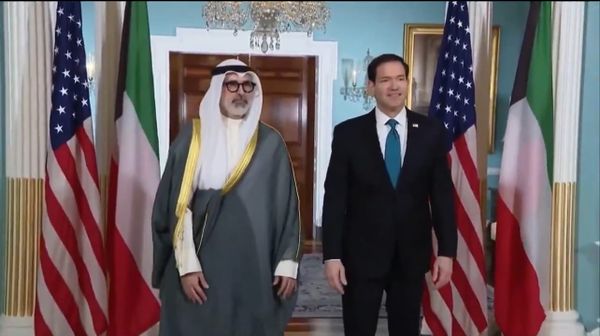
Before the words, there are the optics.
Kuwait’s foreign minister standing next to Rubio sends a clear alliance message: Kuwait and the United States are aligned after Iran’s attack.
But it also shows the power dynamic. Kuwait took the hit, while Washington is now providing reassurance that the broader strategy is still worth the cost.
That is the real subtext of this meeting.
“The commitment of the United States to Kuwait’s security”
This is the most important sentence in the statement.
Kuwait hosts significant U.S. military infrastructure and has long been one of Washington’s closest security partners in the Gulf. That partnership brings protection, but it can also make Gulf states targets when tensions between the United States and Iran escalate.
Kuwait has just experienced that reality firsthand.
Translation: Washington is reassuring Kuwait that it has not been left to absorb the consequences of that partnership alone.
“Ensuring that Iran never acquires a nuclear weapon”
This line explains why the reassurance matters.
The United States continues to frame its regional strategy around preventing Iran from obtaining a nuclear weapon. Yet for Gulf partners, the immediate reality is that they may face retaliation, missile strikes, economic disruption, and security risks while that objective is pursued.
Translation: The United States is asking partners to remain committed to a strategy whose “long-term goal remains unchanged, even as the short-term costs become increasingly visible”.
“Restoration of freedom of navigation through the Strait of Hormuz”
This line is about economics as much as security.
For Gulf countries, the Strait of Hormuz is not simply a shipping route. It is the gateway through which much of their oil, gas, and trade reach global markets.
When Hormuz is threatened, Gulf states face more than military risks. They face higher shipping costs, disrupted exports, uncertainty in energy markets, and direct pressure on government revenues.
Translation: Washington is arguing that the current disruption is part of a broader effort against Iran and that the costs are justified by the larger strategic objective.
But that is precisely where the debate begins.
If Gulf countries become targets because of their partnership with the United States, and their economies are simultaneously hurt by instability in Hormuz, they inevitably begin asking whether the security umbrella is reducing their exposure to conflict or increasing it.
“Iran’s outrageous and unacceptable attacks targeting Kuwait International Airport”
This is the strongest language in the statement.
The attack did not target a military base. It struck civilian infrastructure and resulted in deaths and injuries.
By highlighting the airport, Washington is emphasizing that a close U.S. partner was attacked on its own territory and that civilians paid the price.
Translation: The United States is framing the attack not simply as an act against Kuwait, but as evidence of the broader threat it says Iran poses to the region.
“We stand with the Kuwaiti people”
This is more than a condolence.
It is a political message directed at Kuwait, other Gulf partners, and Tehran simultaneously.
Translation: Washington wants Gulf partners to know that despite the costs they are bearing, the United States remains committed to the relationship and expects those partnerships to endure.
This readout is less about Iran than it is about reassurance.
Kuwait has just taken a hit while participating in a U.S.-led security architecture designed to contain Iran and prevent it from obtaining a nuclear weapon. At the same time, instability in the Strait of Hormuz threatens the economic interests of Gulf states whose prosperity depends on uninterrupted trade and energy exports.
Rubio’s message is therefore straightforward: the costs being borne by Kuwait and other Gulf partners are part of a larger strategy that Washington believes is worth pursuing.
Whether Gulf capitals continue to agree with that calculation is becoming one of the most important questions in the region.
The quiet question underneath this statement is not whether the United States supports Kuwait. It clearly does.
The real question is whether Gulf partners increasingly view close alignment with Washington as a source of protection — or a source of exposure.
The fact that Rubio felt the need to arrange this meeting suggests that question is no longer theoretical.
That is where the diplomatic language becomes strategic.