Daily Brief: UK Drawn Deeper Into Iran War, US–EU Tech Fight Escalates, NATO Downs Drone Over Romania

– 15 min read

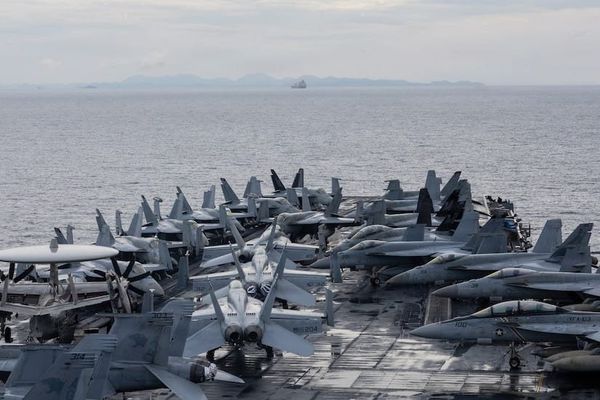
The U.S. completed a 13th night of strikes on Iran, disabled another vessel attempting to breach its blockade and operated B-1 bombers from Britain — prompting Tehran to declare supporting UK bases legitimate targets.
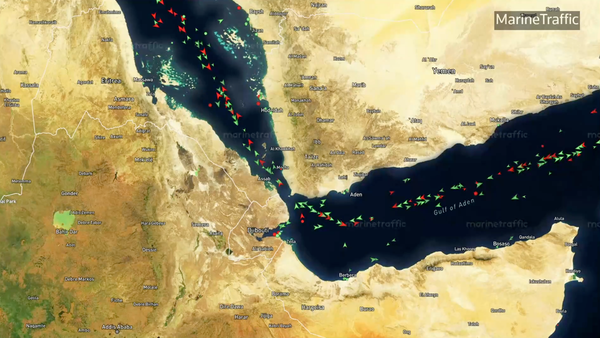
Meanwhile, Iran claimed attacks on U.S. facilities across the region, while the Houthis targeted Saudi tankers in the Red Sea. With both Hormuz and Bab al-Mandab under pressure, the war now threatens two critical shipping routes.
The United States completed a 13th consecutive night of strikes against Iran, targeting Revolutionary Guard facilities, missile and drone infrastructure, coastal surveillance positions and other military sites.
The campaign initially concentrated on Iran’s naval capabilities and its ability to threaten shipping through the Strait of Hormuz. It has since expanded deeper inside the country and toward infrastructure supporting Iran’s military operations.
President Donald Trump has threatened to destroy Iranian bridges, power plants and other infrastructure in response to attacks on commercial vessels. Secretary of State Marco Rubio said the “price will continue to get higher every single night” until Iran accepts an agreement.
The U.S. military also disabled the M/T Lavine in the Gulf of Oman after the merchant vessel allegedly attempted at least four times to breach the American blockade of Iranian ports. It is the second commercial vessel disabled since the blockade was reimposed.
Iran, meanwhile, has continued retaliatory operations across the region. The Islamic Revolutionary Guard Corps claimed attacks against American military facilities in Kuwait and Jordan, while Jordan said it intercepted four missiles and six Iranian drones over the previous 24 hours.
An Associated Press journalist also reported hearing at least seven explosions and seeing smoke near a U.S. military base in Irbil, Iraq. The cause and any casualties were not immediately confirmed.
Within days of taking office, Prime Minister Andy Burnham continued Britain’s authorization for U.S. forces to use UK bases for operations against Iran that London describes as “defensive.”
U.S. B-1 Lancer strategic bombers subsequently operated from RAF Fairford. Their deployment followed President Trump’s threat to strike Iran’s deeply buried Pickaxe Mountain nuclear facility, although officials have not confirmed that the facility was their assigned target.
Iran’s Revolutionary Guard responded by declaring British bases supporting U.S. attacks legitimate targets. The UK said its armed forces were prepared to defend British territory and interests, with military and intelligence services on heightened alert.
London maintains that allowing selected U.S. operations from British territory does not make the UK a direct participant in the broader offensive. Iran rejects that distinction, treating bases that enable attacks as part of the war’s military infrastructure.
Burnham therefore begins his premiership with Britain in a precarious position: it is not formally presented as a combatant, but British territory is supporting U.S. operations and is consequently exposed to Iranian retaliation.
The Houthis claimed attacks against two Saudi oil tankers after announcing a blockade against Saudi Arabia. Saudi authorities confirmed that one vessel caught fire following an attack in the Red Sea.
Two Chinese supertankers carrying a combined four million barrels of Saudi crude subsequently headed toward the Bab al-Mandab Strait, testing whether Houthi threats will affect vessels carrying Saudi oil even when the ships themselves have Chinese links.
The United Nations warned that renewed attacks against commercial shipping risk widening the conflict and drawing Yemen deeper into the regional war. The Houthis, formally known as Ansar Allah, control Yemen’s capital and much of the country’s west and are supported by Iran.
The United States and Pakistan separately condemned the threats to commercial shipping and Saudi Arabia.
The Strait of Hormuz and Bab al-Mandab sit at opposite ends of the region’s central energy and shipping system. Disruption at one forces delays, higher insurance costs and altered routes. Simultaneous disruption at both creates a much larger problem: Gulf energy exports face danger whether ships attempt to leave through Hormuz or travel through the Red Sea and Suez Canal.
Oil prices climbed above $100 per barrel as markets absorbed the risk of two maritime chokepoints coming under sustained pressure.
At least 6,000 crew members aboard approximately 400 vessels remain stranded around the Strait of Hormuz, according to information provided by the International Maritime Organization.
The UN human rights office warned that the actual number may be higher because additional crews on smaller vessels remain unaccounted for.
At least nine ships, carrying 93 crew members, have reportedly been abandoned by their owners since the war began. Some seafarers have been left without adequate food, water, fuel, electricity, medical care or reliable communication with their families.
Seventeen seafarers have been killed since the conflict began.
The UN called on governments, shipowners and the parties to the conflict to provide safe passage, essential supplies, consular assistance, evacuations and repatriation.
The seafarers are the human infrastructure behind global trade. While governments debate freedom of navigation in strategic terms, thousands of civilians are effectively confined aboard ships inside an active conflict zone.
Energy buyers and Gulf companies are already adapting to the likelihood that maritime insecurity will persist beyond the immediate military crisis.
Asian and European buyers plan to press Qatar and the United Arab Emirates for cheaper and more flexible liquefied natural gas contracts, including stronger supply guarantees. Buyers argue that higher insurance and transportation costs have made Gulf deliveries less reliable and more expensive.
The pressure demonstrates a longer-term risk for Gulf exporters: even customers unable to replace Qatari or Emirati LNG immediately will demand compensation for the additional geopolitical exposure.
The UAE’s DP World has signed an agreement to build two deepwater container terminals outside the Strait of Hormuz. The terminals would provide a direct route to international markets without requiring vessels to pass through the strait.
This is more than a commercial expansion. It is an attempt to redesign trade infrastructure around a strategic vulnerability that the war has made impossible to ignore.
Saudi Arabia faces a different problem. Its eastern oil exports depend heavily on Hormuz, while shipments routed west toward the Red Sea are now exposed to Houthi attacks near Bab al-Mandab. The kingdom is therefore caught between two threatened exits.
Pakistan is exploring a possible resumption of U.S.–Iran negotiations following an initiative encouraged by China.
Iranian Interior Minister Eskandar Momeni reportedly visited Islamabad twice within ten days, meeting Pakistani government officials and Army Chief Asim Munir. Pakistan has told Tehran that stopping attacks against Saudi Arabia and other Gulf states is now a prerequisite for renewed talks.
China supports Pakistan’s mediation and has a direct economic interest in restoring maritime traffic. Beijing is Iran’s largest trading partner and principal buyer of its exported crude, but it also depends on Gulf producers and shipping routes passing through both Hormuz and the Red Sea.
This creates a significant change in China’s incentives. Supporting Iran diplomatically is one matter; absorbing simultaneous disruption to Chinese energy supplies and trade routes is another.
There is no indication that new negotiations are imminent. But the initiative shows that Iran’s maritime strategy is increasing pressure not only on the United States and its regional partners, but also on Tehran’s most important economic relationship.
The U.S. Treasury designated four individuals and nine entities connected to Iranian financier Babak Zanjani’s sanctions-evasion network.
The action targets companies operating under Zanjani’s “Dot One” conglomerate across transportation, aviation, rail, gold, digital assets and financial services. Treasury says the network combined public-facing commercial projects with covert financial infrastructure used to move funds and support Iranian state-linked entities.
The designations include Dot One’s holding, rail, airline, ride-sharing, barter and gold operations, as well as companies and executives in Turkey and the UAE connected to the Zedcex and Zedxion digital-asset exchanges.
U.S. authorities say addresses associated with the exchanges processed funds for wallets attributed to the IRGC.
The action illustrates how sanctions policy is moving beyond conventional banks and oil exports. Washington is targeting the combined use of cryptocurrency, precious metals, transportation projects and offshore companies as one interconnected financial system.
The United States also designated a senior UK-based Egyptian Muslim Brotherhood official and individuals and entities accused of using charitable organizations and underground financial networks to support Hamas.
Lebanon and Israel are expected to hold their next round of U.S.-brokered talks in Italy on August 4 as they begin implementing arrangements for Israeli withdrawals and Lebanese Army deployments in southern Lebanon.
Separately, Lebanon’s culture minister condemned the raising of an Israeli flag over a historic Crusader-era castle in southern Lebanon as “hostile and provocative.”
Get briefs like this delivered daily — free.
The European Commission imposed two penalties totaling €890 million against Google under the Digital Markets Act.
Google was fined €460 million for favoring its own shopping, hotel, transport, sports and other services in search results. A separate €430 million penalty addressed restrictions preventing app developers from directing users toward cheaper purchasing options outside Google Play.
Google has 60 days to comply with orders to treat rival services fairly and allow developers to direct customers elsewhere.
The Commission argues that the case is about preventing a dominant digital “gatekeeper” from using its control of search and app distribution to disadvantage competitors. Google says the required changes could remove popular real-time search functions, degrade services and weaken protections within its app store.
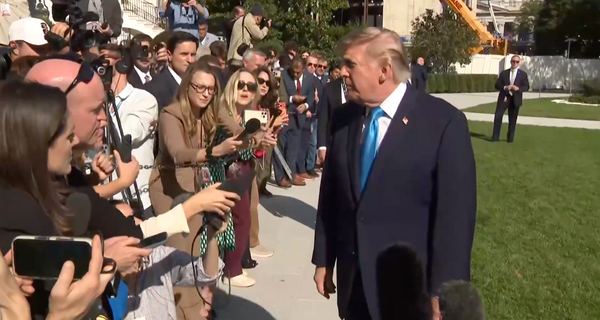
President Trump called the ruling illegal and announced an immediate Section 301 investigation into the EU’s treatment of American companies. He warned that the bloc would “pay a very big price,” raising the possibility of retaliatory tariffs.
A Section 301 investigation does not impose tariffs automatically and will take time. But it moves a disagreement over competition law into the U.S.–EU trade relationship.
The core dispute is larger than Google. Europe considers regulation of dominant platforms an exercise of sovereignty within its own market. Washington increasingly treats penalties against large American technology companies as discriminatory trade actions. If that approach becomes formal U.S. policy, enforcement of European digital law could repeatedly trigger tariff threats.
The International Criminal Court’s member states removed Chief Prosecutor Karim Khan following sexual misconduct allegations, according to diplomats who spoke to the Associated Press.
A large majority of the Court’s 125 member states supported his removal. It is the first time an ICC chief prosecutor has been ousted.
The decision concerns alleged personal misconduct and institutional governance. It does not invalidate the Court’s investigations, warrants or broader legal mandate, although the loss of its chief prosecutor creates another leadership challenge at a moment of intense external political pressure.
For the ICC, institutional credibility is inseparable from legal credibility. Member states could not credibly demand accountability from governments while appearing unwilling to enforce accountability within the Court itself.
More than 200,000 people were forced to leave their homes as wildfires spread through southern France and central Spain.
France’s Interior Ministry said approximately 141,000 people fled in the Gironde and Landes departments. Spain reported that 60,000 people were evacuated from affected areas in the center of the country.
The European Union approved a new sanctions package targeting Russia’s banking sector, cryptocurrency networks, shadow fleet and military-industrial system.
The package includes 218 new designations: 170 entities and 48 individuals. It targets 94 Russian financial institutions, including the Moscow stock exchange, and imposes separate transaction bans on 33 banks.
More than 40 shadow-fleet vessels, oil refineries in Russia and Belarus and over 50 entities connected to Russia’s military industry and long-range drone production were also included.
The EU froze the Russian oil price cap at $44.10 per barrel for 12 months. Without the freeze, a scheduled adjustment reflecting higher global crude prices could have raised the cap to approximately $58.50, allowing Russia to benefit from the market shock created by the Iran war.
However, much of Russia’s crude already trades above the Western cap. Urals crude was valued at approximately $67.50 per barrel this week, excluding shipping and insurance.
The sanctions package also grants a one-year, automatically renewable exemption allowing EU companies to transfer Russian LNG to third countries. Greece had argued that banning those services would shift business away from European shipping companies without reducing Russian revenue.
The compromise exposes the recurring limitation of EU sanctions: every measure must be negotiated not only around pressure on Russia, but around the economic interests of all 27 member states.
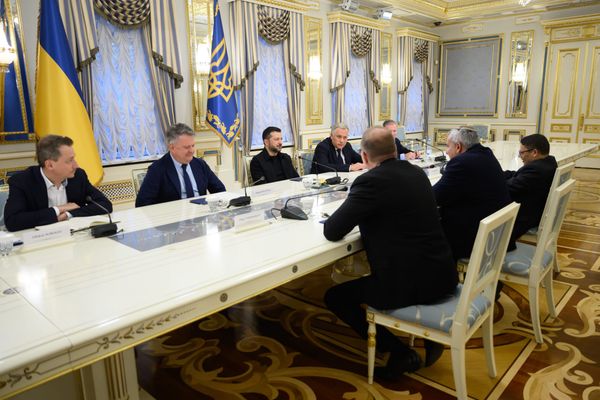
President Volodymyr Zelenskyy met a Raytheon delegation led by Vice President Joseph DeAntona to discuss Ukraine’s proposed co-production of Patriot interceptors.
Zelenskyy said the project was part of his previous discussion with Trump in Ankara and called for the two sides to move forward.
Production would represent a deeper stage of support than transferring finished interceptors. It would place Ukraine inside the manufacturing system for one of the weapons most critical to its survival and help address the persistent gap between air defense demand and available Western inventories.
A Philippine defense delegation visited Ukraine for the first time in the history of bilateral relations.
The two sides agreed to begin work on a special Drone Deal arrangement that would allow the Philippines to draw from Ukraine’s battlefield experience and introduce new defense practices.
Ukraine is also seeking Philippine support for becoming an ASEAN Sectoral Dialogue Partner.
The relationship reflects Ukraine’s expanding role as a supplier of wartime knowledge. Kyiv is no longer engaging partners only as a recipient of weapons and assistance. Its experience with drones, electronic warfare and air defense has become a form of strategic capital — particularly for Indo-Pacific governments studying future high-technology conflicts.
The European Union and the Philippines formally launched an Enhanced Partnership covering foreign policy, security, trade, climate, digital policy and connectivity.
The EU has approved a €15 million European Peace Facility assistance measure for the Philippine Armed Forces. The funding will provide non-lethal maritime surveillance and monitoring equipment.
It is the first European Peace Facility measure implemented in the Indo-Pacific and signals Europe’s intention to become a more visible security partner in the region.
The EU and Philippines are also entering the final stage of free trade negotiations. Bilateral trade in goods is already worth nearly €17 billion annually.
The partnership is directly connected to security in the South China Sea. The EU reiterated its support for freedom of navigation, the UN Convention on the Law of the Sea and the 2016 arbitral ruling rejecting the legal basis for China’s expansive maritime claims.
The Philippines is now building overlapping relationships rather than relying exclusively on one security provider: its U.S. treaty alliance, European surveillance assistance and Ukrainian battlefield cooperation all address different parts of the same defense problem.
Chinese Foreign Minister Wang Yi and Secretary Rubio met in Manila as both governments emphasized implementing agreements reached by Presidents Trump and Xi Jinping.
Chinese Vice Foreign Minister Ma Zhaoxu also visited Washington for talks with the State Department, White House, Pentagon and members of Congress.
Both sides described the objective as a more constructive and strategically stable relationship. But the diplomacy unfolded alongside Chinese live-fire activity around Taiwan and another confrontation involving Philippine vessels near Scarborough Shoal.
Rubio said the United States wanted a positive relationship with China but would not pursue it at the expense of regional allies.
This is the operating model emerging between Washington and Beijing: intensified military and economic competition combined with more frequent senior level communication intended to prevent that competition from becoming an uncontrolled conflict.
NATO’s Special Representative for the Southern Neighbourhood, Javier Colomina, visited Qatar and reaffirmed the Alliance’s solidarity with Gulf partners following Iranian attacks across the region.
Colomina met Qatar’s Secretary of State for International Cooperation, Mariam bint Ali bin Nasser Al-Misnad, and Armed Forces Chief of Staff Lieutenant-General Jasim bin Mohammed Al-Mannai. Their discussions covered the evolving security environment and implementation of Qatar’s newly endorsed Individually Tailored Partnership Programme with NATO.
The program brings NATO’s separate areas of cooperation with Qatar into a single country-specific framework. It does not make Qatar a NATO member or extend the Alliance’s Article 5 collective-defense guarantee, but it creates a more structured basis for political consultation, military cooperation, training and interoperability.
The two sides also discussed four flagship projects launched through the Istanbul Cooperation Initiative at this month’s NATO Summit in Ankara. They cover:
These are precisely the capabilities now being tested by the Iran war: attacks on commercial shipping, Iranian missile and drone operations, threats against energy infrastructure and the possibility of escalation involving nuclear facilities.
NATO is not announcing a Gulf military operation. But the visit shows that its new southern strategy is moving beyond statements and into practical security cooperation. As Washington expands its campaign against Iran, NATO is positioning itself as a framework through which Gulf partners can improve defenses without formally joining the Alliance.
This also strengthens today’s wider theme: the Iran war is drawing NATO’s security relationships beyond its traditional territory at the same time that the Alliance is reinforcing its eastern flank against Russia. NATO is increasingly organizing security across both its eastern and southern neighborhoods.
Two Romanian F-16s and two Italian Eurofighters scrambled under NATO command after an unidentified drone approached and then entered Romanian airspace.
The aircraft were cleared to engage, and the drone was shot down over Romanian territory. An investigation is underway.
The interception is a practical demonstration of NATO’s integrated air defense: Romanian and Italian aircraft, operating from different bases under a common command structure, responded to a single threat.
Romania is also acquiring the MEROPS counter-drone system as NATO members expand defenses against smaller and cheaper unmanned aircraft.
The North Atlantic Council approved NATO’s 2027–2031 Common Funding Resource Plan and set a ceiling of up to €6.5 billion for common funding in 2027.
Allies also approved a €27 billion Fuel Supply Chain Capability Programme to modernize storage and distribution infrastructure and construct new facilities, including pipelines, in NATO’s eastern and southeastern regions.
Fuel infrastructure is less visible than missiles, aircraft or troops, but it determines whether forces can move and remain operational during a war. The plan reflects NATO’s shift from maintaining a limited peacetime presence to preparing the physical systems required for sustained high-intensity operations.
Common funding will also support NATO assistance and training for Ukraine and the NATO–Ukraine Joint Analysis, Training and Education Centre.
The Trump administration is using Section 301 of U.S. trade law for its third attempt to impose broad tariffs on American trading partners.
Approximately 60 partners were assigned tariff rates ranging from 10% to 12.5%. The administration included exclusions for products not made domestically and goods already covered by Section 232 tariffs.
Unlike previous tariff authorities challenged in court, Section 301 provides the administration with a more established investigative process. The U.S. Trade Representative spent four months conducting the investigation, making successful legal challenges less likely.
The exclusions may reduce some immediate costs, but importers will still pay more for consumer goods, machinery and industrial components.
Retaliation is not currently expected. The longer-term response may be more consequential: trading partners are likely to accelerate agreements among themselves and reduce their dependence on access to the American market.
The United States may therefore collect more tariff revenue while simultaneously encouraging the construction of trade networks in which it has less influence.
Trump announced an expansion of the voluntary Ratepayer Protection Pledge.
More than 200 utilities, data center developers, cooperatives and states have pledged that large data center operators — not ordinary customers — will fund the power generation and grid infrastructure required by their projects.
The White House says participating providers account for 80% of electricity delivered to U.S. homes and businesses and cover 263 million people.
But the pledge is non-binding and contains no federal enforcement mechanism.
That distinction matters. Data centers accounted for approximately $6.3 billion — nearly 40% — of the capacity charges in PJM Interconnection’s latest auction. Those costs ultimately enter electricity bills across a region serving 67 million people.
Average residential electricity prices are projected to rise by 5.1% in 2026 and another 2.4% in 2027, before inflation.
The pledge acknowledges a real problem: the public should not subsidize the infrastructure required by some of the world’s wealthiest technology companies. But it does not guarantee protection. Its effectiveness will depend on enforceable contracts approved by utilities and state regulators — and on whether companies build or finance enough new generation and transmission capacity to meet their demand.
In El Obeid, Sudan, women and girls face a choice between collecting water during daylight and risking drone attacks, or waiting until darkness and risking sexual violence, according to the United Nations.
The warning captures how the war has transformed even the most basic act of survival into a calculation between different forms of violence.
The United States designated nine entities and two individuals connected to Cuba’s energy, financial and overseas medical labor sectors.
The measures include entities allegedly involved in sanctions evasion for the military-linked GAESA conglomerate, companies in the energy sector, and individuals and entities accused of exploiting Cuban medical workers deployed overseas.
Washington argues that Cuba’s medical missions generate revenue for the state through coercive labor arrangements. Havana maintains that the programs provide essential medical assistance and international cooperation.
The defining development today is not one strike, threat or diplomatic meeting. It is the construction of a wider system around the Iran war.
Military operations now connect bases in Britain to targets inside Iran. Iranian retaliation reaches American facilities across several regional states. Houthi attacks expose the Red Sea while Hormuz remains obstructed. Gulf companies are building infrastructure around the strait, energy buyers are demanding compensation for geopolitical risk, and China is encouraging diplomacy because both of its principal regional trade routes are under pressure.
The same pattern appears elsewhere.
The EU is turning economic regulation into geopolitical power, whether through sanctions on Russia, enforcement against American technology companies or new security assistance in the Philippines. Washington is responding by treating digital regulation as a trade offense and tariffs as an instrument of foreign policy. Ukraine is converting battlefield experience into new defense partnerships. NATO is investing not only in weapons, but in the fuel systems required to sustain a war.
The international system is not dividing into two clean blocs. Governments are constructing overlapping networks for defense, energy, finance, technology and trade — designed to keep functioning when one partner, one route or one political commitment fails.
Today’s developments show why: a conflict centered on Iran is already reshaping decisions in London, Brussels, Manila, Islamabad, Beijing and across global energy markets.
Get briefs like this delivered daily — free.