China Offers AI as a Global Public Good — But Access Also Builds Influence
Beijing’s lower-cost models, weather technology and training programs could narrow a real technological divide. They are also components of a broader effort to shape the infrastructure, standards and institutions governing artificial intelligence.
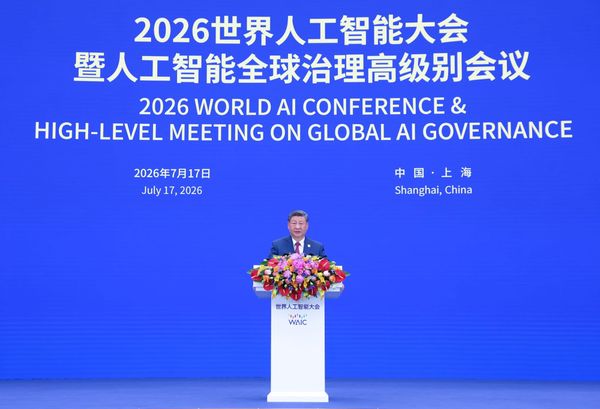
Chinese President Xi Jinping delivers the keynote address at the 2026 World Artificial Intelligence Conference on July 17, 2026. (Photo: Mao Ning/Chinese Ministry of Foreign Affairs)
China used the opening of the World Artificial Intelligence Conference in Shanghai on Friday to present itself as the champion of an alternative global AI order — one built around lower-cost models, open technology and expanded access for developing countries.
Chinese President Xi Jinping announced that Beijing would help 30 countries deploy its MAZU meteorological system, provide 5,000 AI training opportunities over the next five years and establish international AI application centers with organizations representing countries across Africa, Latin America, the Middle East and Asia.
“China, as a responsible major country, is always committed to providing international public goods relating to AI,” Xi said.
The offer addresses a real and widening divide.
AI development depends on far more than access to a chatbot. It requires electricity, data centers, semiconductors, reliable connectivity, technical expertise and enough capital to operate increasingly expensive systems. Africa, despite accounting for nearly one-fifth of the world’s population, has less than 1 percent of global data-center capacity.
For governments unable to finance their own foundation models or purchase large volumes of computing power, lower-cost Chinese systems can provide capabilities that would otherwise remain inaccessible.
Pakistan offers one example. Its meteorological department is using China’s MAZU system to improve predictions of floods, droughts and other extreme weather during the monsoon season. Similar technology could strengthen early-warning capacity in countries facing increasingly severe climate disasters but lacking the infrastructure needed to build such systems independently.
This is not merely promotional language. Affordable models, local training and functioning weather systems can produce tangible public benefits.
But they are not politically neutral.
Open models lower costs and expand ecosystems
Chinese companies including DeepSeek and Alibaba have attracted users partly by releasing models that developers can download, modify and — in some cases — operate on their own infrastructure.
That can significantly reduce both cost and dependence on proprietary US platforms. It can also give governments and companies greater control over where their data is processed. A model hosted locally does not automatically send every query to servers in China.
Chinese state media says the country’s open models have now exceeded 10 billion cumulative downloads. That figure has not been independently established, but their international adoption is clearly substantial. Chinese models are increasingly competitive with leading US systems while often charging considerably less for access.
The terminology nevertheless requires care. “Open-source” is frequently used to describe models whose weights have been released, even when their training data, development process and safety methods remain undisclosed. Open weights allow a model to be adapted and self-hosted; they do not necessarily provide complete transparency into how it was created.
Price comparisons also depend on the specific model, hosting arrangement and task. A low advertised cost per token does not account for infrastructure, energy, customization or the possibility that a cheaper model may require more work to produce the same result.
Still, the broader economic challenge to US companies is real. China’s strategy is lowering the cost of entering the AI market at the same time that many American developers are moving toward costly, proprietary frontier systems.
That difference gives Beijing a powerful message: the United States protects its most advanced technology, while China shares its capabilities with countries previously excluded from the market.
China is building institutions, not only software
One day before Xi’s speech, representatives from 29 countries signed an agreement establishing the World Artificial Intelligence Cooperation Organization. The China-backed intergovernmental body will be headquartered in Shanghai and is intended to promote cooperation and develop approaches to global AI governance.
WAICO’s 29 founding members
Algeria, Belarus, Brazil, Cambodia, Cameroon, China, Congo, Cuba, Ethiopia, Indonesia, Kazakhstan, Kenya, Kyrgyzstan, Laos, Lesotho, Malaysia, Mozambique, Myanmar, Nicaragua, Oman, Pakistan, Russia, Senegal, Serbia, South Africa, Tajikistan, Uzbekistan, Venezuela and Zambia.
*The available signatory list identifies “Congo” without specifying which of the two Congolese states.
The new organization is important precisely because international AI rules remain unsettled.
There is no single global authority determining how advanced systems should be tested, how training data should be governed, when governments may use facial recognition or autonomous decision-making, or what protections individuals should receive when AI systems cause harm.
China is offering developing countries technology, training and a place within a new institution while those rules are still being written. Participation therefore creates more than goodwill. It gives Beijing an opportunity to shape technical standards, regulatory language and diplomatic coalitions around its preferred model of governance.
That does not mean every country receiving Chinese technology will adopt Chinese policy. Nor does it make cooperation inherently coercive. Countries can use Chinese models while imposing their own privacy, procurement and security requirements.
But technology ecosystems tend to reinforce themselves. Training creates familiarity. Familiarity influences procurement. Procurement creates dependence on compatible infrastructure, updates and technical standards. The provider that arrives first and offers an affordable working system often retains influence long after the original project is completed.
China’s AI assistance should therefore be understood as both development policy and strategic statecraft.
The governance question China leaves unanswered
Xi called for a “fair and inclusive” governance system and warned against technological monopolies and an “AI iron curtain.” His criticism was aimed largely at US restrictions on advanced chips and models.
Washington’s restrictions carry their own costs. Limiting access may slow the transfer of sensitive capabilities, but it can also encourage governments and developers to adopt Chinese alternatives. If the United States offers security warnings while China offers affordable tools, training and infrastructure, many countries will choose the system they can actually use.
Yet Beijing’s inclusive message avoids a central question: inclusive for whom?
China’s domestic technology system operates under extensive state controls over information, speech and data. Chinese AI providers must comply with political and content requirements established by the Communist Party-led state. Models offered internationally can be modified, particularly when self-hosted, but the governance philosophy surrounding their development remains substantially different from systems built around independent oversight, judicial review and individual rights.
China’s latest elite political purge underscores that institutional context. This week, the Communist Party expelled Politburo member Ma Xingrui and referred his case for prosecution. Authorities accused the former aerospace technocrat and Xinjiang Party secretary of corruption, abuse of authority and exchanges involving money, power and sexual favors.
The allegations may reflect genuine misconduct. China’s corruption problem is neither invented nor insignificant. But the disciplinary process takes place within a political system in which the Party investigates, removes and refers its own senior officials without the level of independent judicial or public scrutiny expected in pluralistic systems.
Ma is the third member of the 24-person Politburo purged during Xi’s third term. His removal does not alone prove either Xi’s absolute control or an organized challenge to his leadership. It does demonstrate how accountability in China remains subordinate to internal Party procedures.
That distinction matters when Beijing proposes institutions for governing a technology capable of expanding surveillance, automating public decisions and concentrating unprecedented quantities of information.
The economic interests behind the offer
China’s AI diplomacy also supports an economy increasingly dependent on external demand.
The country exported a record $412 billion in goods in June, 27 percent more than a year earlier. Its monthly trade surplus reached approximately $125.6 billion, driven partly by global demand for semiconductors, computing equipment, batteries, automobiles and other advanced manufactured products.
Domestic conditions were less impressive. China’s economy expanded by 4.3 percent during the latest quarter, its slowest rate in more than three years, as weak consumption, property-sector problems and slowing employment continued to weigh on growth.
Offering AI systems abroad can help China cultivate future markets for its chips, cloud services, telecommunications equipment and technical standards. It can also strengthen relationships with countries that possess critical minerals, large populations or strategically important infrastructure.
The development benefit and the commercial interest can coexist. Most major powers use foreign assistance to advance national objectives. The relevant question is not whether China benefits, but whether recipient countries retain meaningful choice, control their data and avoid being locked into systems they cannot independently audit or replace.
ONEST Take
China’s pitch should neither be dismissed as propaganda nor accepted at face value.
Five days after Russia targeted an apartment building in Sloviansk, rescuers saved this cat from the rubble after hearing his meows. His family was not rescued. Photo: Ukrainian government
Zelenskyy briefed Pope Leo XIV in detail on the situation with Russian escalation and Russia’s constant strikes on Ukrainian cities and communities. Photo: President Zelenskyy Office