Why Is Canada's Wildfire Smoke Reaching the United States — And Why Has It Become Political?

– 3 min read

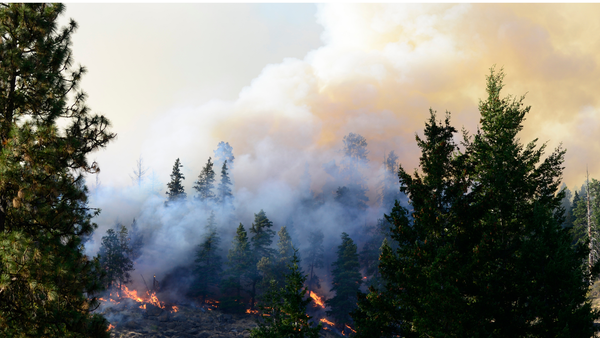
For weeks, smoke from Canada's record wildfire season has spread across large parts of North America, reducing air quality from the Midwest to the East Coast. Millions of Americans have received air quality alerts, while cities hundreds of miles from the fires have experienced hazy skies.
The smoke itself is not unusual. The politics surrounding it increasingly are.
Wildfire smoke consists of extremely small particles (PM2.5), gases and water vapor.
Once large fires generate enough heat, smoke rises thousands of feet into the atmosphere where prevailing winds can carry it hundreds — or even thousands — of miles.
The U.S.-Canada border has virtually no effect on where smoke travels.
Just as hurricanes cross coastlines and rivers flow between countries, atmospheric circulation determines where wildfire smoke goes.
Several factors are contributing:
Many fires occur in remote areas where they cannot be extinguished immediately and are instead monitored until weather conditions or firefighting resources allow intervention.
Not every wildfire is human-caused.
This is one of the most common misconceptions.
Canada contains roughly 347 million hectares (857 million acres) of forest — one of the largest forested areas on Earth.
Many fires occur hundreds of miles from roads or communities.
Sending thousands of firefighters and aircraft to every ignition would be physically impossible and, in many cases, dangerous.
Canadian authorities prioritize fires based on:
Some remote fires are allowed to burn under supervision because immediate suppression would require enormous resources with little public safety benefit.
Yes.
Forest management includes:
Experts continue debating whether additional prescribed burning should be expanded, particularly as climate conditions change.
In other words, there is legitimate discussion about forest management — but no country has found a way to eliminate large wildfires entirely.
The United States faces many of the same debates in states such as California, Oregon, Washington and Alaska.
This week, several Republican lawmakers criticized Canada's wildfire response.
Some accused Canada of mismanaging its forests.
Others threatened legislative action or penalties over smoke affecting American communities.
The criticism focuses on Canada's responsibility for preventing "cross-border pollution".
This is where the debate becomes more complicated.
Many of the same political leaders criticizing Canada have also supported expanding domestic oil and gas production while reducing or cancelling numerous federal clean-energy initiatives.
That does not mean fossil fuels alone caused Canada's fires.
Nor does it mean forest management should not be discussed.
Rather, it highlights two different conversations happening simultaneously:
One focuses on who is responsible for today's smoke.
The other focuses on what conditions are contributing to increasingly destructive wildfire seasons across North America.
Those are related — but they are not the same question.
Yes.
Major wildfires in California, Oregon, Washington and other western states have repeatedly "sent" smoke into Canada.
Both countries routinely assist one another through mutual aid agreements by sharing firefighters, aircraft and equipment during severe fire seasons.
Wildfire smoke is increasingly becoming a continental challenge rather than simply a national one.
Wildfire smoke has become another example of how complex problems are often reduced to political narratives.
There are legitimate questions about forest management. Canada continues to debate prescribed burns, fuel reduction and firefighting capacity, just as the United States does.
But treating cross-border smoke as though it were a deliberate policy failure — or something that can simply be stopped at the border — misunderstands how wildfires work.
The atmosphere does not recognize national borders. Neither do drought, heatwaves or prevailing winds.
If North America is entering an era of longer and more destructive fire seasons, the question is likely not whether Canada or the United States is to blame, but whether both countries are prepared for a future in which wildfire resilience, forest management, emergency response and long-term environmental policy become inseparable.