World Cup 2026 Comes to the UN: Sport, Diplomacy, and Canada’s National Moment
At the UNHQ, Canada, Mexico, the United States, FIFA leaders, and diplomats marked the countdown to the 2026 FIFA World Cup.

– 2 min read

At the UNHQ, Canada, Mexico, the United States, FIFA leaders, and diplomats marked the countdown to the 2026 FIFA World Cup.
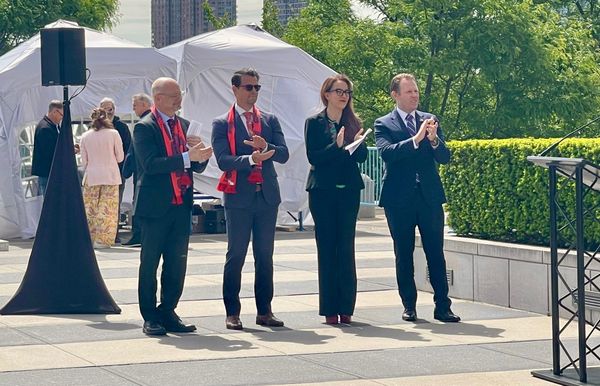
On Friday morning, the spirit of the FIFA World Cup 2026 arrived at the United Nations.
At the Plaza of UN Headquarters in New York, beside the Canada doors, diplomats, UN officials, FIFA leadership, and members of the global football community gathered to mark the countdown to a tournament that will be jointly hosted by Canada, Mexico, and the United States.
The event brought together sport and diplomacy in a setting usually defined by negotiations, crises, and formal statements. But that was precisely the point. The World Cup is not only a sporting event. At this scale, it becomes a diplomatic undertaking, a public infrastructure project, a security operation, a tourism opportunity, and a moment of national and international storytelling.
Canada’s Permanent Representative to the UN, David Lametti, opened the event, followed by remarks from co-host representatives including Adam van Koeverden, Gabriela Cuevas, and Andrew Giuliani. FIFA Vice President Victor Montagliani also addressed the gathering, alongside representatives of the 2030 World Cup co-hosts — Portugal, Spain, and Morocco.
The gathering highlighted the World Cup as a shared international project rooted in cooperation, exchange, and collective anticipation. It also connected the tournament to the broader role of sport in fostering dialogue, inclusion, human rights, and cultural connection.
For Canada, the tournament is being framed as more than a Toronto-and-Vancouver event.
The federal government has announced support for 335 communities across Canada to celebrate soccer through a $1.5 million one-year Celebrate Canada initiative. Additional funding includes $800,000 for the Canada Celebrates the FIFA World Cup 2026 initiative, which will bring tournament-related activities to communities across the country; $300,000 for Canada Soccer youth engagement; $2.165 million to help build 25 community soccer pitches; and up to $9.826 million for planning, design, and pre-construction of the Canada Soccer National Training Centre.
The Spring Economic Update also proposes $755 million over five years for Canada’s sport system, including support for hosting world-class events, athletes, mental health, safe sport, and youth participation. Up to $145 million in federal funding is also proposed for enhanced security operations related to World Cup hosting in Toronto and Vancouver.
That broader investment matters.
Major sporting events are often discussed in terms of spectacle, tourism, and national pride. But they also reveal how countries organize themselves: how they build infrastructure, manage security, support communities, create access to sport, and decide whether a global event leaves a meaningful legacy after the final match.
Canada is seeing the 2026 World Cup as a national moment — one that reaches beyond the host cities and creates opportunities for communities across the country to participate.
At the United Nations, that message took on an additional layer. The World Cup is one of the few global events capable of reaching audiences far beyond politics. It brings together countries that may disagree in diplomatic rooms but still meet on the field, in stadiums, and through shared public attention.
In a world marked by conflict, division, and institutional strain, that kind of common space is not insignificant.
For one morning at UN Headquarters, football became more than a game. It became a reminder that global cooperation is not only built through treaties and summits. Sometimes, it is also built through the moments people are willing to share.