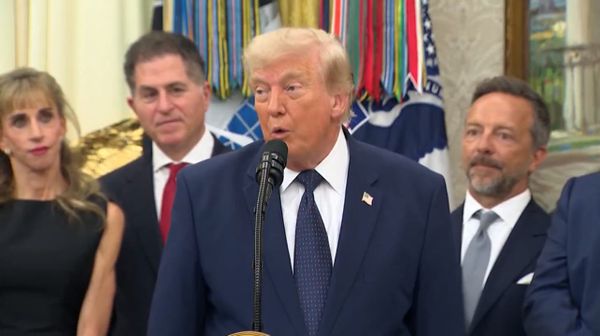
President Donald Trump signed two financial executive orders on Tuesday, presenting them as a crackdown on fraud and a modernization of financial regulation.
But the timing exposed the deeper story.
On the same day the White House directed banks and regulators to intensify scrutiny of immigrants, ITIN users, employers, remittances, payroll activity, and possible tax evasion, the U.S. government agreed to drop or block tax claims and examinations involving Trump, his family, and his businesses tied to past or existing matters.
That is not just a contradiction.
It is the point.
The administration is not simply talking about “financial integrity.” It is deciding where suspicion should fall — and where scrutiny should stop.
One executive order, titled “Restoring Integrity to America’s Financial System,” frames unauthorized immigration as a threat to the U.S. financial system. It directs the Treasury Department to issue an advisory within 60 days warning financial institutions about risks tied to unauthorized workers, employers, payroll tax evasion, off-the-books wage payments, nominee accounts, money services businesses, peer-to-peer platforms, labor trafficking, cash activity, and the use of Individual Taxpayer Identification Numbers, or ITINs.
The order also directs Treasury and federal financial regulators to consider changes to Bank Secrecy Act regulations and customer identification requirements. It says financial institutions may need additional information in some cases to assess whether account holders have lawful immigration status or employment authorization when that information is relevant to concerns such as fraud, identity misrepresentation, sanctions evasion, or other illicit financial activity.
A second order, “Integrating Financial Technology Innovation into Regulatory Frameworks,” moves in the opposite direction. It instructs federal financial regulators to review existing rules, guidance, supervisory practices, and application processes that may be slowing fintech firms from partnering with banks, credit unions, broker-dealers, investment advisers, and other federally regulated institutions. It also asks the Federal Reserve to evaluate whether certain non-bank financial firms, including digital-asset companies, could gain direct access to Federal Reserve payment accounts and payment services.
On paper, both orders sound consequential.
In practice, much of the language is procedural. Agencies are told to review, consider, propose, evaluate, or issue guidance. The orders do not instantly rewrite banking law. They do not immediately change Bank Secrecy Act regulations. They do not force the Federal Reserve to open payment access to fintech firms. They create pressure, direction, and political messaging — not automatic legal transformation.
That is where the smoke and mirrors begin.
The White House gets the headline: Trump cracks down on financial abuse and opens the door to innovation. But the actual mechanism is slower, narrower, and legally constrained.
Still, the symbolism matters because regulatory pressure often begins before formal rules are finalized. Banks, credit unions, lenders, payment companies, and fintech partners may respond to the administration’s language by tightening internal reviews, especially around immigrants, ITIN users, cash-heavy workers, and cross-border transactions.
That could affect people who are not accused of any crime but rely on basic financial services to work, pay rent, send money to relatives, or build credit.
This is where the first order becomes especially revealing.
It does not simply target illicit finance. It links unauthorized immigration to national security, public safety, credit risk, tax evasion, labor trafficking, and structural threats to the banking system. Some of these are legitimate policy concerns. Financial systems can be abused. Employers can exploit unauthorized workers. Labor trafficking and payroll fraud are real issues.
But the order blends those concerns into a broad risk narrative that could turn immigration status itself into a financial red flag.
The use of ITINs is a particularly sharp example. ITINs exist in part so people who do not have Social Security numbers can comply with U.S. tax rules. Yet the order says use of an ITIN to obtain credit products or open accounts, when the applicant lacks verified lawful immigration status, may be treated as a risk factor requiring enhanced due diligence.
That creates a policy contradiction: the government encourages tax compliance through ITINs, then signals that ITIN use may invite extra financial scrutiny.
The deeper message is clear. Some people are to be monitored more closely not because of proven wrongdoing, but because of who they are presumed to be.
At the same time, the fintech order speaks a very different language. It emphasizes innovation, competition, streamlined access, reduced barriers, and collaboration between fintech firms and regulated institutions. It asks regulators to identify rules that “unduly impede” fintech partnerships and to examine whether firms engaged in digital assets and other novel financial activities can access Federal Reserve payment systems.
So the administration is tightening the concept of risk around immigrants and workers while softening the concept of risk around fintech, digital assets, and non-bank financial firms.
That contrast is not accidental. It reflects a political worldview.
For immigrants and low-income financial activity, the language is suspicion: fraud, trafficking, tax evasion, unlawful employment, national security, public safety.
For fintech and digital assets, the language is opportunity: innovation, competition, access, modernization, growth.
And on the same day, the government’s posture toward past and existing tax scrutiny became more protective.
According to AP, the U.S. government agreed to permanently drop tax claims against Trump as part of a settlement resolving his $10 billion lawsuit against the IRS over the leak of his tax returns. AP reported that the deal also involves a nearly $1.8 billion fund to compensate individuals who say they were politically targeted. Reuters reported that the newly released DOJ document bars the IRS from auditing past tax filings by Trump, his family, or his companies.
That juxtaposition is difficult to ignore.
The administration is telling banks to look harder at immigrants, workers, remittances, payroll activity, ITIN-linked accounts, and possible tax evasion — while the federal government is also agreeing to drop tax claims involving the president, his family, and his businesses.
That is not simply a policy tension. It is an accountability question.
A government that claims to be restoring financial integrity cannot credibly define integrity only downward — toward workers, immigrants, and small-dollar transactions — while narrowing scrutiny upward, toward the president’s own financial history.
There may be legitimate reasons to strengthen anti-money-laundering enforcement. There may be legitimate concerns about employer abuse, labor trafficking, tax evasion, and financial fraud. There may also be valid questions about how fintech and digital-asset firms should interact with the banking system and Federal Reserve payment infrastructure.
But Tuesday’s orders are not neutral technocratic documents.
They are political instruments.
They tell agencies where to look. They tell financial institutions whom to treat as risky. They tell fintech firms that the administration wants regulatory doors opened. And they tell the public that “integrity” is being restored — even as one of the most politically sensitive financial accountability questions in the country is being narrowed through a settlement involving the president himself.
That is the core issue.
The executive orders are less about cleaning up the financial system than about reorganizing scrutiny within it.
For some, the system becomes more suspicious.
For others, it becomes more accommodating.
And for the president, on the very same day, the government’s posture becomes more protective.
The question is not whether fraud should be investigated. Of course it should.
The question is why this administration’s definition of financial risk appears to flow in one direction.
Downward, toward immigrants, workers, and people using basic financial tools to survive.
Outward, toward fintech firms and digital assets seeking easier access to regulated systems.
And away from the president, whose own tax claims were dropped on the same day he signed an order claiming to restore integrity to the financial system.
That is the real story.
Not financial integrity.
Selective scrutiny.