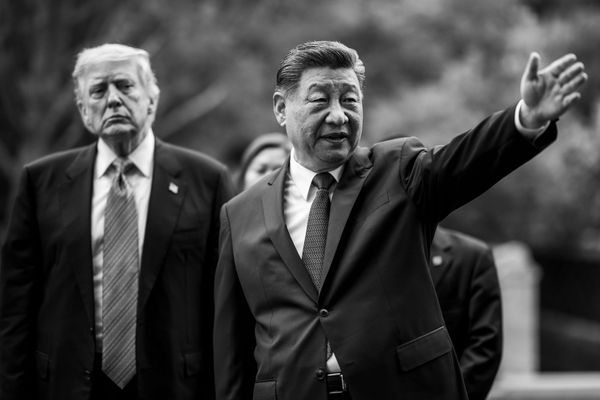
On the second day of President Donald Trump’s visit to China, the tone shifted from grand public ceremony to something more personal — and more symbolic.
Xi Jinping invited Trump to Zhongnanhai, the highly restricted leadership compound that serves as both the political center of the Chinese Communist Party and the residence of China’s top leadership. The former imperial garden is rarely used for this level of diplomatic hospitality. Xi described the invitation as a gesture reciprocating Trump’s earlier hosting of him at Mar-a-Lago.
The symbolism continued through carefully curated details. Xi presented Trump with Chinese rose seeds for the White House Rose Garden — an ironic gift considering Trump had paved over the Rose Garden during the first year of his second presidential term.
The lunch itself blended Chinese and Western elements: minced codfish in seafood soup, crispy lobster balls, beef fillet stuffed with morel mushrooms, kung pao chicken and scallops, dumplings, stewed beef buns, brownie, fruit, and ice cream.
The atmosphere was warm. Trump and Xi reportedly spoke for nearly three hours. Trump called the visit “a great couple of days,” while Xi described it as a “milestone” and declared that the two sides had established “a constructive, strategic, stable relationship.”
That phrase continues to stand out.
Beijing appears increasingly focused on defining a long-term framework for U.S.-China relations — one centered not on partnership, but on managed competition with limits. China’s messaging suggests it wants to lock Washington into a broader understanding of “strategic stability,” where escalation over trade, Taiwan, technology, or military pressure would be viewed as destabilizing behavior.
But while the optics were polished, the actual economic substance remains remarkably thin.
Trump publicly touted “fantastic trade deals,” including a reported Chinese commitment to purchase 200 Boeing aircraft alongside “massive agricultural agreements.” Chinese officials have not confirmed Trump’s claimed Boeing purchase, announced broader agricultural or energy deals, or finalized the proposed “Board of Trade” or “Board of Investment.” Beijing’s most concrete move so far appears to be the resumption of export permits for American beef producers.
That gap between rhetoric and deliverables is becoming increasingly noticeable.
Wendy Cutler, Senior Vice President at the Asia Society Policy Institute and former Acting Deputy U.S. Trade Representative, described the summit as potentially “heavy on atmospherics but light on substance.”
Despite the presence of major American CEOs and days of highly choreographed diplomacy, there were still no confirmed mega-deals in agriculture or energy, no finalized “Board of Trade” or “Board of Investment,” and no extension of the current trade truce, which expires in five months.
In other words: the headlines remain bigger than the agreements themselves.
And that may reveal the real dynamic behind this summit.
For Trump, the trip offers visuals of global leadership, market optimism, and personal diplomacy with Xi Jinping. For Beijing, the summit itself already serves a strategic purpose: projecting China as stable, open, diplomatic, and central to global economic order — especially at a time when much of the world remains unsettled by tariffs, regional conflict, and geopolitical fragmentation.
China’s messaging throughout the visit has repeatedly emphasized openness, continuity, and coexistence. State media framed the visit as proof that “when guests come, the door is open.” Xi himself even linked “the great rejuvenation of the Chinese nation” with Trump’s “Make America Great Again” movement, suggesting the two visions can “go hand in hand.”
But underneath the hospitality, the harder issues remain unresolved.
Taiwan continues to sit quietly at the center of the relationship. Beijing has repeatedly warned that mishandling the issue could lead to confrontation, while Trump has noticeably avoided direct public answers on Taiwan throughout the trip.
That tension became even clearer when Trump said he had not yet made a determination on whether a major U.S. arms sale to Taiwan would move forward. China opposes the deal and has made clear that Washington’s relationship with Taiwan is the key factor in U.S.-China relations. For Beijing, this is not a side issue. It is the test of whether Trump’s new “strategic stability” with Xi comes with limits on U.S. support for Taiwan.
Rare earths, export controls, AI competition, military deterrence, and semiconductor restrictions — all central to long-term U.S.-China rivalry — remain largely untouched publicly.
That absence may itself be the clearest signal from Day 2.
The summit is producing imagery, slogans, and atmospherics far faster than it is producing enforceable agreements or structural breakthroughs.
And for now, Beijing appears comfortable with exactly that.