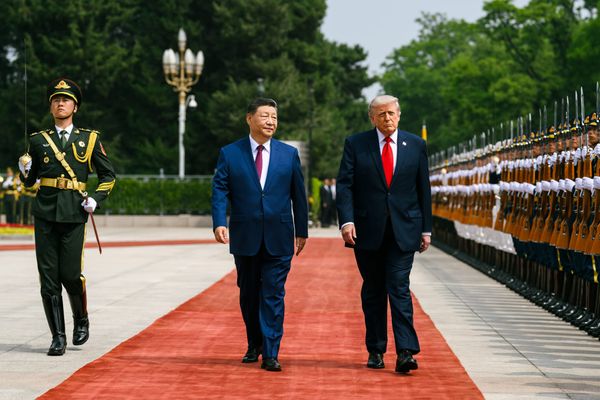
President Donald Trump’s first day in Beijing was framed publicly as a reset: warm language, state ceremony, business optimism, and repeated references to trade, investment, and global stability.
But beneath the choreography, China placed one issue at the center of the visit: Taiwan.
Xi Jinping opened the meeting by saying U.S.-China relations had reached a “crossroads” and that the two countries “should be partners, not adversaries.” Beijing’s official readout then introduced a new formulation: a “constructive China-U.S. relationship of strategic stability” meant to guide relations “over the next three years and beyond.”
That language matters. It suggests China is not only looking for a temporary truce with Trump, but a new baseline — one that could make future U.S. pressure on China appear like a violation of the “stability” both sides just endorsed.
Trump, meanwhile, focused on trade and investment. He praised Xi as a “great leader,” spoke warmly about their personal relationship, and told Xi that when problems came up in the past, “I would call you, and you would call me.” He also praised the children who greeted him at the airport, calling them “happy,” “beautiful,” and “amazing.”
The visuals were carefully managed: the Great Hall of the People, the Temple of Heaven, a formal banquet, CEOs in attendance, and a menu that blended Chinese and international dishes — lobster in tomato soup, slow-cooked salmon in mustard sauce, pan-fried pork bun, tiramisu, fruit, and ice cream.
But the substance was much sharper.
Xi warned Trump that Taiwan is the most important issue in U.S.-China relations. According to China’s readout, Xi said that if Taiwan is handled properly, the relationship can remain stable — but if handled poorly, the two countries could face “clashes and even conflicts,” placing the entire relationship in jeopardy.
The U.S. side did not emphasize Taiwan in the same way. Trump also ignored press questions on Taiwan while posing with Xi.
That silence is significant because China is reportedly seeking a delay or reduction in U.S. arms sales to Taiwan. The context matters: Trump had already delayed announcing a major ($13B) Taiwan arms package ahead of the trip, and Xi had previously warned him to handle Taiwan arms sales with “extreme caution.”
Taiwan pushed back. Michelle Lee, spokesperson for Taiwan’s Executive Yuan, said China’s military threats are the sole cause of instability in the Taiwan Strait and the region. Taiwan also said it remained in close contact with Washington during summit preparations and was grateful for longstanding U.S. support.
This is the central tension of Day 1: Trump wants trade deals, Chinese purchases, help on Iran, and movement on the Strait of Hormuz. China appears to be setting Taiwan as the entry point to that broader cooperation.
That does not mean Beijing sees Taiwan as a bargaining chip in the same way Washington may see tariffs, oil, aircraft, or agricultural purchases. China’s position is rooted in its “One China” framework. But Beijing can still use the moment to test how much Trump is willing to delay, soften, or avoid in exchange for visible wins.
Those visible wins are already being shaped.
U.S. officials and business leaders pointed to "expected" Chinese purchases of Boeing aircraft, energy, beef, and agricultural products. Yet as of now, the most concrete movement appears limited. Beijing has approved export licenses for several hundred American slaughterhouses to ship beef to China, according to customs data. CEOs emerged upbeat after the meeting, with Elon Musk calling it “wonderful,” Tim Cook flashing a peace sign, and Nvidia’s Jensen Huang praising both leaders.
But there is an irony here: Trump imposed tariffs, then brought CEOs whose companies have been affected by those tensions to China to advocate for more open trade. That gives Beijing an easy argument: tariffs hurt business, supply chains, consumers, and global stability.
On Iran, the substance was thinner than the optics. Beijing agreed not to supply weapons to Iran — something it has not officially acknowledged doing anyway — while continuing to purchase Iranian oil. That makes the pledge an easy public “yes,” not necessarily a major shift in China’s position.
China’s own public language was more restrained. Its foreign ministry said the Middle East was discussed, but did not frame the issue in the same detailed terms as the White House.
That gap matters. Beijing does not officially supply weapons to Iran, so agreeing not to do so costs China little. At the same time, China continues to buy Iranian oil and has criticized U.S. actions in the region. Rubio argued that reopening Hormuz is in China’s interest because Chinese ships are stuck there — but China may also see the crisis as leverage.
In other words, Trump’s Iran problem has become part of the U.S.-China negotiation.
The optics were equally revealing. Trump received a grand welcome, praised Xi repeatedly, and invited him to visit the United States on September 24 — a date that could align with the UN General Assembly period. At the banquet, Xi said “the great rejuvenation of the Chinese nation” and “making America great again” can go hand in hand.
That line was not accidental. It placed Xi’s national project and Trump’s political slogan side by side — not as opposites, but as compatible visions.
Day 1, then, was not simply a diplomatic opening. It was a test of what Trump is willing to trade for deals, what China can normalize through ceremony, and whether Taiwan becomes the quiet price of a public reset.
The biggest takeaway: China may already have secured one important win — placing Taiwan at the center of the relationship while letting Trump present the day as a success on trade, investment, and global stability.