ONEST Global Briefing — May 20, 2026
NATO burden-sharing, Canada’s sovereignty push, Ukraine’s long-range pressure, and the UN’s climate law moment.

– 13 min read

NATO burden-sharing, Canada’s sovereignty push, Ukraine’s long-range pressure, and the UN’s climate law moment.
“There’s lots of cooperation with the U.S.; we will continue to do so. But we will also be cooperating with other partners and diversifying our defence cooperation as we should… and in critical areas such as Ukraine. Ukraine is going to triumph and we’re going to be on the right side of history with that.”
— Canadian Prime Minister Mark Carney
“We lost 13 people. In other wars, you lost hundreds of thousands of people. I get a kick when I look at somebody on television and they say, ‘he’s lost 13 people.’”
— President Donald Trump
“I’m right now at 99% in Israel. I could run for prime minister, so maybe after I do this, I’ll go to Israel and run for prime minister.”
— President Donald Trump
Today’s developments show the same pattern across regions: governments are no longer only responding to crises. They are repositioning for a world where alliances are shifting, war is reshaping budgets and supply chains, and international law is being tested in real time.
U.S. Secretary of State Marco Rubio will travel to Helsingborg, Sweden, on May 22 for a NATO foreign ministers’ meeting focused on “greater burden sharing” inside the alliance. He is also expected to meet counterparts from the Arctic Seven before traveling to India from May 23–26 for talks on energy security, trade, and defense cooperation.
According to Reuters-sourced reporting, the United States is expected to tell NATO allies that it will have only limited ability to engage in the defense of NATO members in the event of an attack. That message, if delivered as described, would mark one of the clearest signals yet that Washington expects European allies to assume more direct responsibility for conventional defense.
Separately, Europe should “absolutely” expect additional U.S. troop withdrawals in the future "as European NATO allies strengthen their own defense capabilities", according to the U.S. general who serves as NATO’s top military commander in the region.
The message comes as NATO faces real operational complications. A NATO fighter jet shot down a Ukrainian drone over southern Estonia on May 19 — the latest in a string of incidents in which Ukrainian drones aimed at Russia have crossed into or come down in NATO territory. Western officials are blaming likely Russian electronic jamming for such incidents.
For ONEST readers, the issue is not only whether the United States is “leaving” NATO. It is whether NATO can adapt quickly enough to a security environment where Russia’s war, drone warfare, Arctic competition, and U.S. political uncertainty are all pressuring the alliance at once.
Public Deep Dive: NATO AT A CROSSROADS: What Happens If the Alliance Doesn’t Break — But Stops Working?
The U.S. Senate voted 50–47 to advance a resolution limiting military action against Iran unless approved by Congress. Four Republicans — Bill Cassidy, Susan Collins, Lisa Murkowski, and Rand Paul — voted yes, while Democrat John Fetterman voted no.
The vote does not end the debate, but it signals growing concern in Congress over the scope of executive war powers as the Iran conflict continues to affect energy markets, Gulf security, nuclear safety, and U.S. military posture.
This comes as several U.S. defense and national security developments point to a broader military shift. U.S. Northern Command is standing up a new partnership called Nordic Bridge to improve cooperation between U.S. commands on Arctic security. The Pentagon’s counter-drone task force announced a $500 million contract with Perennial Autonomy, a company known for developing an interceptor used against Russian one-way attack drones in Ukraine. And U.S. Special Operations Command leadership says expertise in emerging technologies is now as important as physical fitness and traditional combat skills.
The direction is clear: the United States is preparing for a security environment defined by drones, missiles, cyber risks, Arctic competition, and simultaneous regional crises.
Prime Minister Mark Carney’s comments captured the core of Canada’s current foreign and defense posture: continued cooperation with the United States, but also deliberate diversification of defense partnerships, especially with Ukraine and other trusted allies.
That shift is visible across several Canadian announcements.
Canada announced a final federal payment of $78.4 million to Alberta through the Disaster Financial Assistance Arrangements program for the 2016 Fort McMurray wildfires. In total, Ottawa has provided $385.4 million to Alberta for that disaster, which forced more than 80,000 people to evacuate and became the most expensive natural disaster in Canadian history.
The government also announced more than $55 million for Arctic infrastructure and critical minerals projects. Up to $50 million will support planning and preconstruction work for the Grays Bay Road and Port project, a proposed deepwater Arctic port and 230-kilometer all-season road that could unlock zinc and copper development. Another $5 million will support Glacies Technologies in piloting a low-emissions alternative to diesel for mine heating and ventilation in Nunavut.
Ottawa is also moving quickly on critical minerals. Prime Minister Carney announced construction is beginning on Nouveau Monde Graphite’s Matawinie Mine in Quebec, six months after the project was referred to the Major Projects Office. Once completed, it is expected to become the largest graphite mine in North America and the G7, producing up to 106,000 tonnes annually, creating more than 1,000 jobs, and attracting nearly $2 billion in investment.
Canada’s strategy is becoming clearer: build infrastructure, secure critical minerals, reinforce Arctic sovereignty, support domestic industrial capacity, and reduce reliance on fragile or concentrated foreign supply chains.
Canada and Spain signed a memorandum of understanding on artificial intelligence during King Felipe VI’s visit to Toronto’s MaRS Discovery District. The agreement, signed by Canada’s AI Minister Evan Solomon and Spanish Deputy Prime Minister Carlos Cuerpo, establishes a framework for cooperation on compute capacity, AI adoption, responsible technology development, and government-industry collaboration.
Cuerpo described AI as one of the forces that will shape competitiveness and economic sovereignty in the coming decades, saying democracies have a responsibility to build technological cooperation rooted in trust, security, and shared benefit.
This matters because AI policy is increasingly becoming a foreign policy issue. Compute capacity, data, research talent, and trusted partnerships are now part of how countries define sovereignty and economic resilience.
Russian President Vladimir Putin’s visit to China produced broad statements of partnership, expanded military cooperation, and dozens of signed documents — but apparently no formal agreement on the long-discussed Power of Siberia 2 gas pipeline.
That matters. The proposed pipeline would carry up to 50 billion cubic meters of gas per year from Russia to China via Mongolia and has been a major priority for Moscow as Europe reduces reliance on Russian energy. The Kremlin said the two sides reached a “general understanding” on parameters, but there was no formal deal. Xi Jinping referred to energy cooperation as the “ballast stone” of the relationship, but did not announce agreement on the pipeline.
At the same time, China and Russia agreed to expand military cooperation, including joint exercises. Reuters has reported that around 200 Russian soldiers trained in China last year on drone operations. The two sides also reportedly signed a 10,000-word joint statement covering nuclear security, Taiwan, and other issues, though the full text has not yet been published.
The outcome shows both the strength and the limits of the China-Russia partnership. Politically, the relationship is deepening. Militarily, cooperation is expanding. But economically, China appears unwilling to give Moscow everything it wants on Moscow’s timeline.
Ukraine says its long-range strikes against Russian oil infrastructure are working. President Volodymyr Zelenskyy said Ukrainian forces struck an oil refining target in Kstovo nearly 800 kilometers from Ukraine’s border and that May’s long-range action plan is being carried out largely as planned. He said the key targets are Russian oil refineries, storage facilities, and infrastructure tied to oil revenues.
Zelenskyy also warned that Russia is considering scenarios for additional attacks from the Belarus–Bryansk direction, threatening Ukraine’s northern regions and the Chernihiv–Kyiv axis. He said Ukraine is strengthening defenses and taking preventive diplomatic steps regarding Belarus.
At the same time, Ukraine is pressing partners not to ease economic pressure on Moscow. Zelenskyy said sanctions and Ukraine’s own long-range strikes are among the most effective tools for forcing Russia toward ending the war. His comments come as the United Kingdom issued a general trade license waiving some sanctions on processed oil products, allowing imports of diesel and jet fuel processed in third countries from Russian crude. Ukraine has conveyed its concerns to London and expects bilateral discussions this week.
This is one of the central contradictions of the current war economy: Ukraine is trying to damage Russia’s oil revenue infrastructure while partners still make carveouts to manage energy markets and supply chains.
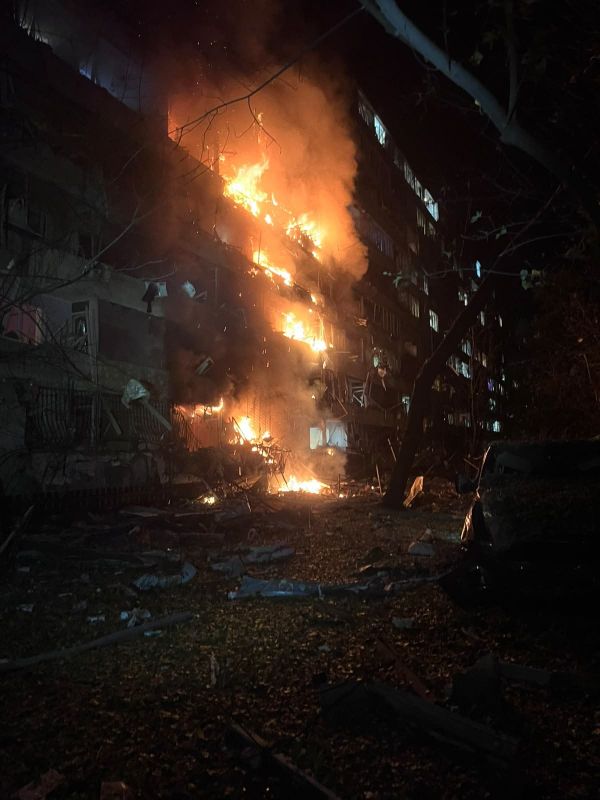
The UN refugee agency condemned a deadly Russian missile and drone attack in Dnipro that killed at least two civilians and damaged a UNHCR-contracted warehouse. According to UNHCR’s representative in Ukraine, Bernadette Castel-Hollingsworth, the warehouse was struck by a ballistic missile and caught fire.
Preliminary estimates indicate that about 900 pallets of aid items — including blankets and hygiene kits valued at more than $1 million — were destroyed. The supplies were intended for evacuees, people in collective and transit sites, and residents whose homes had been damaged.
This is not only a humanitarian loss. It is part of a broader pattern in which aid infrastructure, civilian logistics, and humanitarian workers themselves are increasingly endangered in war zones.
The UN General Assembly adopted a resolution welcoming the International Court of Justice’s advisory opinion on states’ obligations in relation to climate change. The vote was 141 in favor, 8 against, and 28 abstentions. Countries voting against included the United States, Russia, Belarus, Israel, Iran, Saudi Arabia, Liberia, and Yemen.
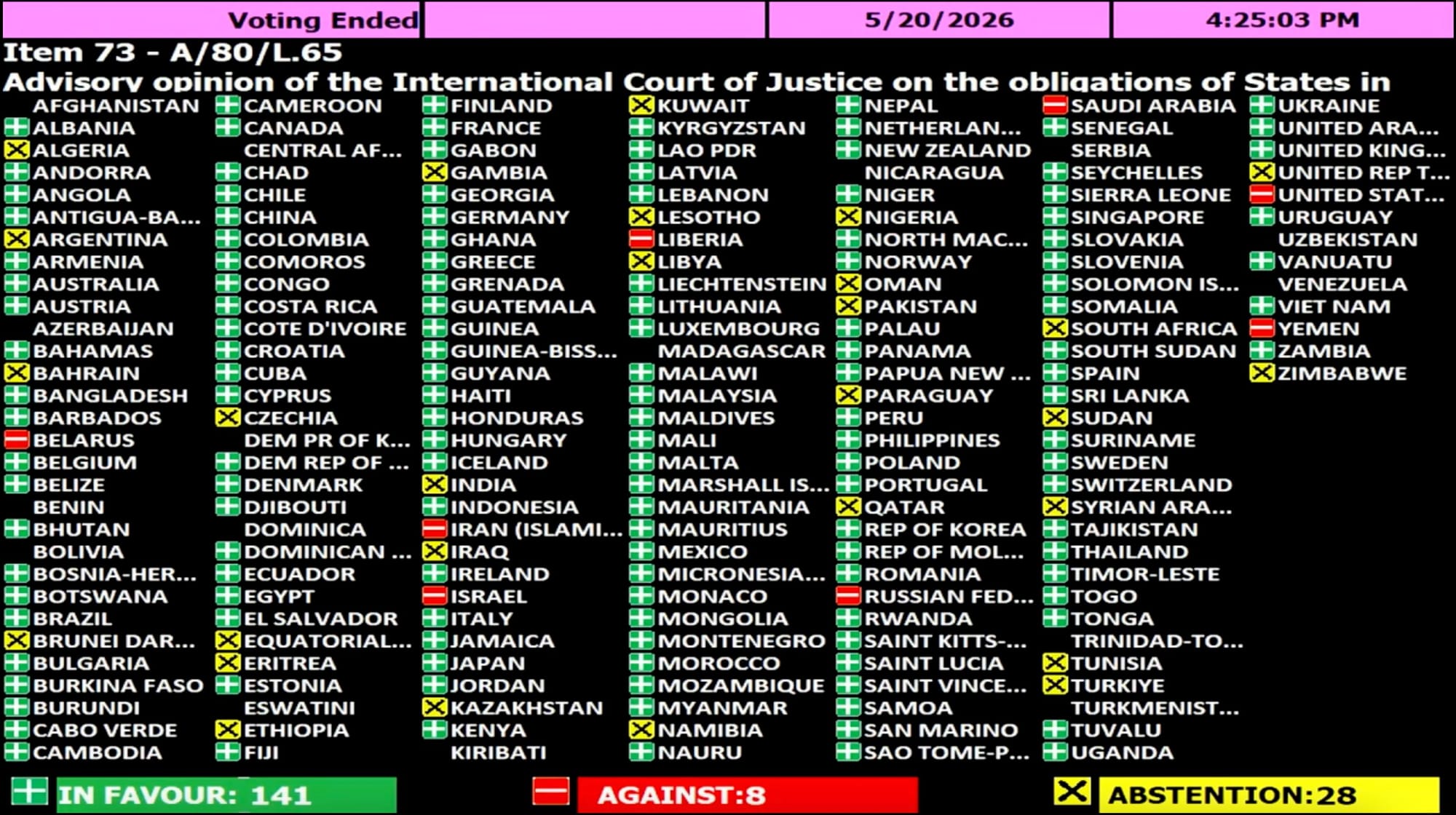
The ICJ ruled in July 2025 that states have obligations to protect the environment from greenhouse gas emissions. While advisory opinions are not binding, they carry legal and moral authority and help clarify international law. The General Assembly resolution reinforces the idea that tackling climate change is not only a political choice, but a legal duty under international law.
Secretary-General António Guterres called the ICJ opinion “a victory for our planet” and said the General Assembly had now answered the world court’s call. He also emphasized that those least responsible for climate change are paying the highest price, and that climate justice requires a rapid and equitable transition away from fossil fuels toward renewable energy.
For ONEST, this is one of the most important institutional developments of the week: international law is increasingly being asked to define not only what states owe each other, but what they owe future generations.
The UN Security Council is holding its annual open debate on the protection of civilians in armed conflict amid growing concern over civilian casualties, attacks on humanitarian workers, and widespread destruction of homes and critical infrastructure. The UN’s top humanitarian official for crisis response told ambassadors that one civilian was killed every 14 minutes last year.
The debate comes as multiple conflicts — Ukraine, Gaza, Sudan, Haiti, Syria, and others — show how civilian protection is being eroded not only by direct attacks, but by the destruction of aid routes, hospitals, warehouses, energy systems, water networks, and shelter.
As the NPT Review Conference enters its final stretch, ONEST spoke with Alyn Ware, a peace educator, disarmament advocate, and longtime global leader in nuclear nonproliferation and disarmament. Ware is a recipient of the Right Livelihood Award, often described as the “Alternative Nobel Peace Prize,” and has spent decades working through international law, the United Nations, parliamentarians, and civil society networks to advance nuclear disarmament and common security.
At this year’s NPT Review Conference, Ware has been advancing one of the central questions facing the nuclear order: whether nuclear-armed and nuclear-allied states can move away from reliance on nuclear deterrence and toward a model of common security built on cooperation, law, and mutual survival.
In this ONEST Voices profile, Ware reflects on New Zealand’s anti-nuclear movement, the International Court of Justice, Ukraine and the Budapest Memorandum, nuclear energy, AI risks, future generations, and why patient institutional work still matters in an unstable world.
Read ONEST Voices:
Security Cannot Be Built on the Threat of Catastrophe
https://www.onestnetwork.com/security-cannot-be-built-on-the-threat-of-catastrophe/
Former Cuban President Raúl Castro, 94, has been indicted by the U.S. Department of Justice over his alleged role as Cuba’s defense minister in ordering the 1996 shootdown of two civilian aircraft belonging to the Cuban-American group Brothers to the Rescue. Secretary of State Marco Rubio addressed Cubans in Spanish, blaming Cuba’s current government for the country’s economic crisis. Cuba’s deputy foreign minister accused Rubio of lying and justifying aggression against the Cuban people.
James Murdoch is buying Vox Media’s podcast network, New York magazine, and Vox.com for more than $300 million.
President Trump sold between $5 million and $25 million each of Microsoft and Amazon stock in February and purchased millions of dollars’ worth of the companies’ stock in March, according to disclosures filed with the U.S. Office of Government Ethics.
Strikes carried out by the U.S. military in coordination with Nigeria killed scores of Islamic State fighters over the last several days, according to officials from both countries, as the Trump administration expands its counterterrorism campaign in Africa.
The Defense Department’s inspector general is investigating U.S. Southern Command over its targeting of alleged drug-smuggling boats in the military campaign against drug cartels.
The U.S. Air Force drastically reduced eligible career fields for active-duty reenlistment bonuses in 2026, dropping from 89 to 24.
Ukrainian authorities say elevated radiation was detected on wreckage from a Russian strike drone attack in the Chernihiv region. Fragments of an R-60 missile near Kamka reportedly showed 12 μSv/h, with depleted uranium components identified in the warhead.
The deadly Ebola outbreak in the Democratic Republic of the Congo and Uganda does not currently represent a global pandemic emergency, although the risk remains high at regional and national levels.
The World Health Assembly honored six laureates for contributions to public health, including work on community-based primary care, rural and stateless populations, healthy aging, disease control, digital innovation, and health equity.
Around 30,000 people have fled their homes in Port-au-Prince and surrounding areas following a new wave of gang attacks and atrocities over the past ten days.
UN Secretary-General António Guterres strongly condemned Israel’s decision to establish military facilities at a seized UNRWA compound in occupied East Jerusalem, calling the move “wholly unacceptable.”
The United Arab Emirates said drones that targeted the Barakah nuclear power plant came from Iraq, suggesting Iranian-backed Shiite militias were likely behind the attack.
Two Chinese supertankers carrying 4 million barrels of Middle East crude exited the Strait of Hormuz after waiting in the Gulf for more than two months, according to shipping data.
Israeli forces opened fire on at least two vessels in an aid flotilla sailing toward Gaza, according to video footage and organizers. Israel said no live ammunition was used and reported no casualties.
The Board of Peace warned in its first report to the UN Security Council that Hamas’s refusal to disarm remains the main obstacle to reconstruction and a broader political settlement in Gaza.
Israeli Finance Minister Bezalel Smotrich said he was told the International Criminal Court prosecutor had sought a confidential arrest warrant against him, and said he would retaliate by waging a “war” on the Palestinian Authority.
Somaliland, a breakaway region of Somalia, will set up an embassy in Jerusalem soon, according to its ambassador, after Israel became the first country to formally recognize the self-declared republic.
The United States announced sanctions on four people associated with an aid flotilla trying to reach Gaza, with Treasury describing the operation as a “pro-Hamas flotilla.”
A bomb exploded outside a Defense Ministry building in Damascus, killing one soldier and wounding about a dozen others, according to Syrian officials and state media.
In a week dominated by war, climate law, nuclear risk, and geopolitical repositioning, the World Health Assembly also honored public health workers and institutions whose contributions often happen far from global headlines.
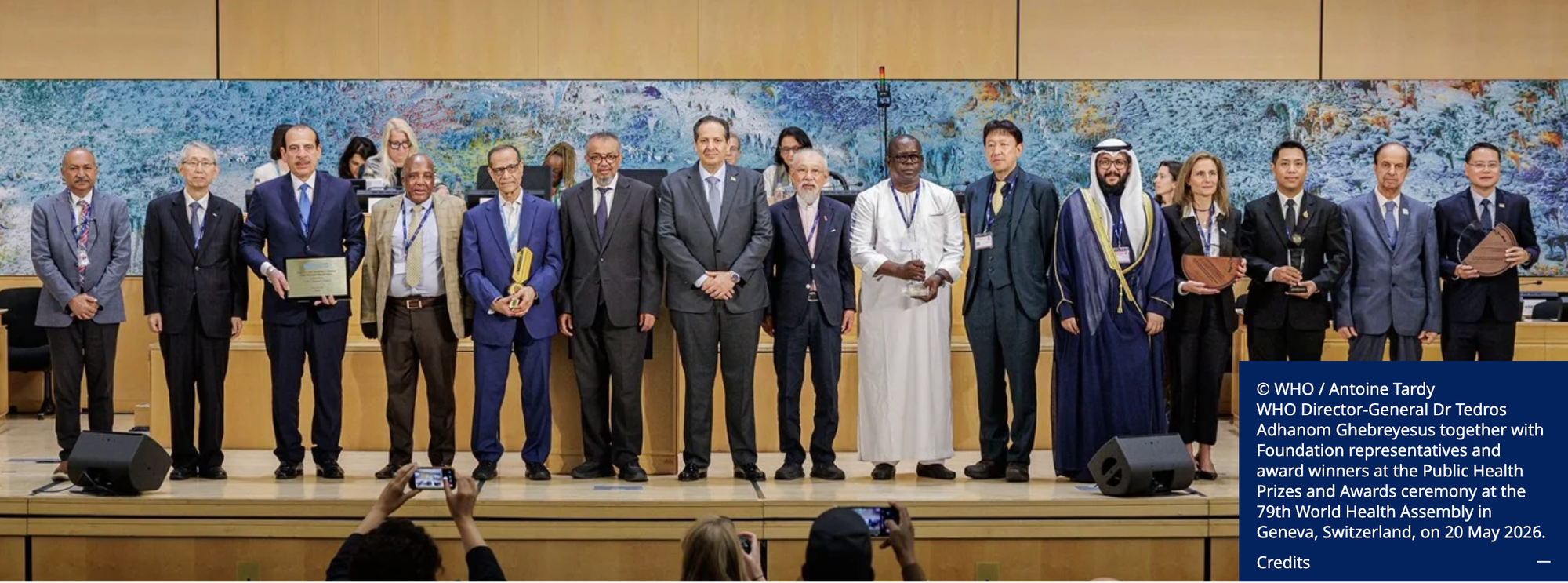
From community-based care in Mali to rural health outreach in Thailand, healthy ageing work in Singapore and France, public health service in Bangladesh, and prevention-focused health innovation in Egypt, the awardees are a reminder that global stability is not only built through treaties and summits.
It is also built through people who make care possible.
Today, ONEST announced the next phase of the platform: a more focused, reader-first structure designed to make our reporting clearer, easier to access, and more useful.
This includes the launch of the ONEST+ Library, where members can find Deep Dives, Diplomatic Notes, Summit Debriefs, and real-time global analysis in one place.
ONEST remains independent, ad-free, and supported by readers — not commercial sponsors. Our goal is simple: to make complex global developments clear, factual, and accessible while protecting the independence that makes this work possible.
We invite you to be part of building it.
Read the announcement:
Putting Readers First: The Next Phase of ONEST
Join ONEST+:
https://onestnetwork.com/onestplus