Canada Is Diversifying Because America Became Unpredictable

– 2 min read

U.S. Ambassador to Canada Pete Hoekstra gave a master class in how not to do public diplomacy.
Asked whether he understood where Canadian frustration toward the United States was coming from, he answered: “Absolutely, no.”
That answer matters because Canadian frustration is not mysterious.
Donald Trump repeatedly referred to former Prime Minister Justin Trudeau as a “governor,” described Canada in state-like terms, and imposed or threatened tariffs that disrupted major industries, including auto manufacturing. Against that background, dismissing Canadian frustration is not diplomacy. It is denial.
But the bigger story is not only what Washington does not understand. It is what Canada is now doing in response.
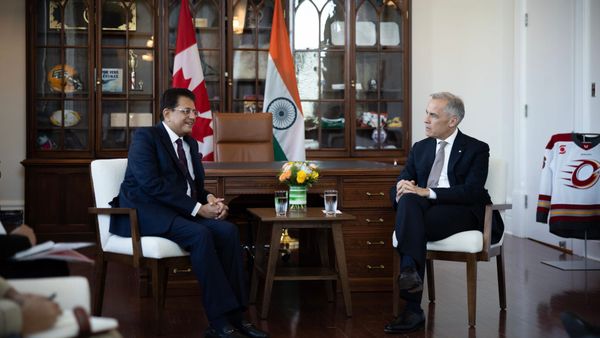
Prime Minister Mark Carney is moving to diversify Canada’s strategic trade relationships away from overwhelming dependence on the United States. Canada is working toward a trade agreement with India, with both sides aiming to increase bilateral trade to $50 billion by 2030. The talks include energy, agri-food, technology, education, critical minerals, uranium, and nuclear cooperation.
Now Canada has also struck an important agreement to export liquefied natural gas to Germany — a breakthrough for both countries as Canada seeks new markets beyond the United States and Germany looks to diversify its energy supply. Under the agreement, Canada would export up to one million metric tons of LNG per year from British Columbia’s Pacific Coast to Germany, starting in the early 2030s, over a two-decade horizon. Germany has been seeking new energy suppliers since cutting itself off from Russia after Moscow’s full-scale invasion of Ukraine. Canada, meanwhile, still exports the overwhelming majority of its energy resources to the United States.
That is why this matters.
This is not just trade policy. It is strategic repositioning.
Canada is trying to reduce its exposure to U.S. volatility by building new markets for energy, critical minerals, agriculture, technology, education, and nuclear cooperation. Germany is trying to avoid overdependence on any single supplier. India is looking to reset relations with Canada after years of tension. And Carney is trying to turn Canada’s resources into geopolitical leverage.
ONEST take:
Canada is not becoming “anti-American.” Canada is learning not to depend on America alone.
When your closest partner becomes unpredictable, diversification is not betrayal. It is strategy.
Carney’s India push and the Germany LNG agreement are part of the same story: Canada is building options.
Public diplomacy begins with listening. Hoekstra’s answer showed the opposite.
Like the ONEST Newsroom? Donate any amount to help keep this reporting going.