The Switzerland Talks Descend Into Threats, Snubs and Contradictions

– 8 min read

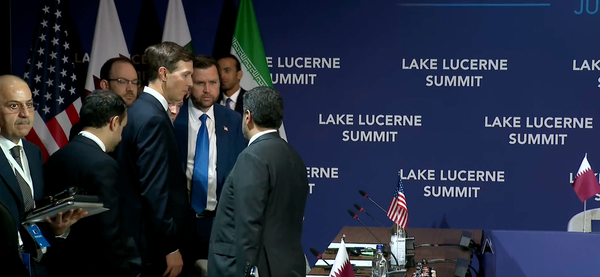
The United States and Iran arrived in Switzerland for talks intended to move their memorandum of understanding toward implementation.
Instead, the Lake Lucerne Summit exposed how little the parties appear to agree on — including whether negotiations are still functioning, whether the Strait of Hormuz is open, what the agreement requires in Lebanon and whether the United States can restrain its own partners long enough for diplomacy to survive.
The atmosphere was strained before substantive negotiations even began.
Vice President JD Vance, Jared Kushner and Steve Witkoff entered the meeting room before the Iranian delegation and addressed reporters alone.
Iranian Foreign Minister Abbas Araghchi briefly entered the room, embraced Pakistani Prime Minister Shehbaz Sharif and then walked out again. He did not publicly interact with Vance, who was standing on the opposite side of the room.
Reporters were removed before the wider Iranian delegation entered.
There was no joint photograph. There was no public handshake. Qatar and Pakistan, the two mediators, were seated physically between the American and Iranian delegations.
Vance nevertheless told reporters that significant progress had already been made.
“We’ve already made great progress over just the last few hours, and I expect that we’ll make additional progress in the hours to come,” he said.
The vice president had arrived separately from the traveling press after leaving on a smaller aircraft.
The previous day, when asked whether he planned to join Kushner and Witkoff, Vance admitted that he did not understand the diplomatic coordination surrounding the talks.
“It’s always a delicate coordination dance with the diplomatic protocols,” he told Fox News. “I’ve gotta be honest with you, I don’t really understand these things.”
The awkwardness continued inside the summit.
Video from the meeting appeared to show Qatar’s prime minister and foreign minister entering without immediately acknowledging Vance. The vice president then attempted to lighten the atmosphere with a joke about two important people in his life.
“The Indian is my wife, and the Pakistani is Field Marshal Munir,” Vance said.
But the diplomatic discomfort was secondary to a much larger contradiction.
While Vance was trying to present the negotiations as constructive, President Donald Trump was publicly threatening the country sitting across from the American delegation.
Fox News reported that Trump had told Iranian officials overnight: “You close the strait and you won’t have a country. You won’t even make it back to your f’ing country. We’ll take over the rest of the country.”
Trump later posted that Iran must immediately stop its “highly paid PROXIES” in Lebanon from causing trouble.
“If they don’t, we’ll hit Iran very hard again, just like we did last week, only harder,” he wrote.
The president then attacked Italy and Prime Minister Giorgia Meloni (again) for refusing to become involved in confronting Iran, arguing that NATO allies were "failing to defend the United States" after Washington had spent trillions of dollars protecting them.
The result was an extraordinary split-screen.
The vice president was asking Iran to believe that Washington wanted progress while the president was threatening to destroy the country if it did not comply.
The status of both the Strait of Hormuz and the negotiations remained disputed.
Iran said the strait was closed and that its delegation would not return to the table unless Trump personally apologized for his threats and Israel fully withdrew from southern Lebanon.
Iranian-linked reporting said the delegation was prepared to leave Switzerland and return to Tehran.
The United States disputed that account.
American officials said maritime traffic was continuing through a U.S.-protected route and maintained that Iran remained engaged through Qatari and Pakistani mediators.
That leaves two directly conflicting versions.
Iran says the strait is closed and the talks are suspended.
The United States says vessels are still moving and negotiations remain active through intermediaries.
Shipping data offered only a partial picture. Kpler recorded five vessels crossing the strait on Sunday, down from 26 the previous day, although additional ships may have passed without broadcasting their positions.
At this stage, those positions remain claims by the respective sides.
While the talks were underway, Iranian President Masoud Pezeshkian appeared on national television and said Iran would not surrender its right to enrich uranium.
He said the United States would ultimately have to accept that position.
That directly challenges one of the central unresolved questions surrounding the memorandum: whether Washington and Tehran have reached any genuine understanding over Iran’s future nuclear program or merely postponed the dispute.
Israel, meanwhile, continued to describe Iran’s nuclear capabilities as a threat it would address independently of the negotiations.
Prime Minister Benjamin Netanyahu said Israel would ensure that Iran never obtained a nuclear weapon, regardless of what happened diplomatically.
He also rejected Iran’s demand for a complete Israeli withdrawal from southern Lebanon.
“We will remain in the security zone in Southern Lebanon as long as necessary,” Netanyahu said.
National Security Minister Itamar Ben-Gvir went significantly further.
“Lebanon, all of Lebanon, should become our playground,” he said. “All of Lebanon should be our target.”
Ben-Gvir rejected any distinction between Lebanon and Hezbollah, calling it an “artificial approach.”
“Let a thousand Lebanese mothers weep, and not one Israeli mother weep,” he added.
The message from Israel was therefore the opposite of what Iran says is necessary for the memorandum to proceed.
Iran says the agreement must include an end to Israeli operations in Lebanon and a full withdrawal from the south.
Netanyahu says Israeli forces will remain for as long as Israel considers necessary.
And a senior Israeli minister is calling for the entire country to become a target.
Vance defended Secretary of State Marco Rubio’s handling of Lebanon, saying Rubio and the wider administration had been actively managing the crisis.
“Despite the headlines, things are actually getting better there, and things are slowing down a little bit,” Vance said.
He described the objective as making both Israel and Lebanon safe and secure.
“The big problem is that you have somebody will shoot and then somebody will respond, and you kind of have a chicken and egg problem where you’ve just got to stop the shooting for long enough to get the ceasefire to keep hold,” he said.
But this is not a chicken-and-egg problem.
It is a sequence of cause and consequence involving identifiable attacks, responses and further escalation.
Describing it as an almost accidental cycle obscures who initiated each action, what prompted the response and whether that response was proportionate.
It also avoids the immediate contradiction confronting the talks.
Iran says Israel must withdraw from southern Lebanon.
Netanyahu says Israel will remain.
Vance says the objective is to make Lebanon safe and secure, but the United States has not explained how that goal is compatible with an indefinite Israeli military presence inside Lebanon, continuing attacks or statements treating the entire country as a legitimate target.
Asked about accusations of genocide in Lebanon, Vance said the United States had done more to stop the conflict than any other government.
“I think that the President of the United States and the United States of America have done more to stop the conflict in Lebanon than any government anywhere in the world over the last few months,” he said.
“Peace is never easy.”
While the administration insisted negotiations were progressing, Senator Lindsey Graham was already predicting their failure.
Speaking on CBS’s Face the Nation, Graham said the United States should attempt a diplomatic solution but that he expected it to collapse.
He then predicted that Trump would ultimately take control of the Strait of Hormuz.
Graham also connected the confrontation with Iran to the possible expansion of the Abraham Accords.
That may appeal to Washington, Israel and some Gulf governments, but raising the prospect of a wider regional alignment with Israel during negotiations over Lebanon is hardly likely to reassure either Iran or Hezbollah.
It also raises the question of why administration allies are publicly predicting military action and promoting a strategic realignment against Iran while American officials are still sitting across from Iranian negotiators.
Syrian President Ahmad al-Sharaa also appeared to push back against Trump’s suggestion that Syria could assume responsibility for confronting Hezbollah instead of Israel.
Al-Sharaa said the situation in Lebanon required joint solutions and that Syria could help search for a security path.
But he explicitly rejected both war and a return to the former Syrian regime’s tutelage over Lebanon.
Instead, he proposed supporting the Lebanese state, strengthening its institutions and creating communication channels among Lebanon’s political parties and active forces — including Hezbollah.
That is a fundamentally different role from the one Trump appeared to describe.
Syria is offering mediation and institutional support, not a military campaign against Hezbollah.
The distinction is even more consequential because Damascus maintains close relations with the Kremlin and continues to host Russian military facilities, including air and naval bases.
Syria is also becoming increasingly important as an alternative economic corridor.
Iraq is preparing to export crude oil and naphtha through Syrian ports after the war and disruption in the Strait of Hormuz restricted its normal Gulf shipping routes.
That means Syria is not simply an available substitute for Israeli military operations in Lebanon.
It is becoming a central point through which Russian, Iranian, Iraqi, Gulf and Western interests increasingly intersect.
While officials in Switzerland spoke about stabilizing the region, Iraq was already adapting to the consequences of the conflict.
Reuters reported that Iran’s Islamic Revolutionary Guard Corps had established covert cells in Iraq intended to carry out attacks against Gulf countries hosting American forces.
According to eight Iraqi sources cited by Reuters, the cells were designed to bypass established militia networks and make their activities more difficult to detect.
At the same time, Iran-backed Iraqi armed groups are reportedly preparing to integrate into state institutions following the U.S.-Iran memorandum.
Such integration could formally place fighters under government structures, but it could also allow the groups to retain political influence, state salaries and access to public resources rather than genuinely disarm.
Iraq’s preparations to redirect energy exports through Syria show that the economic consequences are already reshaping regional trade routes.
These are not secondary developments.
They show a region reorganizing itself around the possibility that the Strait of Hormuz will remain unreliable, Iranian-linked armed networks will survive in new forms and Syria will become increasingly important as both an intermediary and an economic outlet.
The tension intensified further when an explosion was reported at a factory in Qatar’s Ras Laffan Industrial Area.
Qatar’s Ministry of Interior said the internal explosion followed a technical incident and that civil defense teams had begun responding.
The ministry said there were no leaks posing a threat to public safety.
There was no verified indication that the explosion was connected to the talks, Iran or the wider regional conflict.
But its timing added another layer of anxiety to a summit already unfolding amid threats against Gulf states, warnings about Iranian covert cells and uncertainty over the security of regional energy infrastructure.
What stands out is the absence of any clear objective, method or even common position within the U.S. team.
Is the chaos deliberate? Perhaps. But the more important question is who benefits from it.
America’s allies do not.
Europe faces higher energy costs, an ongoing war in Ukraine and a Washington increasingly consumed by crises of its own making rather than acting as the stabilizing force its partners relied upon for eight decades.
Russia and China are a different story.
Russia benefits from higher oil revenues, disrupted Gulf shipping and every additional crisis that diverts Western attention from Ukraine.
China continues building a disciplined, hierarchical system of influence. Whatever the pressures inside the country, Beijing increasingly appears calm and predictable from the outside — particularly beside Washington’s improvisation.
That contrast is not lost on Indo-Pacific partners. They built their security assumptions around an America that contained instability, not one that generated it.
Diplomacy is now being conducted through threats, television appearances and social media posts. It increasingly resembles a reality show.
That may be entertaining to observe.
But the rest of us are not merely watching. We are living with the consequences.