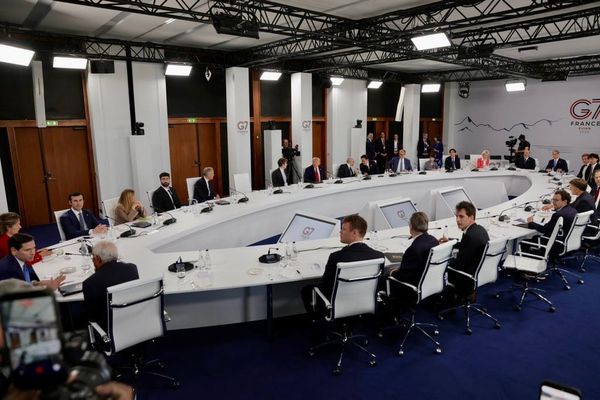
Day 2 of the G7 Summit in Évian showed three different realities moving at once: Canada continuing to reposition itself, Ukraine and its allies trying to keep Donald Trump publicly attached to their side, and Trump using the summit to sell an Iran framework that is now signed, immediate, and still unfinished.
Canada’s direction is the clearest story.
Prime Minister Mark Carney used the summit to deepen Canada’s pivot toward Europe and trusted industrial partners, especially in defense, energy, critical minerals, artificial intelligence, and supply chains.
His meeting with German Chancellor Friedrich Merz produced new movement on critical minerals, high-purity silica, solar manufacturing, defense cooperation, and a new security information agreement meant to make procurement and industrial cooperation easier.
Canada also announced new sanctions on Russia, targeting the shadow fleet, energy revenues, defense industry, and disinformation actors. But the broader message was not only about Russia. It was about Canada building alternatives: new partnerships, new markets, new procurement channels, and a larger role in the industrial architecture now emerging across Europe and the G7.
The critical minerals track matters here. The G7 is moving toward a more organized effort to reduce dependency on concentrated supply chains, build stockpiles, increase processing and recycling capacity, and coordinate with trusted partners. Canada is positioning itself not just as a participant in that shift, but as one of its central suppliers and political anchors.
Ukraine’s day was more complicated.
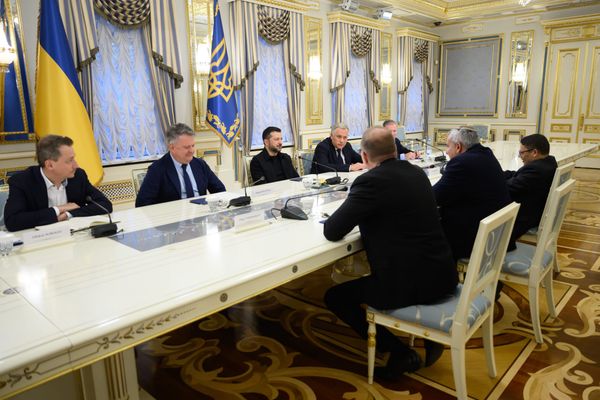
President Volodymyr Zelenskyy used the G7 to keep Ukraine in every major conversation: with Brazil’s Lula da Silva, with Trump and French President Emmanuel Macron, with Finland’s Alexander Stubb, and later with NATO Secretary General Mark Rutte in Brussels.
The public language was positive. The harder question is whether it becomes action.
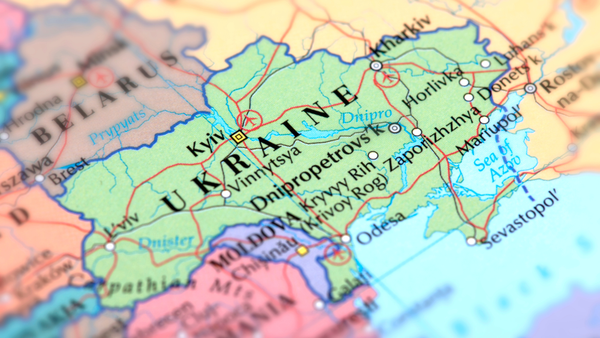
Ukraine has battlefield momentum, but momentum does not stop missiles. Kyiv still needs air defense systems, Patriot interceptors, and production capacity to withstand Russia’s escalating attacks on civilian infrastructure.
That is where the U.S. question matters.
So far, there is still no clear shift confirming meaningful U.S. backing for Ukraine. Under Trump, the best-case scenario may now be more limited: keeping him neutral, preventing an open break with Kyiv, and ensuring he is not visibly working with Moscow.
At this stage, that alone is being treated as progress.
Trump did not break publicly with Ukraine. He did not torpedo the G7 language. He did not openly side with Moscow at the summit. But that is a low bar — especially as members of his own orbit, including Jared Kushner and Steve Witkoff, are expected to move toward Kremlin-linked diplomacy soon.
That is why the Ukraine section of the summit reads less like a breakthrough and more like a performance of alignment. European leaders are trying to keep Trump inside the tent. Ukraine is trying to turn that into leverage.
Meanwhile, Trump’s real focus was Iran.
The U.S.-Iran framework dominated the summit’s political atmosphere. By Wednesday, Trump said he had signed the agreement while in France, after earlier reports that he and Vice President JD Vance had digitally signed it days before. Pakistani Prime Minister Shehbaz Sharif, who helped mediate the initial deal to end the war, said the agreement was taking “immediate effect,” with a formal signing ceremony still expected Friday.
That distinction matters.
The agreement is now signed, but it is still not a final settlement. It is a memorandum of understanding designed to stop the fighting, reopen the Strait of Hormuz toll-free for 60 days, and create space for further negotiations.
The immediate concession is significant: the United States will waive, but not eliminate, some sanctions, allowing Iran to sell oil more freely right away. In return, Iran is expected to dilute its stockpile of highly enriched uranium on site as a minimum step, while reaffirming that it will not develop or procure nuclear weapons.
But the hardest questions remain unresolved.
The text has not been formally released. It is still unclear when the 60-day clock begins, how the agreement will be verified, what happens after the 60-day window, whether future fees on Hormuz are possible, and how Lebanon’s territorial integrity language will be enforced when Israel is not clearly bound by the arrangement.
That makes the agreement presented as a diplomatic breakthrough also a major concession.
And because it is a memorandum of understanding, not a legally binding treaty, its force depends less on law than on politics: whether the parties keep honoring it, how violations are defined, and whether there are real consequences if the 60-day window collapses.
Trump gets the headline. Iran gets immediate economic breathing room. Vance gets the signing ceremony. The world gets a pause in the fighting and a temporary reopening of one of the most important energy corridors.
But the real deal is still ahead.
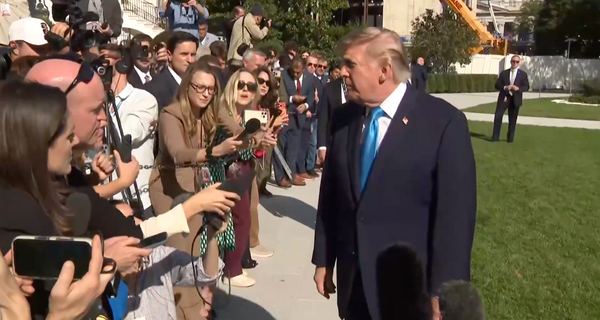
Trump captured the political logic himself during his G7 press conference.
“If it works out, I’m going to take the credit,” Trump said. “If it doesn’t work out, I’m blaming JD.”
That line now reads less like a joke than a governing strategy.
ONEST Take
The clearest takeaway from Day 2 of the G7 is that we are living through split realities.
There is what is actually happening: Canada building new strategic partnerships, Ukraine fighting with momentum but still needing air defense, and Trump signing a non-binding Iran MOU that gives Tehran immediate breathing room.
There is what diplomacy is trying to project: unity, coordination, momentum, and breakthroughs.
And there is what the media cycle often turns it into: clean wins, clean losses, and simple narratives.
But this moment is not simple.
The facts are moving quickly, the language is carefully constructed, and the gap between announcement and implementation is where the real story often sits.
That is why staying alert — and keeping your head on a swivel — matters.
Thank you for reading actual news.
Explore the latest articles below.