Europe Just Rewrote Its Deportation System
The EU approves offshore "return hubs", longer entry bans and bloc-wide deportation enforcement — marking one of the biggest shifts in European migration policy in decades.

– 5 min read

The EU approves offshore "return hubs", longer entry bans and bloc-wide deportation enforcement — marking one of the biggest shifts in European migration policy in decades.

For years, the European Union built its migration policy around asylum procedures, refugee protection and burden-sharing between member states.
This week, that balance shifted.
The European Parliament approved the new EU Return Regulation by 418 votes to 218, giving member states sweeping new powers to deport migrants whose asylum claims have been rejected, recognize deportation orders issued anywhere in the EU, and establish so-called "return hubs" outside the European Union.
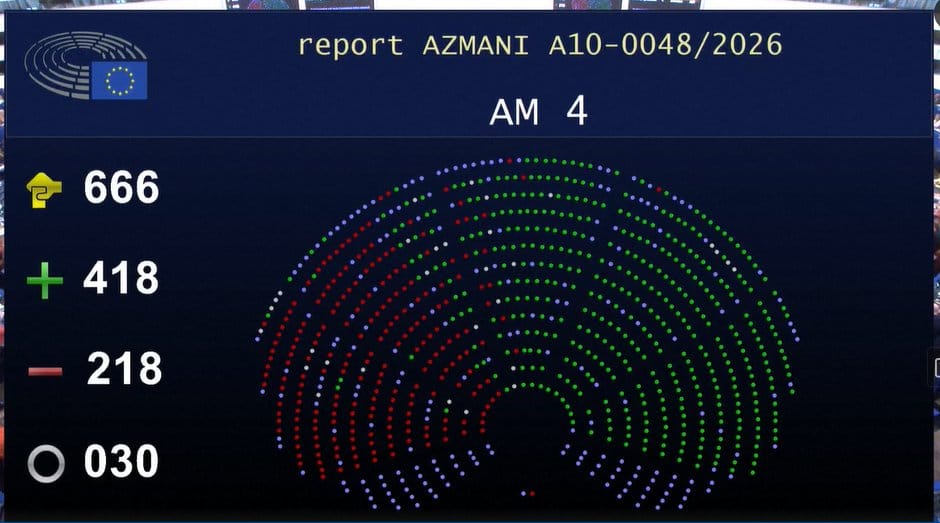
Supporters describe the reform as the missing piece of Europe's migration system.
Critics call it one of the most significant reductions of migrant protections in EU history.
Both views reflect just how consequential this legislation is.
The legislation comes after years of frustration among European governments over the bloc's inability to enforce deportation orders.
According to the European Commission, fewer than one-third of migrants ordered to leave the EU are actually returned to their countries of origin. Governments argue that asylum decisions lose credibility if rejected applicants simply remain inside Europe.
Migration has also become one of Europe's defining political issues.
Following the 2015-2016 migration crisis, immigration has steadily reshaped elections across the continent, strengthening conservative and right-wing parties and pushing traditionally centrist governments toward stricter border policies.
The Return Regulation represents the EU's answer to that political pressure.
The regulation introduces several major changes.
Perhaps the most controversial provision allows member states to transfer rejected asylum seekers to designated third countries outside the European Union while deportation procedures continue.
These facilities — commonly called return hubs — would operate through agreements negotiated between individual member states and non-EU countries.
Unlike previous systems, migrants do not need to have any prior connection to the country where they are transferred.
A deportation decision issued in one EU member state will become enforceable throughout the bloc.
Instead of restarting legal procedures after crossing an internal EU border, authorities across member states will be able to recognize and execute existing return orders.
Supporters argue this closes loopholes created by the Schengen area's open internal borders.
The regulation strengthens detention powers during return procedures and allows:
The regulation draws an important distinction.
Unaccompanied minors cannot be transferred to return hubs.
Families traveling with children, however, may still be relocated under the new framework.
The legislation itself does not designate any host countries.
Instead, it creates the legal framework allowing member states to negotiate agreements with countries outside the EU.
Several governments — including Denmark, Greece, Austria, Germany and the Netherlands — have already expressed interest in establishing such arrangements. Rwanda has frequently been mentioned in previous discussions, although no EU-wide agreements have yet been finalized.
Separately, the EU has adopted a common list of "safe countries of origin," including Bangladesh, Colombia, Egypt, India, Kosovo, Morocco and Tunisia, primarily to accelerate asylum processing for applicants from those states. That list is distinct from any future agreements to host return hubs.
The legislation did not emerge in a vacuum.
Italy's bilateral migration agreement with Albania became the political blueprint for much of today's debate.
But there are important differences.
Italy's facilities operate under Italian jurisdiction through a bilateral agreement.
The new EU framework instead creates a broader legal mechanism allowing multiple member states to negotiate similar arrangements individually, potentially involving countries with no previous connection to the migrants transferred there.
That broader approach raises new legal questions about responsibility, oversight and accountability.
Two institutions will play particularly important roles.
The ECJ remains the ultimate legal authority.
Its role includes determining whether third countries genuinely qualify as "safe," ensuring migrants retain access to judicial review and verifying compliance with the EU Charter of Fundamental Rights.
Recent ECJ case law has emphasized that a country cannot simply be declared safe in general terms; safety assessments must withstand judicial scrutiny.
Operationally, much of the system will rely on Frontex, the European Border and Coast Guard Agency.
Frontex is expected to coordinate return operations, organize flights, provide logistical support and assist member states with implementation.
Its role will become even more significant as return hubs begin operating.
Human rights organizations argue the legislation risks shifting legal responsibility beyond Europe's borders rather than resolving migration challenges.
Their concerns include:
UN High Commissioner for Human Rights Volker Türk warned that expanding detention and offshore return mechanisms risks weakening protections against refoulement — the international principle prohibiting the return of people to places where they face persecution or serious harm.
The comparisons with the Trump administration are unavoidable — but the systems are not identical.
Both increasingly rely on third-country removals and tougher enforcement.
The differences lie in governance.
The European model operates through EU legislation, judicial oversight by the European Court of Justice and common legal standards that all member states must follow.
The U.S. system remains primarily executive-driven, with implementation led by DHS and ICE and shaped through ongoing litigation in federal courts.
The EU framework is therefore more centralized legally, while the U.S. approach has generally been larger operationally and more fragmented judicially.
This legislation is about much more than deportation.
It marks a philosophical shift in European migration policy. For years, Brussels focused on who should be admitted. The new regulation increasingly focuses on how people are removed.
But enforcement raises questions the legislation does not answer.
Who will carry it out? Europe has watched the United States rapidly expand immigration enforcement through mass hiring. If Frontex and national authorities are expected to scale up deportations, who will recruit these officers, who will train them, and who will hold them accountable when mistakes happen?
Who pays for it? European taxpayers already facing higher energy prices, growing defense spending and economic uncertainty? Or third countries that may discover hosting Europe's deportation system has become a profitable business?
Anyone who has travelled across the Schengen Area knows how invisible Europe's internal borders are. Will enforcement now mean more document checks, more vehicle searches and more police operations inside the bloc? And what happens when someone is wrongly detained or cannot immediately prove their legal status?
Every deportation system has a margin of error. The United States has shown how aggressive enforcement can separate innocent families and create suffering before courts have the opportunity to intervene.
The EU points to judicial safeguards. But safeguards only work if they are timely. If thousands of deportation cases begin moving through national courts and ultimately the European Court of Justice, how long will people remain in detention while waiting for a ruling? A legal right delayed can become a legal right denied.
Europe calls these facilities "return hubs." But if people are held there against their will while awaiting removal, they are detention camps, regardless of the terminology. And if detention becomes privately managed or economically incentivized, governments must ensure that financial interests never begin shaping decisions about how long people are held or how these facilities operate.
As I have often said, the United States sets trends — not always good ones.
Europe is attempting to build a more regulated and legally supervised version of a model that has already generated deep political, legal and humanitarian controversy in the United States.
The law gives Europe stronger tools.
Whether those tools strengthen the rule of law — or simply move detention farther from public view — will define how this legislation is remembered.