The Nuclear Treaty Under Pressure: What’s Happening at the 2026 NPT Conference
The 2026 NPT Review Conference begins at the UN amid rising nuclear tensions. What’s at stake, key disputes, and early developments.

– 2 min read

The 2026 NPT Review Conference begins at the UN amid rising nuclear tensions. What’s at stake, key disputes, and early developments.
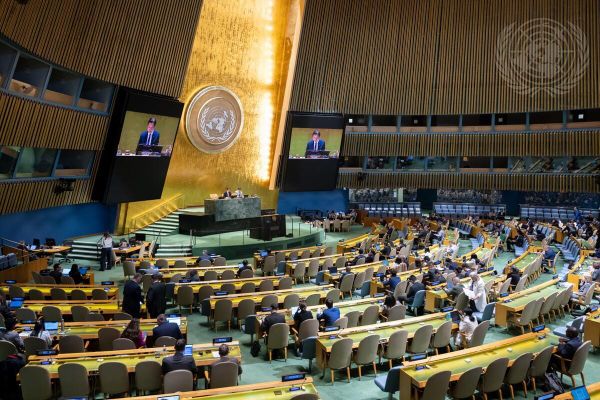
The Treaty on the Non-Proliferation of Nuclear Weapons Review Conference begins this week at the United Nations in New York, at a time when nuclear risk is no longer abstract — but actively shaping global security decisions.
Held once every five years, the conference is meant to assess whether the world is meeting its commitments: preventing the spread of nuclear weapons, pursuing disarmament, and allowing peaceful nuclear energy.
But in 2026, the question is more fundamental:
Is the system still functioning at all?
The NPT has long been considered the backbone of nuclear governance. Nearly every country in the world is part of it.
Yet the reality has shifted.
The United States and Russia still control the vast majority of nuclear arsenals, while modernization programs are accelerating across multiple powers. At the same time, nuclear considerations are increasingly embedded in active conflicts — from Europe to the Middle East.
This conference is not taking place in a stable environment.
It is taking place in the middle of competing wars, rivalries, and breakdowns in trust.
Before discussions even began, the conference was already facing political tension.
Iran was elected as one of the 36 vice presidents of the conference, alongside countries including China and Saudi Arabia.
The decision immediately drew criticism from the United States, which argued that Iran’s role undermines the credibility of a treaty focused on non-proliferation.
Iran, in turn, rejected the criticism as political.
This is not just symbolic. Vice presidents play a role in shaping the agenda and guiding negotiations.
The disagreement reflects a deeper issue:
there is no longer consensus on who should define nuclear responsibility.
Formally, this is a review process.
In practice, it has become a platform for confronting ongoing geopolitical crises.
The discussions this year are expected to focus heavily on:
These are not side issues.
They are now central to how nuclear policy is being shaped.
The first two days have made one thing clear:
consensus will be difficult.
A direct clash between the United States and Iran during opening discussions set a confrontational tone early on. Delegations have already signaled deep divisions over compliance, accountability, and interpretation of the treaty itself.
At the same time, many states are trying to shift the conversation back toward risk reduction and disarmament commitments, warning that continued fragmentation could weaken the treaty beyond repair.
There is an increasing gap between:
Nuclear powers continue to modernize and expand capabilities, while trust between them continues to erode.
That tension is now fully visible at the conference.
The 2026 NPT Review Conference is not just a diplomatic checkpoint.
It is a test of whether global powers can still cooperate on the most consequential issue of all: nuclear risk.
The outcome will not be defined only by a final document.
It will be defined by whether there is still a shared belief that nuclear weapons can be constrained — or whether that assumption is quietly disappearing.
ONEST+ members will receive ongoing coverage throughout the month, including Diplomatic Notes from inside the United Nations and Deep Dives unpacking key developments as they unfold.