Russia is once again telling a neighboring country that its sovereignty has limits.
This time, the target is Armenia.
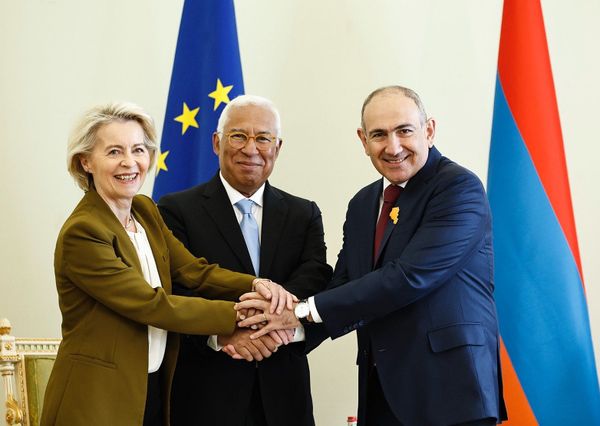
As Prime Minister Nikol Pashinyan moves Armenia closer to the European Union, Moscow is escalating pressure. Russian officials have warned that Armenia’s European path may be incompatible with membership in the Russian-led Eurasian Economic Union. The Moscow-led bloc has raised the possibility of suspending Armenia. Russia has also threatened economic consequences, including the loss of preferential energy supplies and new restrictions on Armenian goods.
And then came the deeper warning: Ukraine.
Vladimir Putin has invoked what he described as a “Ukrainian scenario” while speaking about Armenia’s European ambitions. That is not a neutral comparison. It is a political message.
Russia is not simply saying that Armenia must make a technical trade decision between the EU and the Eurasian Economic Union. Moscow is suggesting that choosing Europe could bring punishment.
That is the real story.
Armenia is not only deciding between economic blocs. It is testing whether a smaller country in Russia’s former imperial space is allowed to make its own strategic choices without being threatened.
Today, Pashinyan tried to lower the temperature while keeping Armenia’s options open.
“Our relations with Russia are in a transformation phase,” he said, adding that he considers that transformation positive. He described relations with Moscow as “open and sincere” and said Armenia has kept “no dark corners” in that relationship.
But the most important part came next.
Pashinyan said Armenia will continue working inside the Eurasian Economic Union until the moment when a choice between the EU and the EAEU becomes unavoidable. And if that moment comes, he said, the decision must be made by the Armenian people in a referendum.
That is a careful position.
It does not slam the door on Russia. It does not declare an immediate exit from the Eurasian Economic Union. It does not pretend Armenia can join every structure at once forever.
But it does say something Moscow does not want to hear: Armenia’s future will not be decided in the Kremlin.
It will be decided by Armenians.
Then Trump entered the story.
Donald Trump publicly endorsed Pashinyan for re-election, calling him a friend and praising his vision for peace and prosperity in Armenia and the South Caucasus. He also tied Armenia’s future to the “Trump Route for International Peace and Prosperity,” a proposed transit route meant to connect the South Caucasus and Central Asia while opening access for American energy interests across the region.
That is why this story is bigger than Armenia’s election.
Russia sees Armenia’s EU path as a threat to its regional influence. The United States sees Armenia’s opening as an opportunity — diplomatic, strategic, and economic. And Armenia is trying to maneuver between them without losing the one thing that matters most: the right to decide its own future.
Trump’s endorsement is not subtle. It places Washington directly inside Armenia’s domestic political moment just as Moscow is warning Yerevan about the consequences of moving west.
For Pashinyan, that support may strengthen the argument that Armenia has options beyond Russia. But it also gives Moscow an easy talking point: that Armenia’s European and Western turn is not sovereign, but foreign-backed.
That is the danger.
Armenia’s future cannot simply become a contest between Putin’s threats and Trump’s branding.
The question should not be whether Armenia belongs to Moscow’s sphere or Washington’s corridor. The question is whether Armenians themselves can choose a future that gives them security, prosperity, and sovereignty.
This is no longer only about Armenia choosing between the European Union and the Russian-led Eurasian Economic Union.
It is about whether Armenia can escape the old post-Soviet trap: Russia treating independence as betrayal, and outside powers treating small states as corridors, buffers, or bargaining chips.
Putin is warning Armenia with Ukraine. Trump is endorsing Pashinyan with promises of peace, prosperity, and a route named after himself.
And in the middle is Armenia — a country trying to make a sovereign choice while larger powers turn its geography into strategy.
This is the same pattern we have seen before.
Russia often describes its neighbors’ independent choices as Western interference. It presents their desire for European institutions, democratic reforms, or security diversification as a threat to Russia itself. Then it uses that alleged threat to justify pressure, destabilization, or punishment.
Ukraine knows this pattern better than anyone.
Before the full-scale invasion, Ukraine’s European future was also treated by Moscow not as a sovereign choice, but as a provocation. The Kremlin repeatedly framed Ukraine’s independence as conditional. It insisted that Ukraine’s foreign policy had to remain within Russia’s acceptable limits.
Now, Armenia is hearing a version of the same message.
The circumstances are not identical. Armenia’s geography, security situation, economy, and military position are different from Ukraine’s. Armenia is also coming out of its own trauma after Azerbaijan’s 2023 recapture of Nagorno-Karabakh, when many Armenians concluded that Russia had failed to protect them despite years of alliance and security dependence.
That failure changed the relationship.
For years, Armenia relied on Russia as a security guarantor. But when the crisis came, Moscow did not act in the way many Armenians expected. Since then, Yerevan has frozen its participation in the Russian-led Collective Security Treaty Organization, deepened ties with the EU and the United States, and begun openly discussing a more European future.
Russia is now trying to stop that shift before it becomes irreversible.
The timing is also important. Armenia is heading toward elections. Pashinyan’s government is under pressure from both pro-Western and pro-Russian forces. Moscow’s warnings are not happening in a vacuum. Trump’s endorsement is not happening in a vacuum either.
Both are part of a broader struggle over Armenia’s political direction.
That is why the referendum language matters.
Pashinyan is effectively saying: if Armenia must one day choose, that choice should not be imposed by Moscow, Brussels, Washington, or any outside power. It should be made by the Armenian people.
That is a democratic answer to an imperial question.
Russia is asking: who gave Armenia permission to move toward Europe?
Pashinyan is answering: Armenia does not need permission.
This is why the Armenia story belongs in the same conversation as Ukraine, Georgia, Moldova, and the broader struggle over Europe’s eastern neighborhood. The question is not only which institutions these countries join. The question is whether their sovereignty is real.
Can a post-Soviet state choose Europe without being threatened?
Can it diversify its alliances without being punished?
Can it hold a referendum without the outcome being shaped by fear?
Russia’s message is clear: choose carefully, because Ukraine chose Europe and look what happened.
But that is exactly why this moment is so revealing.
Ukraine was not attacked because it threatened Russia. Ukraine was attacked because it insisted on existing as an independent country with its own future. Armenia is now trying to preserve that same principle in its own way — more cautiously, more delicately, but unmistakably.
Pashinyan’s language today was diplomatic. Russia’s pressure is not.
And Trump’s endorsement, however politically useful for Pashinyan, also shows how quickly Armenia’s geography can become someone else’s strategy.
The deeper issue is simple: Armenia is trying to transform a relationship of dependence into a relationship of choice.
That is what Moscow fears most.
And that is what Armenians will ultimately have to decide for themselves.