ONEST Newsroom Is Now Daily. Here’s Today’s Global Briefing.
Six short video briefs and full written analysis on Trump, Iran, China, Ukraine, India, Alberta, and the Middle East.

– 10 min read

Six short video briefs and full written analysis on Trump, Iran, China, Ukraine, India, Alberta, and the Middle East.
Starting today, ONEST Newsroom is moving into a clearer daily format.
The Daily Brief will bring you the most important developments of the day — fast, factual, and explained in plain language.
When a story needs more than a daily brief, ONEST Explained will continue to go deeper on one major issue shaping the world, connecting the dots beyond the breaking headline.
For ONEST+ members, Diplomatic Notes and Deep Dives remain unchanged: behind-the-scenes insight from diplomatic rooms, UN coverage, summit analysis, and the deeper geopolitical context behind the news.
To receive immediate ONEST Newsroom updates for free, activate ONEST Newsroom in your profile settings. That way, you will get the latest briefs and urgent updates as soon as they are published.
This is the next step in building ONEST as an independent, reader-supported newsroom — focused on facts, clarity, and understanding beyond the noise.
Today’s ONEST Newsroom is also available as a six-part video briefing.
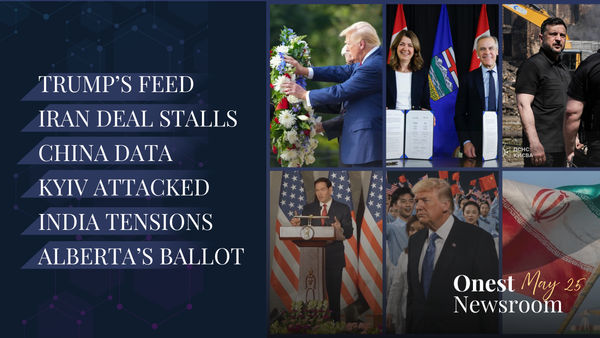
You can watch all six stories in under 20 minutes: Trump’s Memorial Day messaging, the Iran deal, China data, Russia’s attack on Kyiv, U.S.-India tensions, and Alberta’s separation vote.
Watch the full ONEST Newsroom May 25 playlist HERE
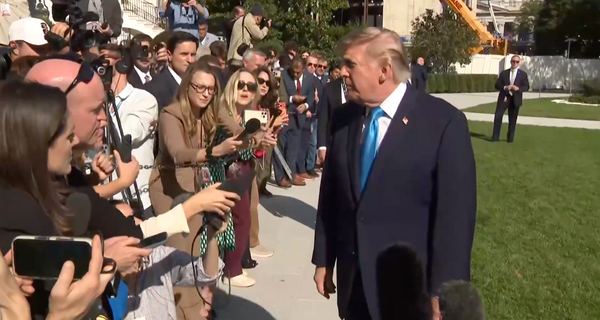
President Trump marked Memorial Day with a wreath-laying ceremony at Arlington National Cemetery. But his public messaging also veered sharply into politics, with Truth Social posts attacking Democrats, Republican critics, and the Obama-era Iran nuclear deal. Trump began the day with political posts aimed at “Dumocrats, RINOS and Fools” while defending his Iran negotiations.
That is not what Memorial Day is for.
Memorial Day is the day Americans remember those who died while serving in the U.S. Armed Forces. It began after the Civil War as Decoration Day, when communities decorated the graves of fallen soldiers, and later became a federal holiday observed on the last Monday in May.
For many Americans, it has also become the unofficial start of summer — a weekend of travel, gatherings, beaches, barbecues, and family time. But at its core, the day is not about politics, parties, or personal grievances.
So here is the message worth centering:
Today, we remember and express our gratitude to every American who gave their life in service to the country. Their sacrifice is not a slogan. It is the reason this day exists.
ONEST Take:
Memorial Day works best when politics gets smaller, not louder. The country can argue tomorrow. Today belongs to those who did not come home.
The Iran deal was already politically fragile. Now Trump may have made it worse.
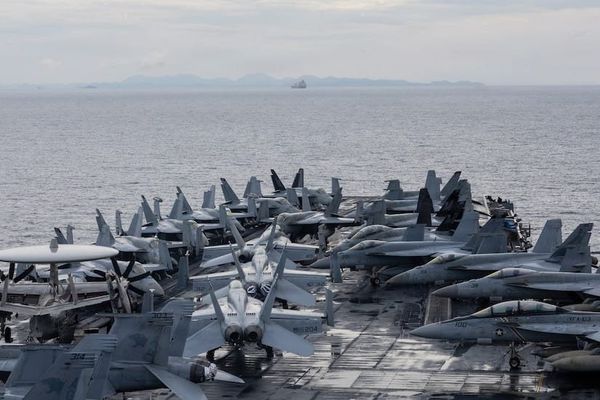
Iranian negotiators traveled to Doha for talks mediated by Qatar, even as the United States carried out what it described as “self-defense” strikes targeting Iranian missile and drone infrastructure and boats near Bandar Abbas and the Strait of Hormuz. Washington says the strikes were defensive and did not violate the broader ceasefire framework.
But the optics matter.
The same corridor at the center of the negotiations — the Strait of Hormuz — is also where military escalation remains possible. That means the talks are not happening in a calm diplomatic environment. They are happening under pressure, with the risk of miscalculation still very real.
Major unresolved issues reportedly include sanctions relief, uranium enrichment, reopening Hormuz, and Iran’s regional proxy activity. Reuters reported that the Doha discussions focused on the Strait of Hormuz, Iran’s nuclear program, including its highly enriched uranium stockpile, and the possible release of frozen Iranian funds.
That matters because the reported framework has raised major concerns. Iran could receive financial relief, movement on frozen funds, and a pathway out of the Strait of Hormuz crisis while major questions remain unresolved over uranium, enforcement, missiles, and regional activity.
Then Trump added another complication.
In a lengthy post, he said negotiations with Iran were “proceeding nicely,” but argued that countries including Saudi Arabia, Qatar, Pakistan, Türkiye, Egypt, Jordan, Bahrain, and the UAE should also join the Abraham Accords as part of a broader regional settlement. Trump linked expanded Abraham Accords participation to the Iran deal, while Pakistan rejected the request and other countries have not publicly committed.
That may sound historic. But diplomatically, it makes an already difficult deal even harder.
Saudi Arabia has its own conditions, including the Palestinian statehood question. Qatar has its own regional role. Türkiye, Pakistan, Egypt, and Jordan each have different domestic and strategic calculations. Iran being folded into a framework associated with normalization with Israel would be an entirely different political universe.
And now Trump has tried to address one of the biggest objections directly: Iran’s enriched uranium.
In a new post, Trump said the enriched uranium — which he called “Nuclear Dust” — would either be immediately turned over to the United States to be brought home and destroyed, or preferably destroyed in place or at another acceptable location in coordination with Iran, with an atomic energy authority witnessing the process. Reporting also indicates Trump has proposed on-site destruction of nuclear material under international supervision, while Iran has not agreed to hand over its enriched uranium.
That sounds tougher than earlier reporting suggesting Iran’s enriched uranium could be left for later negotiations.
But it also raises a much larger question: is this an agreed term, a U.S. demand, or simply Trump describing what he wants in real time?
At this stage, it is not clear whether Iran has accepted this, whether U.S. negotiators have formally put it on paper, whether allies were consulted, or whether anyone beyond Trump knows what the final version of this proposal actually is.
That uncertainty matters.
Nuclear agreements are not built on social media posts. They require verification, sequencing, enforcement, and clear commitments from all sides. The basic question is not whether Trump says Iran’s uranium will be turned over or destroyed. The question is whether Iran has agreed to it, who verifies it, what happens to undisclosed stockpiles, and what consequences apply if Tehran does not comply.
Trump is no longer only trying to negotiate with Iran. He is trying to combine Iran, the Gulf states, Israel normalization, the Abraham Accords, sanctions relief, the Strait of Hormuz, U.S. military pressure, and enriched uranium into one political package.
That does not make the deal stronger. It makes it harder to land.
ONEST Take:
Trump wants a legacy deal. Iran wants relief. Israel wants constraints. Gulf states want guarantees. The U.S. is still carrying out strikes it calls defensive, while Trump is now adding another public condition: Iran’s enriched uranium must be turned over or destroyed.
But we still do not know whether this is diplomacy, messaging, or improvisation.
A credible agreement depends on what is written, verified, and enforceable — not what is posted.
A deal that lowers tensions can be good diplomacy. But a deal that gives Iran relief without verifiable limits is not a breakthrough. It is a postponement.
Trump has leaned heavily into personal praise for China and Xi Jinping, presenting the relationship as something he can manage through personal chemistry.
But China is not treating this as a love story. It is treating it as a strategic opening.
Gallup’s latest global leadership data shows China has edged ahead of the United States in global approval. Median approval of U.S. leadership fell to 31%, while approval of China’s leadership rose to 36%. Gallup described the five-point gap as the largest lead it has recorded for China over the United States. U.S. disapproval also reached a record-high 48%, while China’s disapproval remained at 37%.
That does not mean China is broadly beloved. It means the United States is losing ground in the global perception contest — and Beijing benefits when Washington looks chaotic, transactional, or internally divided.
ONEST Take:
Trump is treating China as a relationship. China is treating the United States as a strategic opening.
Trump wants chemistry. Beijing wants leverage.
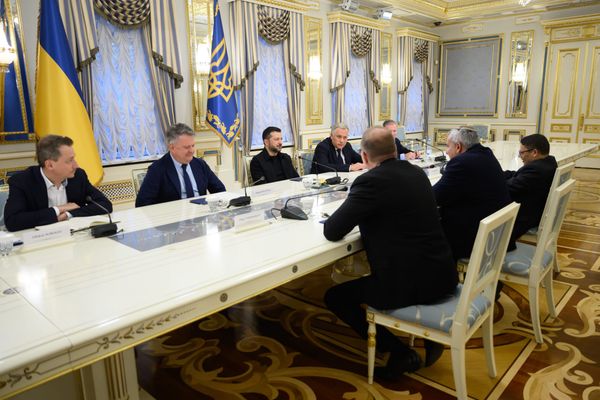
After Russia’s latest massive attack on Kyiv, President Volodymyr Zelenskyy visited damaged civilian sites and did not soften his words.
Standing near the damaged Chornobyl Museum, he said:
“They saw this museum. They attacked the museum. Just crazy a*sholes. That’s it.”
The anger was not performative. It followed one of Russia’s heaviest attacks on Kyiv since the full-scale invasion began. The recent attacks killed people, injured dozens, and damaged roughly 300 sites, including the National Chornobyl Museum. Russia also threatened “systematic strikes” on military-related and decision-making sites in Kyiv and urged foreigners to leave the city.
The Chornobyl Museum matters because it is not simply another building. It is a civilian cultural site dedicated to preserving the memory of one of the world’s worst nuclear disasters.
ONEST Take:
Zelenskyy’s language was blunt because the attack was blunt.
Russia is not only targeting infrastructure. It is targeting places that hold Ukraine’s memory — from museums to civilian neighborhoods — as part of a broader effort to exhaust the country’s sense of continuity and normal life.
Russia is not only trying to exhaust Ukraine’s defenses. It is trying to exhaust Ukraine’s sense of itself.
Secretary of State Marco Rubio’s visit to India was meant to reinforce one of Washington’s most important strategic partnerships.
The optics were warm. Trump called into the U.S. Embassy’s Freedom 250 Independence Day reception in New Delhi and praised India and Prime Minister Narendra Modi, saying the United States had “never been closer to India” and that India could count on him.
Rubio also emphasized cooperation with India on defense, energy, trade, technology, and regional security. But the trip came against the backdrop of U.S. immigration restrictions, visa concerns, tariffs, India’s Russian oil purchases, and unease in India over Trump’s approach to Pakistan and China.
There is also a bigger geopolitical complication: India is not only a U.S. partner. It is also the “I” in BRICS — a member of the bloc that includes Brazil, Russia, China, South Africa, and a growing group of additional countries seeking more influence outside the traditional Western-led order.
That makes Washington’s India strategy more complex. The United States wants India closer as a counterweight to China. But India has long resisted being treated as anyone’s junior partner. It works with Washington where interests align, while maintaining relationships with Russia, engaging BRICS, and pursuing its own strategic autonomy.
The tension became visible when Rubio was asked about hostile and racist comments toward Indian immigrants in the United States. He responded that every country has “stupid people” who make “dumb comments,” while insisting the United States remains welcoming and that visa changes are not aimed specifically at India.
That answer may have been meant as reassurance. But it also showed the contradiction at the center of the relationship.
Washington wants India as a strategic partner, a counterweight to China, a technology partner, and a democratic ally. But immigration politics and visa restrictions are making many Indians feel less welcome in the United States.
ONEST Take:
America is telling India it matters. Its visa system is telling many Indians something else.
And India has options.
That is what makes this relationship so important — and so delicate. India is not simply moving “toward” Washington. It is balancing Washington, Moscow, Beijing, BRICS, and its own ambitions as a major power.
The U.S.-India relationship may be warm at the leadership level, but it is increasingly tense where people actually experience it: visas, mobility, and belonging.
Alberta Premier Danielle Smith now says she will vote for Alberta to remain in Canada.
But her government has also helped keep alive the referendum pathway separatists can use.
Smith posted that the last decade under the Trudeau-NDP was difficult for Alberta, but argued that the tide is turning. She pointed to changes in federal policy, renewed investment, and Alberta’s economic strength, saying that on October 19 she will vote for Alberta to remain in Canada.
The shift comes after Prime Minister Mark Carney moved to address some of Alberta’s central grievances. AP reported that Carney has backed efforts to improve market access for Alberta’s resources, including advancing a potential oil pipeline to the Pacific.
Carney has warned Alberta’s non-binding separation vote could become a “dangerous bluff,” comparing the risk to Brexit. The vote has no direct legal force, but it could create political momentum toward a future binding referendum. Reuters also reported polling showing that 60% of Albertans favor staying in Canada, while 67% would reject separation in a binding vote.
That is the contradiction.
Smith may not want separation. But she has helped create a political instrument for separatists.
ONEST Take:
Carney gave Alberta a negotiating path. Smith gave separatists a political instrument. Those are not the same thing.
Smith may want leverage, not separation. But history is full of leaders who opened referendum doors thinking they could close them later.
Prime Minister Mark Carney also spoke with Israeli President Isaac Herzog and delivered a broader message on Gaza, the West Bank, Lebanon, and regional stability.
Carney said the treatment of civilians, including Canadian citizens, aboard the Gaza-bound flotilla was unacceptable and called for an independent investigation. He condemned comments by Israel’s Minister of Public Security, Itamar Ben-Gvir, and stressed that the protection of civilians and respect for human dignity must be upheld everywhere.
The call also reaffirmed Canada’s support for a negotiated two-state solution, Israel’s security and right to self-defense under international law, and the imperative of protecting civilians and civilian infrastructure. Carney also called for immediate and unimpeded humanitarian access to Gaza, opposed illegal settlement expansion and settler violence in the West Bank, and stressed de-escalation in critical maritime corridors, including the Strait of Hormuz. The broader controversy over the flotilla intensified after Ben-Gvir released video of detained activists in degrading conditions, drawing international criticism.
ONEST Take:
Carney is trying to hold a difficult line: support for Israel’s security, sharper criticism of Israeli government conduct, and a renewed push for humanitarian access, civilian protection, and regional de-escalation.
The important part is that Canada is no longer treating Gaza, the West Bank, Lebanon, and the Strait of Hormuz as separate files. Carney is framing them as one regional stability crisis — and that matters.
From Trump’s Memorial Day posts to Iran, China, Ukraine, India, Alberta, and the Middle East, today’s news carries the same pattern: leaders are trying to control the message while events keep exposing the limits of political theater.
A bit of good news for everyone who has loved an aging cat.
Japanese researchers are moving a long-awaited cat kidney disease treatment toward regulatory approval after decades of work. Chronic kidney disease is one of the biggest killers of older cats, and for years it has been treated as something veterinarians could manage, but not truly stop.
The new injectable treatment is built around a protein called AIM — apoptosis inhibitor of macrophage — discovered by Dr. Toru Miyazaki, who has studied its role in kidney function for more than 25 years. The University of Tokyo previously reported that Miyazaki’s research suggested AIM could improve kidney function and potentially help extend cats’ lives.
If the treatment reaches the market, researchers hope it could dramatically extend feline lifespans. Miyazaki has said the goal is to help cats live closer to 30 years, roughly double the current average of around 15. Reporting on the treatment says regulatory approval could be sought in Japan, with a possible launch as early as 2027 if successful.
Like the ONEST Newsroom? Donate any amount to help keep this reporting going.