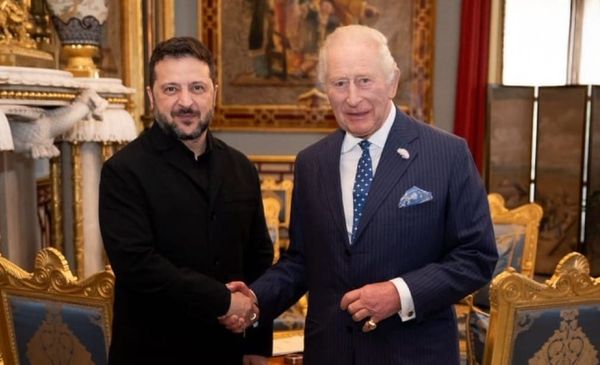
May 26: Power Without Accountability: Kyiv, Starlink, AI, Canada, Hungary, and Europe’s Heat Wave

– 8 min read

Today’s Daily Brief begins in Kyiv, where Russia is not only escalating its attacks — it is trying to shape the psychology of the battlefield.
Moscow warned foreign diplomats to leave Ukraine’s capital before planned “systematic” strikes. It then used the United Nations to reverse reality, presenting itself as the victim while continuing a war of aggression against a sovereign state.
But the same question appears across today’s other stories too: who holds power accountable?
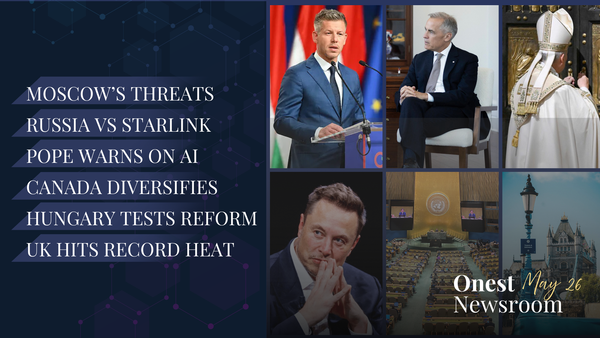
Russia is threatening satellite infrastructure because Ukraine remains connected. Pope Leo XIV is warning that artificial intelligence cannot become a moral authority. Canada is diversifying its trade relationships as Washington struggles to understand why Canadians are frustrated. Hungary’s new government is trying to signal a break from corruption. And the United Kingdom just broke its May heat record twice in two days.
These are not disconnected events. They are stress tests.
Today’s ONEST Newsroom is also available as a six-part video briefing.
You can watch all six stories in under 25 minutes right HERE
Russia warned the United States and other foreign governments that it intended to launch additional strikes on Kyiv, urging diplomats and foreign nationals to leave the Ukrainian capital. Secretary of State Marco Rubio confirmed that Russian Foreign Minister Sergey Lavrov had called him, saying Putin wanted the message relayed directly to President Trump. The EU and several member states summoned Russian envoys over Moscow’s threats, while the United Nations Secretary-General said he was “deeply concerned” by Russia’s announced plans to target Kyiv.
This was not a courtesy warning. It was psychological warfare.
Russia is trying to create a visual: embassies emptying, diplomats leaving, Kyiv appearing isolated, Ukraine looking abandoned. If Moscow can make international presence in Kyiv shrink, it can use that image as part of the war.
But several diplomatic missions, including the EU, France, and Poland, said they would remain in Kyiv despite Russia’s warnings. Ukraine also said the security situation has not changed in substance: Kyiv has already been living under Russian attack.
At the UN, Ukraine’s Ambassador Andrij Melnyk delivered a joint statement on behalf of Ukraine and its 50 allies, condemning Russia’s escalating attacks on civilians and civilian infrastructure, calling for an immediate ceasefire, the return of prisoners, deportees, and children, and Russia’s full withdrawal from Ukrainian territory. The statement also condemned Russia’s threats against diplomatic institutions and embassies in Kyiv.
Then Russia’s ambassador used a briefing to claim Ukraine is targeting civilians in Luhansk — part of the same inversion Moscow has used throughout the war. Russia occupies Ukrainian territory, stages sham referendums under military pressure, then claims civilians “chose Russia.” It bombs Ukrainian cities, then claims Ukraine is the real aggressor.
ONEST take:
Russia’s message was not only “we are coming.” It was: leave before we come, so we can say Ukraine is alone.
The threat to diplomats is part of the strike. The panic is part of the weapon.
Russia’s latest threat against Elon Musk and Starlink came after Moscow claimed that Ukrainian drones used Starlink terminals in a deadly strike on a college dormitory in Russian-occupied Luhansk.
Russian State Duma chairman Vyacheslav Volodin accused Musk’s satellite network of helping Ukraine “kill children” and warned that if Starlink continues supporting Ukraine, Russia could respond with weapons that would “leave no trace of anyone.” The claim is being amplified by Russian state media and pro-Kremlin outlets as part of Moscow’s broader effort to portray Ukraine as the aggressor — even as Russia continues escalating attacks on Ukrainian civilians and civilian infrastructure.
Ukraine has relied heavily on Starlink for battlefield communications, drone coordination, logistics, and resilience under attack. Starlink has helped Ukrainian units stay connected even when Russia targets conventional communications infrastructure.
But Starlink is not simply “private internet.”
SpaceX has received roughly $6 billion in U.S. government contracts over the past five years, and about one-fifth of its 2025 revenue came from federal agencies. The publicly reported Starlink-for-Ukraine contracts are smaller — at least $37 million in Pentagon Starlink service contracts, with a possible $150 million Ukraine sale approved later — but the full Starlink/Starshield government exposure is harder to isolate because SpaceX contracts are spread across NASA, the Pentagon, classified programs, launch services, Starshield, and satellite communications.
Russia has several realistic ways to threaten satellite-enabled warfare. The most immediate are jamming, electronic warfare, cyberattacks, and attacks on ground terminals. These are already part of modern conflict.
The more escalatory threat involves anti-satellite weapons. Western intelligence agencies have warned that Russia is developing counterspace capabilities, including systems that could threaten satellite networks.
But Russia’s apocalyptic rhetoric should not be confused with a clean or simple capability.
Destroying or significantly degrading a large satellite constellation like Starlink is not easy, clean, or consequence-free. An attack in orbit could create debris, disrupt civilian services, affect systems used far beyond Ukraine, and risk a much broader escalation.
ONEST take:
Russia is threatening Starlink because Ukraine is still connected.
And in this war, connection is power.
The battlefield is no longer only on the ground. It is in orbit, in code, and in the signal between them.
Pope Leo XIV’s first encyclical, Magnifica Humanitas, is not an anti-technology document. It is a warning against surrendering human judgment to systems built by private power, deployed by states, and increasingly embedded in war, work, education, law, and public life.
The encyclical is as a call for artificial intelligence to serve humanity rather than concentrate power. The document focuses on human dignity, truth, labor, social justice, peace, and the moral danger of technological systems that evolve faster than public accountability.
The timing matters. Tech leaders are increasingly describing intelligence as infrastructure. Sam Altman has spoken of a future where intelligence becomes a utility, bought and metered like electricity or water. That framing is not only a business model. It is a political question: who owns intelligence, who prices it, who regulates it, and who is excluded?
Anthropic has also published research identifying internal “emotion concepts” in Claude models. The careful interpretation matters: this does not prove AI feels emotion. It shows that emotion-like internal representations can emerge in large models trained on human language — and that researchers are still trying to understand how those systems behave internally.
ONEST take:
The Pope is asking the question Silicon Valley and governments keep avoiding: not whether AI is impressive, profitable, or inevitable — but whether humanity is still the author of its own moral decisions.
The danger is not that machines become human. The danger is that humans become optional.
If intelligence becomes a utility, morality cannot become a subscription feature.
U.S. Ambassador to Canada Pete Hoekstra gave a master class in how not to do public diplomacy.
Asked whether he understood where Canadian frustration toward the United States was coming from, he answered: “Absolutely, no.”
That answer matters because Canadian frustration is not mysterious.
Donald Trump repeatedly referred to former Prime Minister Justin Trudeau as a “governor,” described Canada in state-like terms, and imposed or threatened tariffs that disrupted major industries, including auto manufacturing. Against that background, dismissing Canadian frustration is not diplomacy. It is denial.
But the bigger story is not only what Washington does not understand. It is what Canada is now doing in response.
Prime Minister Mark Carney is moving to diversify Canada’s strategic trade relationships away from overwhelming dependence on the United States. Canada is working toward a trade agreement with India, with both sides aiming to increase bilateral trade to $50 billion by 2030. The talks include energy, agri-food, technology, education, critical minerals, uranium, and nuclear cooperation.
Now Canada has also struck an important agreement to export liquefied natural gas to Germany — a breakthrough for both countries as Canada seeks new markets beyond the United States and Germany looks to diversify its energy supply. Under the agreement, Canada would export up to one million metric tons of LNG per year from British Columbia’s Pacific Coast to Germany, starting in the early 2030s, over a two-decade horizon. Germany has been seeking new energy suppliers since cutting itself off from Russia after Moscow’s full-scale invasion of Ukraine. Canada, meanwhile, still exports the overwhelming majority of its energy resources to the United States.
That is why this matters.
This is not just trade policy. It is strategic repositioning.
Canada is trying to reduce its exposure to U.S. volatility by building new markets for energy, critical minerals, agriculture, technology, education, and nuclear cooperation. Germany is trying to avoid overdependence on any single supplier. India is looking to reset relations with Canada after years of tension. And Carney is trying to turn Canada’s resources into geopolitical leverage.
ONEST take:
Canada is not becoming “anti-American.” Canada is learning not to depend on America alone.
When your closest partner becomes unpredictable, diversification is not betrayal. It is strategy.
Carney’s India push and the Germany LNG agreement are part of the same story: Canada is building options.
Public diplomacy begins with listening. Hoekstra’s answer showed the opposite.
Hungary’s new Prime Minister Péter Magyar has moved quickly to signal a break from the Viktor Orbán era. His government has pledged investigations into alleged corruption and abuse of power under Orbán, including six investigative committees, a proposed eight-year prime ministerial term limit, and the dismantling of institutions associated with Orbán’s political control.
Magyar has also reportedly cut his own salary and reduced ministerial pay as part of an effort to rebuild public trust.
That symbolism matters. After years of allegations involving patronage, political privilege, state capture, and democratic backsliding, a leader taking less money sends a message.
But lower salaries do not automatically reduce corruption. In weak institutional systems, low official pay can even create incentives for bribery if enforcement is weak. Countries that control corruption tend to combine adequate compensation with independent courts, transparent procurement, investigative journalism, asset declarations, public audits, and real consequences.
ONEST take:
A pay cut can signal humility. It cannot substitute for justice.
Corruption is not defeated by symbolism. It is defeated when powerful people become prosecutable.
The question is not whether Magyar earns less than Orbán. The question is whether Hungary’s institutions become stronger than any prime minister.
The United Kingdom provisionally recorded its highest May temperature ever for the second day in a row, reaching 35.1°C at Kew Gardens and Heathrow on May 26. The previous May record had been 32.8°C, set in 1922 and matched in 1944. Just one day earlier, Kew Gardens had reached 34.8°C, already breaking the record before it was broken again.
The heat wave has also affected France, Spain, and Italy. AP reported extreme early-season heat across Western Europe, with France reaching up to 36°C, Spain forecast near 38°C, health alerts issued, infrastructure under strain, and several drownings as people sought relief in water before seasonal lifeguard coverage was fully in place.
The danger of heat is not only the headline temperature. It is the systems underneath: homes without cooling, transit without air conditioning, hospitals under pressure, older people living alone, children swimming in unsafe water, and cities that do not cool down overnight.
ONEST take:
The record is the headline. The real story is the system underneath it.
A heat wave becomes deadly when the city was built for a climate that no longer exists.
Climate strain does not arrive as one apocalypse. It arrives as a subway car, an apartment, a hospital, a river, a power grid — all pushed past design.
Today’s stories are not only about crisis. They are about systems being tested.
Russia is testing whether fear can empty Kyiv.
Moscow is testing whether commercial space infrastructure can be intimidated.
AI companies are testing the boundaries of intelligence without fully answering who governs it.
Washington is testing how far Canadian patience can stretch.
Hungary is testing whether symbolism can become reform.
Europe is testing whether its infrastructure can survive a climate that has already changed.
The world does not lack power. It lacks guardrails.
And today, those guardrails are being tested everywhere.
Like the ONEST Newsroom? Donate any amount to help keep this reporting going.