Iowa Is Preparing to Detonate Nearly Five Tons of Explosives Tomorrow. What Should Residents Do?
The US Army plans to destroy deteriorating lead azide on Wednesday morning. Here's what residents in Iowa and neighboring Illinois need to know about potential exposure, evacuation and safety precautions.
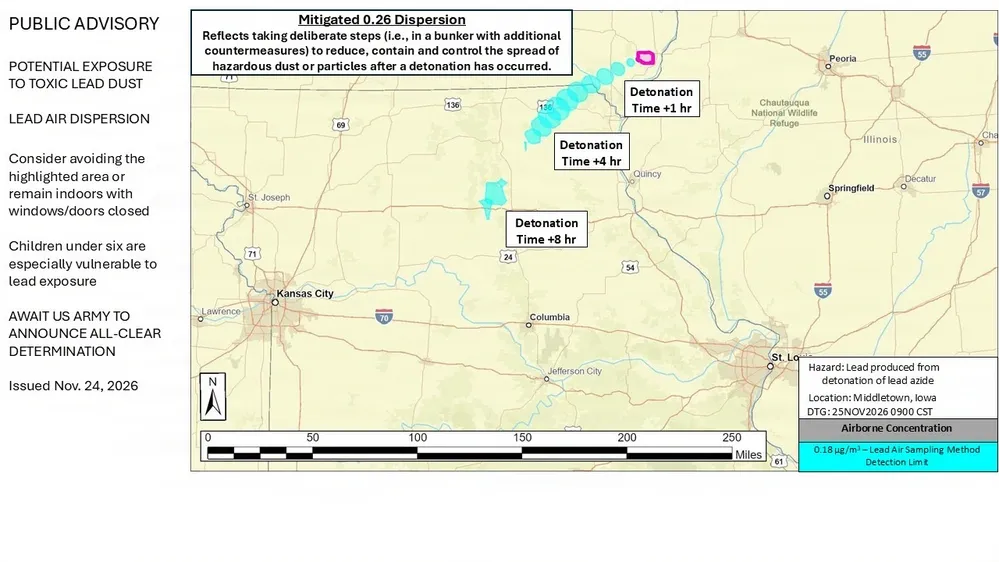
The US Army is preparing to detonate approximately 9,700 pounds of unstable lead azide at the Iowa Army Ammunition Plant in Middletown on Wednesday, November 25, at approximately 9 a.m. Central Time, weather permitting.
The operation involves 68 barrels of deteriorating explosive material. While the Army says a controlled detonation is necessary to prevent a potentially catastrophic accidental explosion, health and environmental organizations are warning about possible exposure to toxic lead dust.
A federal appeals court cleared the way for the operation on Monday following a legal challenge from environmental groups.
For nearby communities, the immediate question is not political: What precautions should residents take?
Who needs to evacuate?
The Army recommends temporary relocation for all residents of Middletown and immediately surrounding affected areas, including a modeled zone extending approximately five miles southwest of the ammunition plant.
The Federal Emergency Management Agency (FEMA) is providing transportation, temporary accommodation, meals and other assistance. Lodging is currently available through November 27, with extensions possible.
Residents can call FEMA at 1-800-621-3362, available 24 hours a day, to determine whether they are in the evacuation area and request assistance.
Evacuees should wait for official clearance before returning home.
What if you live outside the evacuation zone?
Residents in potentially affected areas of eastern Iowa and western Illinois should prepare to shelter indoors.
The Army and American Lung Association recommend:
Close windows and exterior doors.
Set heating and air-conditioning systems to recirculate indoor air rather than drawing air from outside.
Turn off kitchen and bathroom exhaust fans that pull air outdoors.
Keep children and pets inside.
Cover outdoor animal feed and water.
Avoid unnecessary travel through affected areas.
Use a HEPA air purifier if available.
The American Lung Association recommends remaining indoors for 24-48 hours following the detonation, while the Army advises residents to follow official updates about when the airborne exposure period has ended.
These are precautionary recommendations, not evidence that every community in the region will experience dangerous lead concentrations.
Why is lead dust a concern?
Lead is a toxic metal that can damage the nervous system, kidneys and other organs. Young children and pregnant people are particularly vulnerable.
The detonation may release lead-containing particles into the air. Depending on wind conditions, some particles could settle on soil, buildings, vehicles and outdoor equipment.
After officials determine the airborne exposure period has ended, residents in affected deposition areas should wet-clean surfaces frequently touched by children, including toys, playground equipment, patio furniture and windowsills.
Avoid dry sweeping or other activities that could stir settled dust back into the air.
Anyone concerned about possible exposure, particularly involving young children, should contact a healthcare professional for guidance.
Why is the Army detonating the material?
During an inspection on March 11, the Army discovered that decades-old lead azide had partially crystallized, making it increasingly sensitive to friction, shock and temperature changes.
Officials say transporting, chemically neutralizing or continuing to store the material could create an unacceptable risk of an accidental explosion.
Instead, the Army plans to destroy it inside reinforced, earth-covered structures, using sand barriers, water saturation, misting and other containment measures to reduce the release of lead particles.
Environmental groups have questioned the adequacy of the risk assessment and public notification.
How will residents know when it's safe?
The Army says it will update its airborne-dispersion and ground-deposition maps beginning six hours before the detonation and hourly until the operation.
Air, soil and water monitoring will continue afterward, with results to be published when available.
Residents should not rely on social media maps showing broad, fixed danger zones. The potential path of lead-containing dust depends on actual weather conditions, and exposure risks are not uniform across a geographic radius.
The bottom line: Residents within the Army's recommended evacuation area should relocate using the assistance available. Those in potentially affected surrounding communities should prepare to shelter indoors, monitor official updates and take precautions against lead-containing dust.
The most important information tomorrow will be the actual weather conditions, the observed plume, post-detonation monitoring results and the official all-clear.
Olga Nesterova is a journalist and founder of ONEST Network, a reader-supported platform covering U.S. and global affairs. A former White House correspondent and UN diplomat, she focuses on international security and geopolitical strategy.
Comments
Trump, Putin and Xi meeting in Shenzhen. Photo: Screenshot from the official broadcast.