Why One Fighter Jet Has Become NATO's Biggest Political Test
Why Trump's comments on Türkiye's F-35 request could shape the NATO Summit in Ankara

– 5 min read

Why Trump's comments on Türkiye's F-35 request could shape the NATO Summit in Ankara
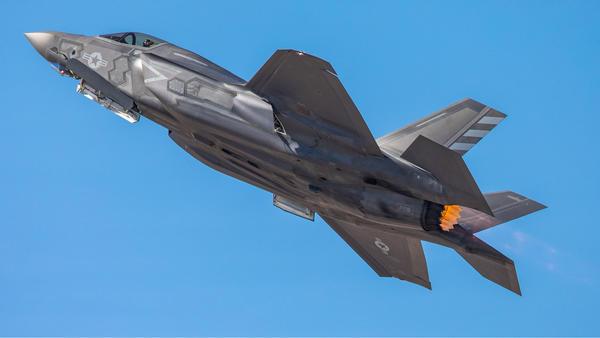
Ahead of the NATO Summit in Ankara on July 7–8, one issue is quietly emerging as one of the alliance's most consequential debates: whether the United States should allow Türkiye back into the F-35 fighter jet program.
President Donald Trump recently suggested he may have good news for Turkish President Recep Tayyip Erdoğan, saying he would "probably do something" that would make Erdoğan "very happy." Vice President JD Vance later confirmed the administration is reviewing whether Türkiye has met the legal requirements for Washington to reconsider the sale.
Those remarks immediately revived a debate that extends far beyond military procurement.
At first glance, this may appear to be a dispute over fighter aircraft.
In reality, it touches nearly every major geopolitical question surrounding NATO today: alliance unity, Israel's security, Greece and Cyprus, China's growing influence, Türkiye's increasingly independent foreign policy, and America's willingness to trust one of its most strategically important, but often unpredictable, allies.
Türkiye was one of the original industrial partners in the multinational F-35 program.
Before being removed from the program in 2019 following its purchase of Russia's S-400 air defense system, Turkish companies manufactured hundreds of components for the aircraft, Turkish pilots trained to fly it, and Ankara planned to purchase approximately 100 F-35s.
Today, Türkiye argues that its strategic need for the aircraft has only increased.
The military balance in the Eastern Mediterranean is shifting.
Greece has modernized its air force with French Rafale fighters and is expected to receive F-35s. Israel already operates one of the world's most experienced fleets of F-35I "Adir" (Hebrew for "Mighty One") aircraft.
Without a fifth-generation stealth fighter, Türkiye risks relying primarily on upgraded F-16s while neighboring air forces gain increasingly advanced capabilities.
The F-35 is also central to Ankara's broader regional strategy.
Türkiye's "Blue Homeland" (Mavi Vatan) doctrine asserts extensive maritime claims across the Aegean Sea and Eastern Mediterranean, bringing Ankara into disputes with Greece and Cyprus over maritime boundaries and offshore energy resources.
A stealth aircraft capable of operating in heavily defended airspace would significantly strengthen Türkiye's ability to project power in these contested areas.
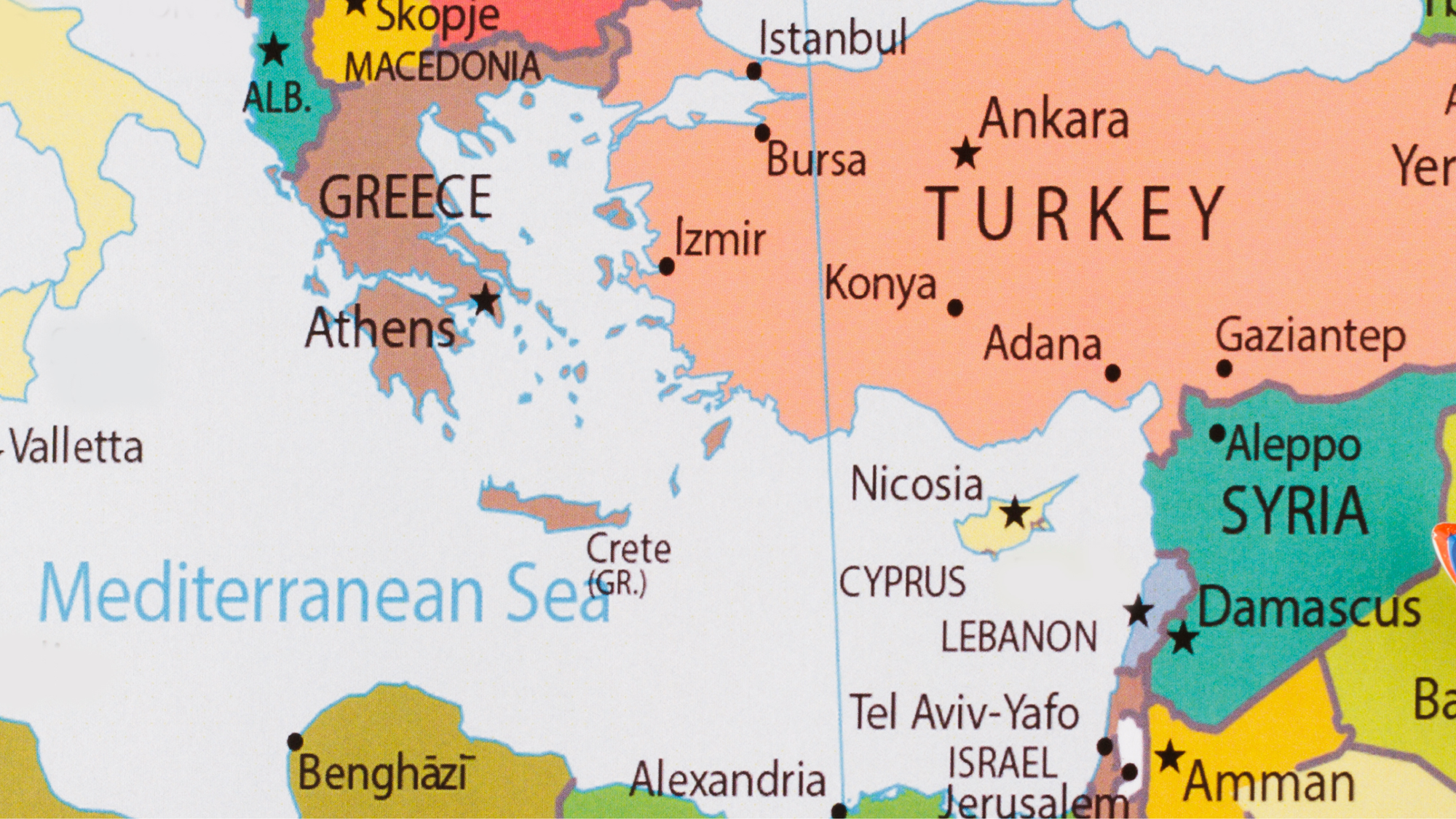
Cyprus lies just 40 miles (about 65 kilometers) from Türkiye's southern coast.
Ankara considers itself the guarantor of the Turkish Cypriot community under the 1960 Treaty of Guarantee. Following a Greek-backed coup in 1974 aimed at uniting Cyprus with Greece, Türkiye intervened militarily and has maintained forces in northern Cyprus ever since.
While most of the international community recognizes the Republic of Cyprus as the island's sole legitimate government, Türkiye continues to support the Turkish Republic of Northern Cyprus, which only Ankara recognizes.
For Turkish policymakers, Cyprus is not only a historical issue but a critical component of national security and control over the Eastern Mediterranean.
Türkiye is also developing its own fifth-generation fighter aircraft, the KAAN.
However, the program will require years before it reaches full operational capability. The F-35 would provide an immediate advanced capability while Ankara continues investing in its domestic defense industry.
Opposition in Congress extends beyond Türkiye's purchase of the Russian S-400.
Many lawmakers view the issue through Israel's security.
Under long-standing U.S. policy, Washington is committed to preserving Israel's Qualitative Military Edge (QME) — ensuring Israel maintains a technological military advantage over potential regional adversaries.
Israel currently enjoys that advantage through its fleet of F-35I "Adir" fighters.
Providing the same platform to Türkiye would narrow that gap at a time when relations between Ankara and Jerusalem remain deeply strained.
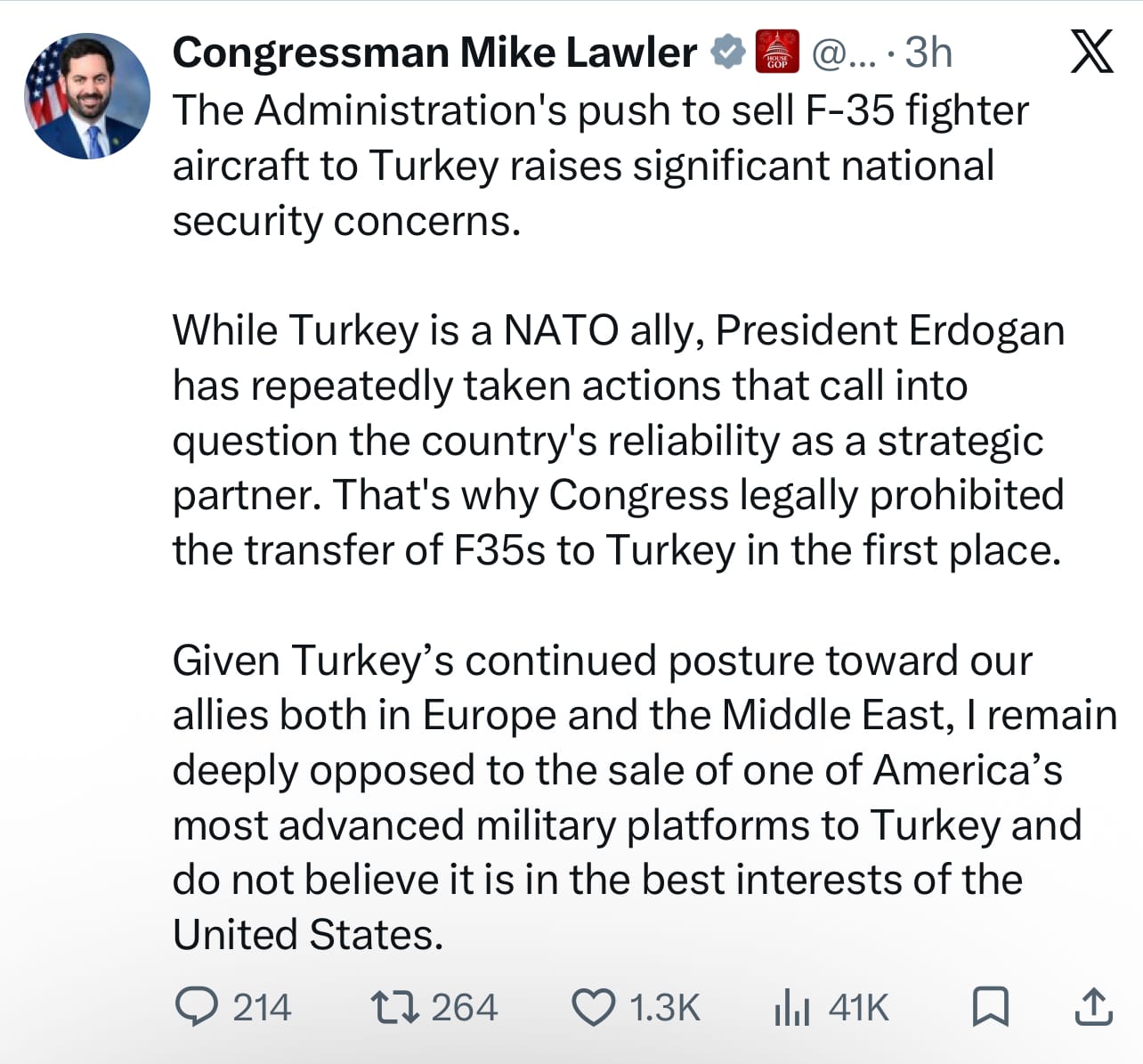
Representative Mike Lawler (R-New York), Chair of the House Foreign Affairs Subcommittee on the Middle East and North Africa, recently argued that returning Türkiye to the F-35 program raises significant national security concerns, pointing to Ankara's recent foreign policy decisions and tensions with several U.S. partners.
The debate is also shaped by Türkiye's increasingly multi-directional foreign policy.
Although Türkiye remains NATO's second-largest military, Ankara has simultaneously expanded cooperation with China, maintained close dialogue with Russia, and positioned itself as a diplomatic intermediary between competing global powers.
Relations with Beijing illustrate that balancing act.
In recent years, President Erdoğan has largely muted public criticism of China's treatment of the Uyghur Muslim minority — an issue that once featured prominently in Turkish politics because of the close cultural and linguistic ties between Uyghurs and Turks.
Instead, Ankara has prioritized expanding economic cooperation with Beijing, including projects connected to China's Belt and Road Initiative.
Türkiye has also deepened engagement with the Shanghai Cooperation Organization (SCO), becoming a Dialogue Partner in 2012, regularly attending SCO summits, and repeatedly expressing interest in closer cooperation with the China- and Russia-led organization.
Although Türkiye remains firmly inside NATO, its willingness to simultaneously strengthen ties with competing geopolitical blocs has raised questions in Washington about the country's long-term strategic direction.
For supporters of the F-35 sale, bringing Türkiye back into the program would reinforce its place within the Western security architecture.
Critics argue the opposite — that providing America's most advanced fighter aircraft would strengthen a government increasingly comfortable balancing between NATO, Russia and China.
One of the most misunderstood aspects of the F-35 debate is the idea of a U.S. "kill switch."
The Pentagon has publicly denied that the aircraft contains a literal remote kill switch capable of instantly disabling allied aircraft.
However, defense analysts argue that the F-35's software and logistical architecture can create a similar practical effect over time.
The aircraft depends on U.S.-controlled software updates, mission data files, maintenance systems, spare parts and technical support. If access to those systems were restricted, an F-35 would not suddenly stop flying, but its readiness, capabilities and long-term operational effectiveness could gradually deteriorate.
For Türkiye, this presents a strategic dilemma.
Ankara seeks greater defense autonomy through investments in indigenous systems such as the KAAN fighter. Purchasing the F-35 would significantly enhance Turkish military capabilities while also increasing dependence on continued U.S. support.
The debate over Türkiye and the F-35 is ultimately not about one aircraft.
It reflects a broader question facing NATO itself.
Throughout the Cold War, alliance members generally aligned their military, diplomatic and economic partnerships in the same direction. Today, countries increasingly compartmentalize those relationships.
Türkiye remains a NATO ally while purchasing Russian air defense systems, expanding trade with China, seeking closer engagement with the Shanghai Cooperation Organization, mediating between Russia and Ukraine, and simultaneously requesting access to America's most advanced fighter aircraft.
The question facing Washington is no longer simply whether Türkiye is an ally.
It is how much strategic flexibility the United States is willing to accept from allies pursuing increasingly independent foreign policies.
The F-35 debate is not really about a fighter jet.
It is about whether NATO can remain cohesive while some of its members pursue relationships with competing global powers. The discussions surrounding the Ankara summit may reveal not only the future of U.S.-Türkiye relations, but also how the alliance intends to balance security, strategic autonomy and geopolitical competition in an increasingly multipolar world.
ONEST will be covering the NATO Summit in Ankara in real time.