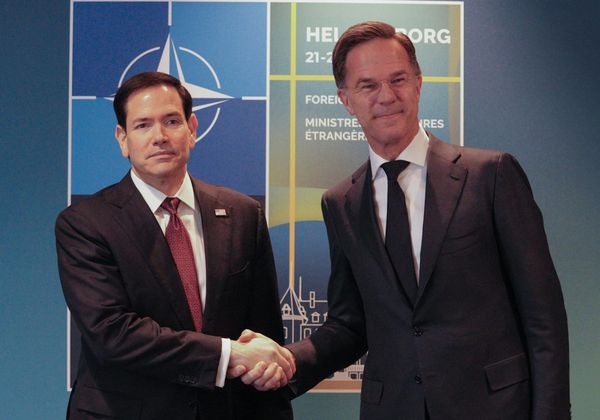
As Secretary of State Marco Rubio stood beside NATO Secretary General Mark Rutte in Sweden ahead of the next NATO summit, his remarks were framed as routine alliance coordination.
They were not.
Rubio said President Trump’s “disappointment” with some NATO allies over their response to U.S. operations in the Middle East was “well documented” and would need to be addressed at the leaders’ level. He also acknowledged that the U.S. and its allies “simply are not able to produce munitions today” at the rate required for future needs. And on Iran and the Strait of Hormuz, he said Washington was backing a Bahrain-sponsored UN Security Council resolution, adding: “Let’s see if the United Nations still works.”
Taken together, those remarks exposed a larger contradiction at the center of U.S. foreign policy: Washington wants NATO solidarity, UN legitimacy, and expanded military production capacity — after acting first, consulting later, and stretching the same alliance resources across Ukraine, Europe, and the Middle East simultaneously.
1. Rubio’s NATO Complaint Reveals a Fundamental Tension
Rubio openly acknowledged President Trump’s “disappointment” with NATO allies over their response to U.S. operations in the Middle East.
But this immediately raises a core issue:
NATO is not legally structured as a military support mechanism for unilateral U.S. military operations outside the treaty area.
The North Atlantic Treaty itself emphasizes collective defense and peaceful dispute resolution. Article 1 commits members to settle international disputes peacefully and to refrain from the threat or use of force inconsistent with the UN Charter. Article 5 — NATO’s famous collective defense clause — applies when a member is attacked.
And historically, Article 5 has only been invoked once: after the September 11 attacks against the United States.
That matters politically.
The United States benefited from alliance solidarity when it was attacked. But in the Iran case, Washington did not publicly consult allies before escalating, nor did it secure a Security Council mandate beforehand. The administration itself framed the urgency around strategic judgment and presidential instinct rather than publicly presented evidence of an imminent nuclear threat.
That creates an uncomfortable reality for European governments:
they are now being criticized for insufficient support in a crisis they did not collectively authorize.
2. Rubio Accidentally Confirmed NATO’s Production Crisis
One of the most important parts of Rubio’s remarks may also have been the least noticed.
He admitted openly that the United States and its allies cannot currently produce munitions at the scale required for future conflict scenarios.
That statement cuts directly into NATO’s current messaging strategy.
For months, NATO leadership has promoted expanded defense coordination and new procurement initiatives, including mechanisms through which European states purchase U.S. systems for Ukraine and broader European defense needs.
But Rubio essentially acknowledged the central structural problem:
the alliance is attempting to support Ukraine, maintain Indo-Pacific deterrence, reinforce Europe, and sustain Middle East military operations simultaneously — without the industrial base necessary to support all of them at once.
This is especially visible in air defense systems like Patriots.
The same systems promised to Ukraine are also needed for U.S. regional force protection in the Middle East and remain in demand among Gulf partners.
The contradiction becomes increasingly difficult to hide:
NATO is discussing expansion of commitments faster than it can expand production capacity.
And Rubio himself reportedly warned foreign ministers weeks earlier that aid flows would increasingly collide with broader U.S. strategic requirements.
3. “Let’s See if the United Nations Still Works”
Perhaps the most striking line came when Rubio described the Bahrain-sponsored Security Council resolution regarding the Strait of Hormuz.
“Let’s see if the United Nations still works,” he said.
But this framing immediately raises another contradiction.
The United States is now seeking UN-backed legitimacy after bypassing broad UN-centered diplomacy during the escalation phase itself.
Washington did not first secure Security Council authorization for military escalation against Iran.
It did not build a broad international legal consensus before acting.
And now it is effectively demanding international institutional support once maritime stability and global shipping are threatened.
For many states — especially in the Global South — that sequence matters.
The question is not simply whether Iran can restrict or toll international maritime transit.
Many countries oppose that.
The question is whether the United States can selectively bypass multilateral structures during escalation phases and then invoke those same structures once consequences begin affecting global trade and energy markets.
That is precisely why the Security Council vote now becomes politically sensitive.
4. The China Problem
Rubio also indirectly highlighted another strategic reality:
China currently presides over the UN Security Council.
And China has maintained significantly closer alignment with Iran and Russia than many U.S. planners expected several years ago.
When Rubio referenced potential vetoes, the message was clear:
Washington expects resistance primarily from Beijing and Moscow.
But this raises a broader geopolitical question:
did the United States underestimate how far strategic alignment between China, Russia, and Iran would deepen under mounting confrontation with Washington?
Because the current situation demonstrates something important:
the era in which the United States could assume automatic diplomatic dominance inside multilateral institutions is fading.
China may not openly endorse every Iranian action.
But Beijing also has little incentive to support a U.S.-framed resolution that appears disconnected from the earlier escalation cycle.
And as global polarization deepens, the Security Council increasingly reflects the fragmentation of the international order itself.
5. The Strait of Hormuz and International Law
Rubio is correct on one major legal point:
international waterways cannot simply become unilateral toll zones.
Under the UN Convention on the Law of the Sea (UNCLOS), international straits used for navigation are governed by transit passage rights that should not be impeded.
If Iran successfully normalized unilateral tolling or selective maritime restrictions, other strategic chokepoints around the world could potentially face similar pressures.
But here too, the legal picture is not entirely clean for Washington.
The United States itself has long had a complicated relationship with UNCLOS, including selective acceptance of its frameworks while remaining outside formal ratification.
Meanwhile, critics argue that military escalation, coercive maritime enforcement, and unilateral strikes without broad international authorization also weaken the very rules-based order Washington claims to defend.
In other words:
both Iran and the United States are accusing each other of undermining international norms while simultaneously stretching them for strategic purposes.
6. NATO’s Original Purpose vs. Today’s Reality
Rubio’s comments on troop deployments revealed another deeper issue.
NATO’s founding treaty frames the alliance as defensive in nature — designed to preserve peace and security in accordance with the UN Charter.
It was never formally designed as a permanent framework for projecting U.S. military power into multiple external theaters simultaneously.
Yet over time, NATO infrastructure increasingly became intertwined with broader American global strategy.
That evolution now carries risks for Europe itself.
Because once military bases become integrated into wider geopolitical confrontations beyond direct territorial defense, they also become potential strategic targets in future escalation scenarios.
This is precisely why debates inside Europe are quietly becoming more serious:
how much of NATO’s future mission is truly about collective territorial defense — and how much is becoming support infrastructure for wider geopolitical competition between major powers?
The Bigger Picture
Rubio’s remarks were not simply about Iran.
They unintentionally revealed the pressure points emerging across the Western alliance system:
- expanding military commitments without matching industrial capacity,
- demanding alliance solidarity without full consultation,
- invoking international law selectively,
- relying on multilateral institutions after bypassing them during escalation,
- and confronting a world where China and Russia are increasingly willing to challenge U.S. diplomatic assumptions directly.
The result is an alliance system under visible strain.
Not collapsing.
Not breaking apart.
But increasingly forced to confront the gap between the strategic ambitions of the United States and the institutional, industrial, political, and legal realities underneath them.
Support ONEST’s independent real-time reporting and analysis by signing up for ONEST+ or donating today.