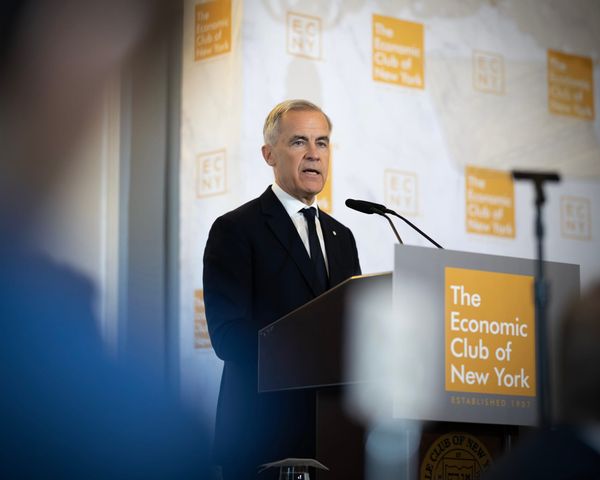
Today, ONEST attended a private event at the Economic Club of New York featuring Canadian Prime Minister Mark Carney.
The atmosphere felt less like a routine policy speech and more like the arrival of a leader many in the room had been waiting to hear from. The buzz began well before Carney entered. Senior finance, investment, policy, and business figures filled the room with the sense that Canada — often treated as predictable background stability — is now becoming central to how allies think about energy, trade, security, and trust.
And Carney knows it.
His message was direct: the world has changed, the old assumptions are gone, and Canada intends to act accordingly.
Repeatedly echoing themes from his Davos remarks earlier this year, Carney framed Canada not as a passive middle power, but as a country aggressively positioning itself inside the next global economic and security order.
He spoke about energy, LNG exports, defense, critical minerals, cyber capabilities, artificial intelligence, Arctic sovereignty, infrastructure, and strategic partnerships.
But underneath all of it was one core argument:
A country that cannot depend on itself is not truly sovereign.
That line explains nearly everything Canada is now doing.
Carney outlined a vision in which Canada becomes simultaneously:
- an energy superpower,
- a trusted democratic supplier,
- a defense and Arctic security actor,
- a clean technology and AI hub,
- and a country capable of reducing strategic dependence without turning inward.
He said Canada is on track to double LNG export capacity by the end of the decade while expanding its electrical grid and strengthening its position in global energy markets.
“That’s how an energy superpower looks when it decides to act like one,” he said.
He repeatedly returned to the idea of trust — not as branding, but as economic leverage.
Canadian institutions, banks, contracts, and alliances, he argued, remain credible because Canada honors its agreements and maintains stable governance in an increasingly unstable world.
The numbers from Carney’s office support that case:
- roughly $280 billion in government investments and incentives over five years are expected to unlock more than $1 trillion in total public, private, and institutional investment,
- Canada holds a AAA credit rating and the lowest net debt-to-GDP ratio in the G7,
- seven Canadian banks rank among the world’s 50 safest,
- Canada was ranked the world’s most attractive infrastructure investment market in May 2026,
- the country has preferential trade access to 1.5 billion consumers through 16 free trade agreements,
- and Ottawa is betting heavily on AI, quantum technologies, clean energy, and critical minerals.
Carney’s broader point was clear: while many countries are reacting defensively to global instability, Canada is trying to convert instability into positioning.
That includes defense.
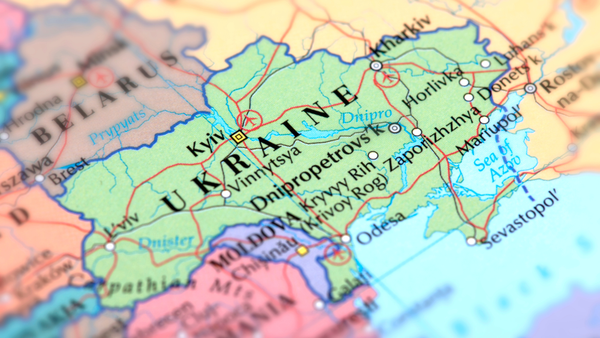
For the first time since the fall of the Berlin Wall, Canada is reaching NATO’s 2% defense spending target, with plans to move toward 5% by 2035. Carney described Russia’s aggression against Ukraine as “criminal,” emphasized Canada’s leadership role in Latvia, and highlighted Ottawa’s participation in the coalition working on postwar security guarantees for Ukraine.
He also pointed to Canada’s growing defense-industrial integration with Europe, including becoming the first non-EU country involved in elements of Europe’s defense infrastructure.
The subtext mattered.
While Washington continues shifting positions on tariffs, alliances, trade conditions, and industrial policy, Canada is trying to make itself indispensable to multiple partners simultaneously.
That was especially clear when Carney discussed the United States.
Rather than framing Canada as dependent on America, he framed Canada as part of the solution to America’s future vulnerabilities.
He spoke about aluminum, steel, uranium, nickel, lithium, electricity, and critical minerals — asking whether it truly makes sense for the United States to attempt replacing Canadian supply chains while energy demand, AI infrastructure, and industrial competition are all accelerating simultaneously.
“Canada is America’s largest customer,” he reminded the room, noting that Canada buys more from the United States than Japan and Germany combined.
But this was not a nostalgic defense of the old relationship.
It was an argument for a new one — between a more sovereign Canada and a United States increasingly focused on strategic competition.
Carney also discussed China in unusually candid terms.
He revealed that he had personally raised the “Thucydides Trap” with Chinese President Xi Jinping — the theory that rising powers and established powers often drift toward conflict unless they deliberately cooperate to avoid it.
According to Carney, Xi responded that cooperation based on mutual benefit — especially around climate and governance — was the way out.
Carney said he pushed China directly on overproduction, global imbalances, and the growing responsibility attached to the yuan as China rises economically.
Notably, this comes as Chinese Foreign Minister Wang Yi is visiting Ottawa this week — the first such visit by a Chinese foreign minister in roughly a decade.
That alone reflects Canada’s broader strategy:
build more relationships, reduce overdependence, and increase strategic optionality.
Carney repeatedly returned to one larger theme: countries are no longer asking only where they can sell products. They are asking where they are exposed.
Russia exposed Europe’s energy vulnerabilities.
China exposed mineral and supply chain vulnerabilities.
Technology monopolies exposed digital vulnerabilities.
And increasingly, governments are trying to ensure they are never left with only one option.
That is why Carney specifically mentioned cyber infrastructure, AI, defense software, and even Starlink-type systems.
“Nobody wants only one option anymore,” he said.
That may ultimately become the defining logic of the next decade:
countries building redundancy not only in military systems, but in energy, finance, communications, technology, trade, and alliances themselves.
On Ukraine, Carney projected confidence.
He argued that the outcome itself is not in doubt — only the amount of suffering still ahead. He pointed to Russia’s mounting losses, Ukraine’s expanding ability to strike deeper into Russian territory, and Canada’s growing defense cooperation with Kyiv, including partnerships modeled after Denmark’s approach of helping Ukraine build its own long-term defense production capacity.
What stood out most was not one announcement or statistic. It was the sense of a country that has already made its strategic choice: Canada is no longer waiting for the world to stabilize before deciding how to move. It is already moving.
Carney spoke like the leader of a country that believes the current geopolitical rupture is not temporary noise, but the beginning of a permanent restructuring of the global system.
And unlike many governments still trying to regain balance amid Washington’s changing signals and mounting global fragmentation, Canada appears increasingly focused on one thing:
turning reliability itself into power.