How Russia and Iran Are Draining the West’s Best Defenses
Cheap drones are reshaping war — and Ukraine may be building the answer.

– 11 min read

Cheap drones are reshaping war — and Ukraine may be building the answer.
A drone does not have to reach its target to accomplish its mission.
It may succeed by forcing a fighter to scramble, compelling an air defense battery to activate its radar, drawing the launch of an expensive interceptor or revealing where defensive systems are positioned. It may carry no meaningful warhead at all. If the defender cannot safely distinguish it from the real threat, the defender must still react.
That is the logic behind one of the most consequential strategies in modern warfare: make the enemy expend scarce resources against threats that are cheaper and faster to replace.
The attacker is not simply trying to penetrate the defense. It is trying to exhaust it.
Military reserves are often discussed as quantities: how many missiles, aircraft or artillery shells a country possesses. But a strategic reserve includes much more:
An attack can therefore be effective without destroying anything directly.
A relatively inexpensive drone may force the defender to launch a missile costing far more. Even when a fighter uses a cheaper weapon — or destroys the drone without firing a missile — the response still consumes fuel, flight hours, maintenance and crew readiness.
One incident is manageable. Repetition changes the equation.
If inexpensive threats arrive every night, the defender faces an increasingly difficult choice: intercept everything and gradually exhaust limited resources, or preserve those resources and accept the possibility that a real weapon will get through.
Large drone attacks are commonly described as attempts to overwhelm air defenses. That is true, but incomplete.
The attacker may pursue several objectives simultaneously:
The drone wave may therefore be the opening mechanism rather than the principal attack.
The United States has confronted this problem during its war with Iran. Iranian missiles and drones have required repeated use of American and allied air defenses across a wide geographic area.
The individual interception rate may be impressive while the strategic exchange remains unfavorable. The relevant question is not simply how many threats were destroyed. It is how many scarce interceptors were used, how quickly they can be replaced and what those weapons will no longer be available to defend elsewhere.
The Iran war has already created concern about the availability of munitions for a potential conflict in the Indo-Pacific. Replenishing sophisticated American missiles can take months or years, not days.
Russia is now presenting NATO with a version of the same problem.
When a Shahed-type drone enters allied airspace, NATO cannot assume it is harmless. Fighters may have to scramble, air defenses must track it, commanders must determine its trajectory and authorities must decide whether to engage.
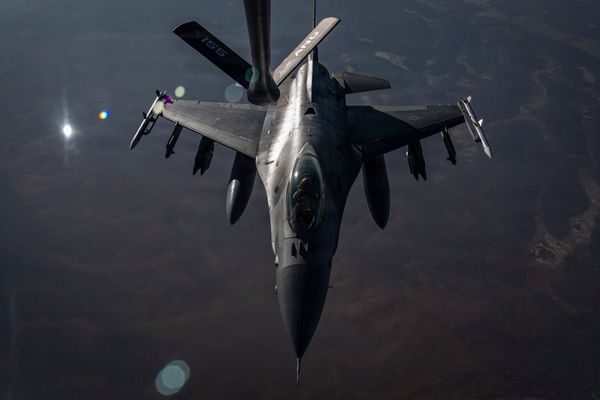
Romanian F-16s and Italian Eurofighters recently scrambled under NATO command after a drone approached and entered Romanian airspace. The aircraft shot it down — but the interception also demonstrated the asymmetry Russia can repeatedly impose.
The question is not whether an F-16 can destroy a Shahed. It is whether Europe can afford to scramble fighters every time Russia sends one — and what happens when one drone becomes 200.
During the Second World War, Germany’s V-1 flying bombs forced Britain to reorganize significant parts of its air defense.
Fighter aircraft conducted interception patrols. Anti-aircraft guns were repositioned. Radar stations, barrage balloons and observation systems were integrated into a defensive belt. Britain eventually became much more effective at destroying the weapons, particularly after adapting detection, gun control and proximity-fuse technology.
But the V-1’s strategic effect was not limited to the damage caused when one reached London. Germany forced Britain to dedicate aircraft, guns, crews and attention to stopping pilotless weapons that were cheaper and simpler than the systems sent to intercept them.
Later militaries refined the logic through unmanned decoys. Decoys could provoke air defense radars into activating, reveal their locations and cause missiles to be launched — allowing follow-on aircraft to attack the newly exposed defenses.
Today’s drones combine these roles. They can be weapons, decoys, reconnaissance platforms and instruments of economic pressure within the same attack.
The concept is not new. Its scale, accessibility and rate of production are.
The public question is whether a drone was intercepted.
The strategic question is what the interception consumed — and whether the defender can replace it before the next, more dangerous attack arrives.
In the full ONEST+ analysis:
Join ONEST+ for independent analysis connecting today’s events to the strategy shaping what comes next.
The United States entered the Iran war with overwhelming advantages in aircraft, intelligence, precision targeting and missile defense. Iran does not need to neutralize those advantages symmetrically.
It can instead make the United States spend them.
Every American interceptor used in the Middle East has an opportunity cost. That weapon cannot simultaneously protect Guam, a carrier group, a European base or Taiwan. Every air defense battery deployed to reassure one regional partner is a battery unavailable elsewhere. Every production slot used to replace a missile fired at Iran affects outstanding demand from American forces and foreign customers.
Estimates following the earlier phase of the Iran conflict already suggested substantial use of THAAD and SM-3 interceptors. The renewed campaign adds pressure to inventories that were never designed around several simultaneous, prolonged wars.
This is where tactical success can conceal strategic damage.
The United States may intercept an extremely high proportion of Iranian weapons and still emerge with a weaker global position if Iran can replace its drones and missiles more quickly than Washington can replace the defenses used against them.
Iran’s objective does not need to be an American military defeat in the conventional sense. It can be a window of vulnerability elsewhere.
A future adversary benefits if the United States must rebuild inventories for years. China does not have to provide Iran with direct military assistance to gain from the diversion of American interceptors, naval capacity and attention away from the Western Pacific.
That is why munitions depletion is not an accounting problem. It alters deterrence.
An adversary calculates not only whether the United States possesses a weapon, but whether Washington has enough of it to fight one war while remaining prepared for another.
The focus on the price of an interceptor can obscure the full cost imposed by a drone.
Scrambling a fighter requires fuel, ground crews, maintenance and potential aerial refueling. Aircraft components have limited service lives. Pilots have finite readiness hours. Every emergency launch interrupts training and other missions.
Air-policing procedures were designed primarily to identify occasional aircraft entering or approaching protected airspace. They were not designed to become the routine first layer against hundreds of mass-produced one-way drones.
Russia can exploit the difference.
It does not need every drone crossing toward NATO territory to carry a major warhead. Ambiguity creates the requirement to respond. A drone may be malfunctioning, deliberately probing NATO’s reactions or approaching a military or civilian target. The defender often cannot know soon enough to ignore it safely.
Each incident also generates political costs. If NATO does not intercept the drone and it causes casualties, governments will be accused of failing to protect their territory. If NATO repeatedly scrambles advanced fighters, Russia imposes a favorable resource exchange without conducting a conventional attack on the Alliance.
This is coercion below the threshold of war, conducted through the defender’s own safety requirements.
The strategic reserve problem is becoming more urgent because drones have erased much of the traditional distinction between the front line and the rear.
Older battlefield assumptions placed many command centers, ammunition depots, artillery positions, logistics hubs and aircraft beyond the immediate reach of ordinary enemy troops. Long-range precision weapons could threaten them, but those weapons were relatively scarce and reserved for valuable targets.
Drones now carry surveillance and strike capability over forces far behind the contact line.
An armored vehicle does not have to encounter an enemy tank to be destroyed. It can be identified by a reconnaissance drone, tracked through a network and attacked by another unmanned system. Artillery can be located after firing. Supply vehicles can be followed. Personnel assembling far from the trenches can be targeted within minutes.
This changes the cost calculation on both sides.
A multimillion-dollar vehicle can be immobilized by a comparatively inexpensive drone. A sophisticated radar can be attacked after revealing itself against an earlier decoy. A large headquarters may become more vulnerable than several small, dispersed command posts.
Military value is consequently shifting away from concentration, perfection and permanence and toward dispersion, redundancy, mobility and replaceability.
The most technologically sophisticated force does not automatically possess the advantage if it presents a small number of exquisite targets to an opponent capable of producing thousands of adequate weapons.
Ukraine could not answer every Shahed with a Patriot interceptor because it never possessed enough Patriots — and because it needs those missiles for threats that cheaper systems cannot defeat.
Its response has been to build a layered defense in which the method of interception is matched, as far as possible, to the threat.
Ukraine has used:
A U.S. Army analysis highlighted Ukraine’s network of thousands of inexpensive acoustic sensors, which detects engine and propeller signatures and directs mobile teams toward incoming drones. The network provides warning without requiring every target to be tracked continuously by an expensive active radar.
Ukraine has also developed automated gun systems and interceptor drones intended to preserve scarce missile defenses for more difficult targets.
This is not an argument that inexpensive systems solve everything. Guns have limited range. Electronic warfare can be defeated or circumvented. Interceptor drones may struggle in poor weather or against faster targets. Acoustic systems depend on correct identification and effective command networks.
The advantage comes from combining them.
A layered system forces the attacker to defeat several different detection and interception methods while allowing the defender to avoid using its most expensive weapon by default.
Wars have traditionally been measured through platforms: how many fighters, ships, tanks or missile batteries each side possesses.
Drone warfare makes the production system itself part of the battlefield.
Russia’s Shahed-derived drones are estimated to cost tens of thousands of dollars each and can be produced in volumes that would be impossible for advanced cruise missiles. The precise unit cost matters less than the replacement relationship: Russia can build them more quickly than many Western countries can manufacture the missiles used to destroy them.
According to a NATO-hosted study, Russia increased its use of one-way attack drones from fewer than 1,000 in 2024 to more than 44,000 during the first ten months of 2025. The same study warned that using powerful, expensive and slowly produced missiles against this volume risks depleting stockpiles while placing unsustainable pressure on defense budgets.
The defender therefore needs more than a higher interception rate. It needs a favorable replacement rate.
If 95 of 100 drones are destroyed but the defender uses weapons that require years to replenish, the five successful drones do not tell the full story. The defender may have won the night and weakened its ability to survive the month.
None of this makes American air defense technology obsolete.
Patriot, THAAD, Aegis and other advanced systems remain essential precisely because some threats cannot reliably be defeated by machine guns, electronic warfare or interceptor drones.
Ballistic missiles descend at extreme speeds. Advanced cruise missiles can maneuver and fly complex routes. Some threats carry warheads capable of causing mass casualties or destroying strategically critical infrastructure. Against those weapons, the defender may have only seconds to detect, classify and engage.
American systems provide:
Ukraine’s lower-cost defenses cannot replace that layer. They make it possible to preserve it.
The error is not buying an expensive interceptor. The error is using that interceptor against every object in the sky because no appropriate lower-cost layer was fielded beneath it.
American technology remains indispensable at the high end. But indispensability creates scarcity, and scarcity requires discipline.
In parts of the counter-drone market, yes.
Ukraine’s advantage is not that every system it produces is technologically superior to its American equivalent. Its advantage is that Ukrainian systems are developed against real attacks, modified quickly and judged by whether they work at scale under battlefield conditions.
Traditional U.S. procurement often aims for a highly capable system that can satisfy extensive requirements across several services over many years. Ukraine’s model begins with an immediate operational problem, fields an imperfect solution, learns from failure and changes the design within weeks or months.
That process produces different weapons.
American companies remain strongest in advanced interceptors, sensors, aircraft, integrated command systems and high end precision strike. Ukraine is increasingly strong in areas where price, production volume and rapid adaptation matter more than technical perfection:
NATO has already begun adopting this logic. The Alliance and the U.S. Army demonstrated the Merops counter-drone system for Poland and Romania. NATO said each interceptor costs approximately $14,500 — about one-tenth of the estimated cost of the Shahed drones it is designed to destroy. The system had already been used extensively in Ukraine.
That reverses the usual exchange: the defender can destroy the attacking drone with something cheaper.
The most important Ukrainian export may therefore not be a specific drone. It may be a procurement philosophy built around adaptation, replaceability and mass.
The emerging defense market should not be understood as a contest in which Ukrainian systems replace American ones.
They solve different parts of the same problem.
The United States produces the shield needed against the most dangerous weapons. Ukraine is developing the layers that prevent that shield from being wasted.
A sustainable architecture would combine:
The strategic advantage belongs not to the country possessing the single best interceptor, but to the country capable of selecting the cheapest reliable response without allowing the real weapon through.
The lesson from Iran and Ukraine is not that cheap drones have made expensive weapons irrelevant.
It is that every expensive weapon now needs a cheaper system protecting its reserves.
Iran can use repeated attacks to reduce America’s readiness for another theater. Russia can compel NATO to spend fighter hours and expose its response patterns without launching a conventional assault on allied territory. Both can combine drones, decoys and missiles so the defender must decide which threat deserves which resource — under time pressure and with incomplete information.
The country that fails to adapt may continue winning every individual interception while losing the larger contest of production, endurance and choice.
That is the war before the strike: the effort to determine what the defender will have left when the enemy’s weapon that truly matters finally “arrives.”