Why the U.S. Just Bought Billions in Japanese Yen

– 4 min read

Earlier this week, Reuters reported that the U.S. Treasury had alerted major banks that Washington could intervene in currency markets to support Japan's yen.
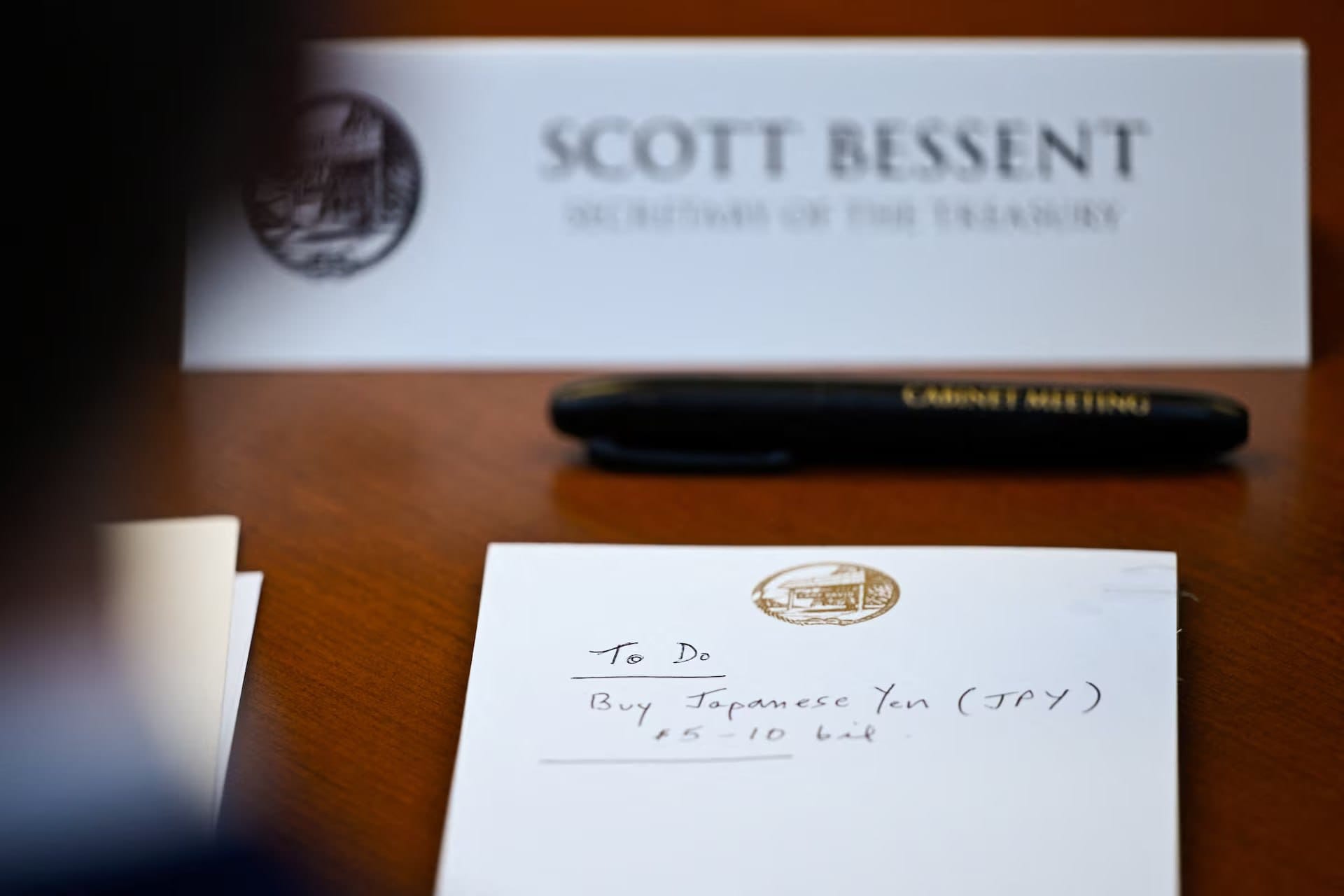
Then, during a Cabinet meeting at Camp David, photographers captured Treasury Secretary Scott Bessent's handwritten note:
"To Do — Buy Japanese Yen (JPY) $5–10 billion."
Now, speculation has become confirmation.
Japan's Ministry of Finance announced that on July 31 (U.S. Eastern Time) it coordinated with the U.S. Department of the Treasury to purchase Japanese yen in foreign exchange markets.
President Donald Trump later described the move as "a signal of friendship" toward one of America's closest allies.
So...
Why would the United States buy another country's currency?
The Japanese yen had fallen sharply against the U.S. dollar in recent months.
That may sound like a technical issue, but it affects almost everything.
A weaker yen makes Japanese exports cheaper overseas, but it also makes imports — especially food, oil, and natural gas — more expensive at home.
For a country that imports most of its energy, a rapidly weakening currency can fuel inflation, increase household costs, and slow economic growth.
To counter that pressure, Japan intervened in foreign exchange markets.
This time, however, it wasn't acting alone.
The United States joined the operation, making it one of the rare occasions in recent decades that Washington has directly participated in supporting the Japanese currency.
The biggest reason is interest rates.
For years, Japan kept interest rates near zero while the United States raised them significantly.
That created an opportunity for investors.
They could borrow money cheaply in yen, convert it into U.S. dollars, and invest in higher-yielding American assets.
This strategy is known as the yen carry trade.
When millions — or billions — of yen are sold this way, the currency weakens even further.
Normally, governments don't determine exchange rates.
Financial markets do.
But when currency movements become excessively volatile, governments can step in.
Japan sells part of its foreign currency reserves — primarily U.S. dollars — and uses that money to purchase yen.
Buying more yen increases demand for the currency, which can help strengthen its value.
When the United States joins that effort, the message becomes much stronger.
Markets are no longer trading against Tokyo alone.
They're trading against Tokyo and Washington together.
Japan has intervened in currency markets before.
The United States almost never joins.
Coordinated intervention between the world's largest economy and one of its closest allies is exceptionally rare.
It sends a powerful message to investors:
Governments believe the market has pushed the currency too far.
Japan's Ministry of Finance has also made clear that it will not hesitate to conduct further joint intervention if excessive volatility returns.
At least in the short term, yes.
Following the intervention, the yen strengthened over several consecutive trading sessions, reversing part of its recent decline.
But history suggests intervention alone rarely changes long term trends.
Governments can calm markets.
They can discourage speculation.
They can buy time.
What they cannot do is permanently override economic fundamentals.
As long as U.S. interest rates remain substantially higher than Japan's, investors will continue to have an incentive to move money into dollar-denominated assets.
There are several reasons.
Japan is one of America's closest allies and one of the world's largest economies.
A rapidly weakening yen raises inflation inside Japan, increases energy costs, and can create broader financial instability across Asia.
The United States also has an interest in maintaining orderly global financial markets.
There may also be a trade dimension.
A stronger yen makes Japanese exports relatively more expensive while making American products more competitive abroad.
President Trump framed the intervention in geopolitical terms, describing it as "a signal of friendship" between Washington and Tokyo.
This isn't simply a story about Japan.
The U.S. dollar and the Japanese yen are two of the world's most heavily traded currencies.
When the governments behind two of the world's largest economies enter currency markets together, investors around the world pay attention.
Exchange rates influence:
A single intervention can ripple through financial markets far beyond Japan.
The intervention also comes as China's yuan has strengthened in recent days.
Unlike Japan's yen, however, the yuan's gains have largely reflected broader weakness in the U.S. dollar and improving market sentiment rather than coordinated intervention with another government.
That distinction matters.
Japan's operation represents a deliberate policy decision jointly executed with the United States, while recent moves in the yuan have been driven primarily by market conditions.
For years, investors treated the yen's decline as a one-way trade.
The joint U.S.-Japan intervention is a reminder that governments are not merely observers of financial markets.
Most of the time, they allow markets to determine prices.
But when volatility becomes large enough to threaten economic or financial stability, they can step in — and, in rare cases, do so together.
Whether this intervention marks a lasting turning point will depend less on how many billions are spent buying yen and more on whether the underlying economic conditions change.
Markets can be influenced.
They are much harder to overrule.