Did the G20 Just Side With the U.S. Against China on Trade?

– 4 min read

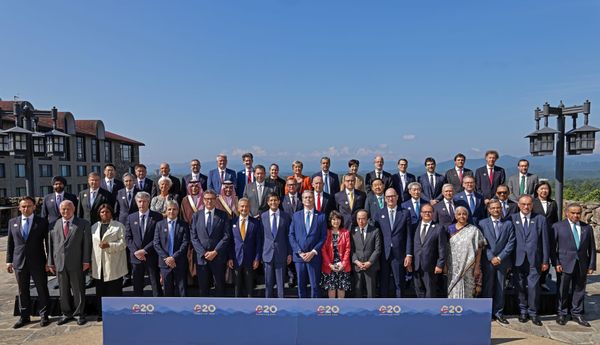
China found itself isolated at this week’s G20 finance ministers meeting in Asheville, North Carolina.. at least on paper.
U.S. Treasury Secretary Scott Bessent said 19 members of the Group of 20 agreed that persistent trade imbalances and a stream of cheap exports from non-market economies were becoming unsustainable. China was the only member that refused to endorse the relevant portions of the final statement.
That sounds like a significant diplomatic victory for Washington.
But did the rest of the G20 really agree to pressure Beijing into changing its economic model?
The short answer: yes on the problem, but not necessarily on the U.S. solution.
The meeting ended without the traditional unanimous communiqué because China objected to several sections of the proposed text. Instead, the U.S., which currently holds the G20 presidency, released a Chair’s Statement reflecting the areas supported by the other members.
One of its most consequential passages addressed persistent trade imbalances.
The statement called on countries with excessive external surpluses to address policies that constrain domestic consumption and make their economies overly dependent on exports. It also called for the elimination of “non-market policies and practices” that contribute to those distortions.
China was not named. It did not need to be.
Beijing has spent years trying to move its economy toward greater domestic consumption, but investment and manufacturing remain unusually important drivers of growth. At the same time, Chinese factories produce enormous quantities of manufactured goods that are sold abroad.
Bessent made clear after the meeting that China was the principal target of the discussion.
He argued that economies producing persistent streams of inexpensive exports were effectively taking growth away from other countries and described China’s enormous trade surplus as unsustainable. According to Bessent, the fact that the other 19 G20 members accepted the language demonstrated how widespread that concern has become.
Because the Trump administration believes its tariff policy has changed where Chinese exports go.
Washington has erected significantly higher barriers against Chinese goods. Bessent says he warned other governments that if Chinese products could no longer enter the U.S. market as easily, they would not simply disappear.
They would be redirected elsewhere.
That matters for Europe, Canada and other major economies because domestic manufacturers may suddenly find themselves competing with larger volumes of inexpensive Chinese products.
Chinese exports rose 23.9% year-on-year in July, according to figures cited by Reuters, while concerns over Chinese industrial overcapacity have already intensified in Europe.
Bessent’s message in Asheville was essentially: the trade imbalance is no longer just Washington’s problem.
He went further, suggesting other governments should consider their own tariffs or other measures to protect domestic industries and jobs from diverted Chinese exports.
No.
And this is where the distinction becomes important.
The other members accepted language identifying persistent external surpluses, weak domestic consumption and non-market practices as problems that should be addressed.
That is not the same thing as endorsing Trump’s tariff strategy.
Several governments continue to disagree sharply with Washington over tariffs.
Germany, for example, used the Asheville meeting to criticize U.S. tariff disputes as another source of global economic uncertainty. Britain said it intends to maintain a pragmatic trading relationship with China even while acknowledging concerns about global imbalances.
So Asheville did not produce a 19-country coalition committed to imposing tariffs on Beijing.
What it produced was arguably more subtle: a broad agreement that the underlying imbalance itself is a problem.
That matters.
For years, Beijing has been able to portray complaints about its export model largely as part of Washington’s economic confrontation with China.
It becomes harder to make that argument when nearly the entire G20 accepts language calling on large surplus economies to increase domestic consumption and reduce excessive dependence on exports.
Because the statement goes directly to one of the most sensitive questions surrounding China’s economic model.
Beijing has relied heavily on manufacturing investment and exports while household consumption remains comparatively weak.
Changing that balance is not as simple as ordering consumers to spend more.
It could require restructuring how income is distributed through the Chinese economy, expanding social protections so households feel less need to save, reducing dependence on investment-led growth and potentially withdrawing support from industries Beijing considers strategically important.
In other words, what sounds like technical G20 language about “imbalances” ultimately touches the structure of China’s economy.
Beijing has also repeatedly rejected the argument that its success in industries such as electric vehicles, batteries and renewable-energy technology should automatically be characterized as harmful overcapacity.
Accepting the Asheville language would therefore mean accepting much of the premise behind Washington’s criticism.
China chose not to.
There is another side to the G20 statement that received considerably less attention.
The responsibility for global trade imbalances was not placed entirely on surplus countries.
Deficit economies were also told to increase domestic savings and pursue sustainable fiscal policies.
That includes the United States.
The IMF has made essentially the same argument: China needs to stimulate domestic consumption, but Washington’s enormous fiscal deficits and high consumption also contribute to global imbalances. Correcting the system therefore requires adjustment on both sides.
Put simply:
China is being told to consume more and rely less on exports. The United States is being told to borrow less and save more.
That is considerably different from saying "the G20 simply endorsed Washington’s economic policy".
The important development from this meeting may not be that China refused to sign.
It is that almost everyone else was willing to sign.
The United States has spent years arguing that China’s industrial policy, weak domestic consumption and enormous export capacity create problems well beyond the bilateral U.S.-China relationship.
In Asheville, that argument received unusually broad support.
Whether those governments are willing to follow Bessent toward tariffs and stronger trade barriers is another question entirely.
For now, the emerging consensus appears narrower:
China’s export-driven imbalance is becoming a global problem, even among countries that have no intention of joining Washington’s trade war.
If you value independent reporting and analysis like this, please consider supporting my work by joining ONEST+.