Trust has fallen since the pandemic. At the World Health Summit, new data on science, women’s health and emotional wellbeing points to a more complicated problem: expertise has not disappeared, but it is competing with an information environment where everyone has a microphone.
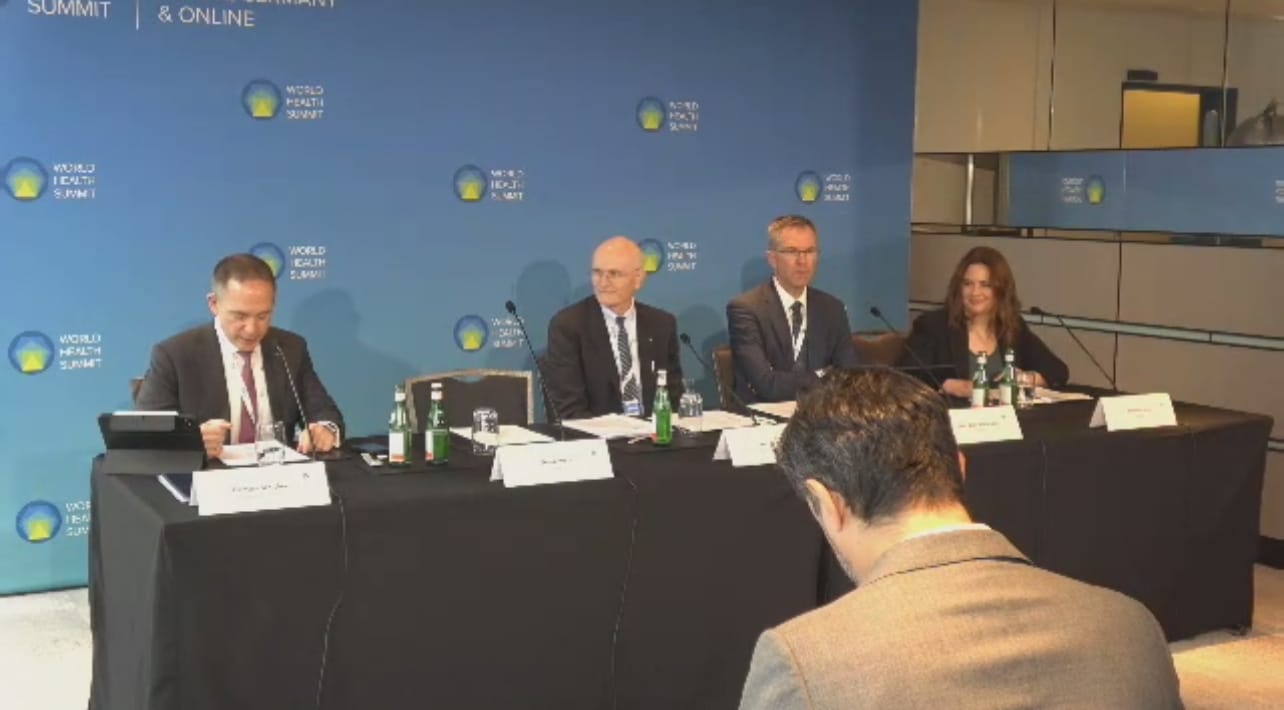
The World Health Summit opened in Berlin on Sunday under the theme “From Crisis to Resilience: Innovating for Health,” bringing together more than 4,000 participants in person and tens of thousands online, with over 400 speakers across more than 75 sessions. Its agenda spans global health architecture, pandemic preparedness, women’s and children’s health, future-ready health systems, conflict and health, and environmental drivers of health.
At the opening press conference, however, one issue cut across almost everything else: trust.
World Health Summit Opening Press Conference | Screenshot from official Zoom Meeting
Wellcome launched its new Global Monitor 2026, based on more than 140,000 people in 140 countries. In the 108 countries surveyed across all three waves, 72% of respondents in 2025 said they trusted science “some” or “a lot,” down from 80% in 2020 and 77% in 2018. The share expressing little or no trust rose to 19%, from 13% in both previous waves. Wellcome cautions that a methodology change in China affects the global trend line; excluding China, trust between 2018 and 2025 appears more stable.
That nuance matters.
So does another finding: 81% of people say the work of scientists benefits people like them, but only 37% believe science benefits most people in their country. One in five say it benefits very few. Trust is also markedly higher among people who feel financially secure, have confidence in hospitals and clinics, and trust national institutions. Among people with a lot of confidence in their health system, 43% trust science “a lot,” compared with 26% globally.
That suggests the trust question is not simply about whether people “believe science.” It is also about whether they see science working in their lives.
And the Summit offered a concrete example of what that can look like.
UNFPA Executive Director Diene Keita highlighted Bangladesh’s proposed €250 million Women’s Health Initiative, developed with support from the European Investment Bank and UNFPA. The programme would direct financing already approved under an EIB sovereign loan toward women’s health and stronger district and critical-care services between 2027 and 2031. It is expected to expand maternal and newborn care, emergency obstetric services, and cervical and breast cancer services to approximately 47 million women and girls.
Keita’s point was not simply that women’s health deserves more attention. It was that governments should stop treating it as a narrow social cost and start treating it as an investment in productivity, resilience and national development.
She also emphasized something less glamorous but potentially more consequential: continuity of care.
Health systems routinely mobilize money during crises. But if maternal care, cancer screening, reproductive health services or treatment disappear once the emergency phase ends, countries can end up paying more later for worse outcomes.
That connects directly to the Summit’s broader argument: resilience is not simply the ability to react to the next emergency. It is the ability to keep care functioning when the emergency is no longer dominating headlines.
The second major report released Sunday complicated another familiar headline.
Gallup’sState of the World’s Emotional Health 2026 draws on surveys conducted in 97 countries so far this year. A median of 81% of adults reported using social media in the previous week, rising to 95% among people aged 15 to 29. Yet Gallup found that the relationship between social media use and wellbeing is modest and not straightforward. Moderate users often reported better outcomes than either low or high users, while high use was associated with more anger, loneliness, sadness, stress and worry. In high-income countries, including the United States, high use was also associated with lower life evaluation. Gallup stresses that the study is observational and cannot establish cause and effect.
That is precisely the kind of result that struggles in an information environment built for simple conclusions.
“Social media is destroying mental health” is easy to package.
“Effects vary by country, age, intensity of use and outcome measured, and the data show association rather than causation” is much harder.
But the second statement is closer to what the research actually says.
During the press conference, I asked the panel what journalists covering the Summit should pay closer attention to over the next several days, particularly issues that are routinely overlooked.
World Health Summit President Axel R. Pries answered that what is overlooked depends on the audience. One of the Summit’s strengths, he argued, is precisely that it creates a forum for many different issues; journalists have to decide which matter most to the people they serve.
Other panelists were more specific.
Gallup’s Ilana Ron-Levey pointed to emotional wellbeing, arguing that it remains underreported despite the scale of the problem. UNFPA highlighted continuity of care and healthy longevity. And another theme cut across the discussion: health is too important to remain the domain of health specialists alone. It has to reach political leadership.
That may be the more important lesson.
Science does not exist in isolation. Whether a discovery changes lives depends on financing, political decisions, health systems, trust, access and whether people ever hear an accurate account of what the evidence actually says.
And that brings us back to media.
The problem is not that researchers were somehow designed badly for the age of Instagram. They were not trained to become influencers, nor should that be their job. The problem is that scientific expertise now competes on the same screen with politicians, commercial wellness advice, celebrities, influencers, algorithms and anyone else with a large enough audience. When expertise and popularity are presented in exactly the same format, reach can start to look like authority.
Yet when the stakes become real, our behavior often tells a different story. A broken leg sends us to an orthopedic specialist. Dangerously high blood pressure sends us to a doctor. A complicated pregnancy sends us toward obstetric expertise. In practice, people still rely on specialized knowledge when consequences become personal.
So perhaps the challenge is not convincing people that expertise matters. It is making expertise visible, understandable and traceable before a crisis forces the issue. That is where journalism should come in.
Media should be the connective tissue between scientists and the public: go directly to the source, document carefully what was said, explain what is known and what remains uncertain, pair promises with measurable outcomes, and return later to ask whether those outcomes were actually delivered.
If Bangladesh says a €250 million program will reach 47 million women and girls, the announcement matters, but so will the follow-up.
How many facilities improved? How many women actually received care? Did maternal outcomes change? Were cancers detected earlier? Did the investment produce what governments promised?
Those are not less compelling stories than the noise. They are simply harder stories to tell well.
And that is also why we created Simply Put. at ONEST.
The idea is straightforward: go directly to people who understand complicated subjects and ask one clear question at a time. The goal is not to strip away complexity. It is to make complexity understandable, while keeping the evidence attached.
That, perhaps, is one way to make science interesting again. Not by asking scientists to become influencers, but rather by making the results impossible to ignore.
Coming soon on Simply Put: My interview with the CEO of the World Health Summit; bringing you closer to the people shaping global health, and the decisions that affect us all.
Simply Put is part of ONEST — our effort to go directly to experts, ask clear questions, and make complicated issues understandable without stripping away the nuance.
Olga Nesterova is a journalist and founder of ONEST Network, a reader-supported platform covering U.S. and global affairs. A former White House correspondent and UN diplomat, she focuses on international security and geopolitical strategy.