BRICS, Explained: What Does Membership Buy You in a Crisis?

– 7 min read

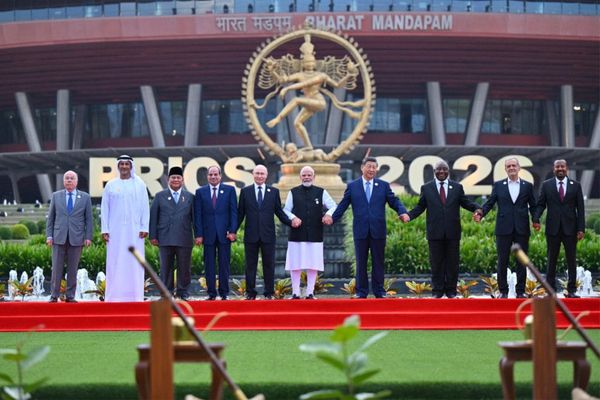
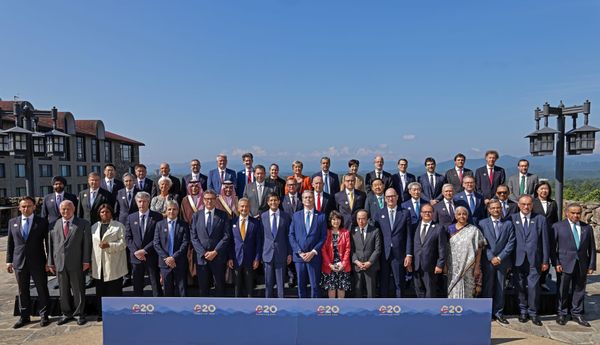
Look at the photographs from New Delhi and BRICS appears remarkably united.
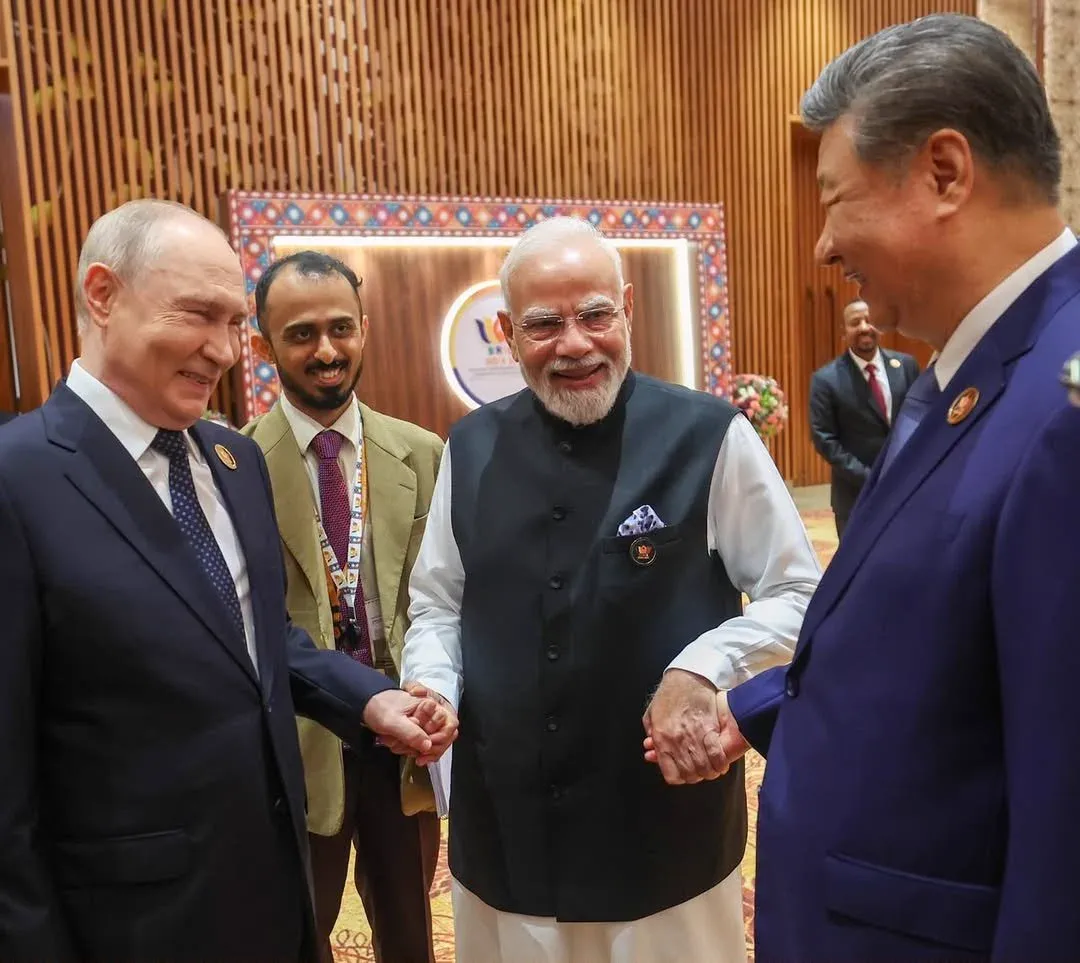
Narendra Modi stands between Vladimir Putin and Xi Jinping, their hands joined.
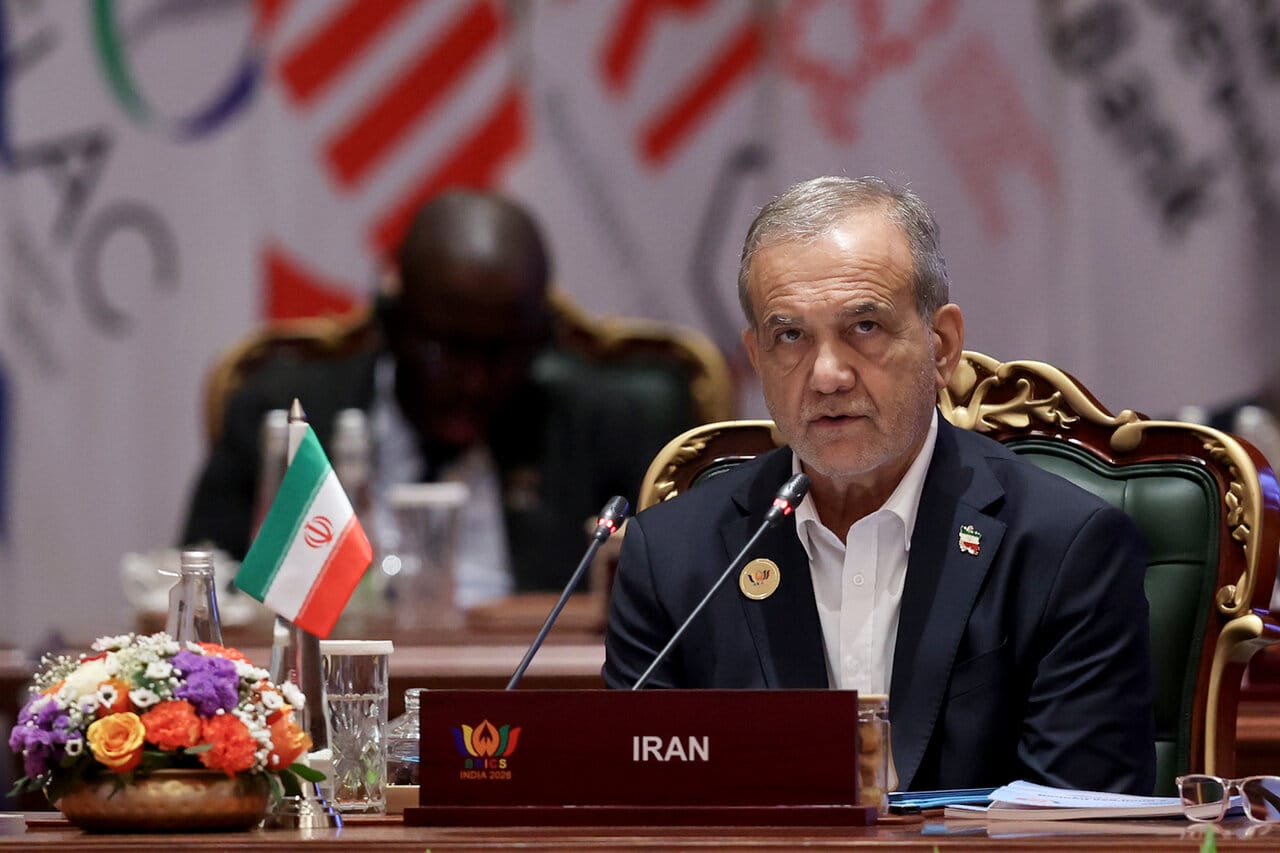
Iran’s President Masoud Pezeshkian is at the table while his country is at war with the United States and Israel.
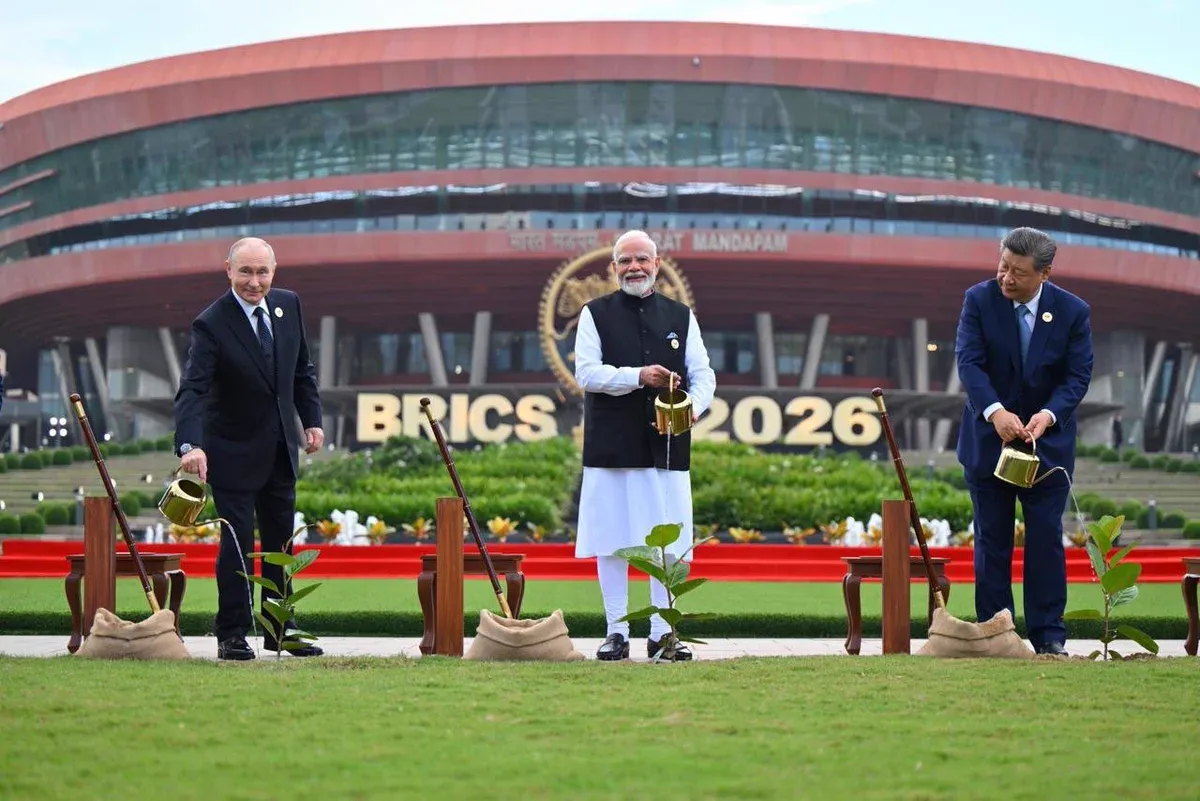
Leaders representing governments with profoundly different security interests pose together, talk about a more multipolar world and sign the same declaration.
The photographs matter, but there may be a better way to measure how powerful BRICS has actually become.
What does being part of BRICS buy you when a crisis comes?
New Delhi gave us several answers at once:
It can buy diplomatic access, political cover, economic alternatives and relationships with some of the largest economies in the world.
What it does not necessarily buy you is an ally.
Iran arrived at the BRICS summit in circumstances few international groupings have had to navigate. It is in an active war involving the United States and Israel. The Strait of Hormuz has become one of the central pressure points of that conflict, disrupting shipping and energy markets and pulling neighboring Gulf countries into the consequences.
Yet Iran was not isolated in New Delhi.
President Pezeshkian sat alongside the leaders of China, Russia, India, Brazil and other major economies. Iran participated in negotiating the New Delhi Declaration alongside the United Arab Emirates, which is another BRICS member whose relationship with Tehran has deteriorated sharply during the war.
That demonstrates one immediate value of membership: BRICS gives Iran a diplomatic room it is still invited into.
The declaration also contains language valuable to Tehran and Moscow. It criticizes unilateral sanctions and trade restrictions and calls for a more representative international order in which emerging economies have greater influence.
BRICS did not commit itself to Iran’s war.
The declaration expressed “deep concern” over the escalating Middle East conflict, called for maximum restraint and emphasized dialogue, consultation and diplomacy. It deliberately allowed members to maintain their own national positions.
No collective military assistance was promised, no BRICS army mobilized, no Article 5 exists.
Iran gained a platform, but it did not gain a military alliance.
At almost exactly the same moment, Saudi Arabia was confronting another crisis; the one involving forces aligned with Iran.
Saudi Arabia is not formally a BRICS member. It was invited to join in 2023 but has still not completed that step. Yet Riyadh sent Foreign Minister Prince Faisal bin Farhan to participate in the New Delhi summit as an invited country.
And while he was there, Yemen’s Iran-aligned Houthis were dramatically changing the security map across the Red Sea.
The Houthis seized the strategic port city of Mokha and expanded their position near the Bab el-Mandeb Strait; yet another critical global shipping chokepoint.
Reuters reported that Iranian weapons, funding and Revolutionary Guard advice helped the offensive. Saudi-backed Yemeni forces retreated as the Houthis advanced.
The images from that battlefield are particularly striking.
Videos verified by The Washington Post showed Houthi fighters in Mokha near Western armored vehicles left behind by retreating forces. One appeared to be a mine-resistant vehicle produced through a joint venture involving U.S. manufacturer Oshkosh and Saudi Arabia’s Al Tadrea Manufacturing. PBS also showed footage of Houthis seizing Western armored vehicles as Saudi-backed forces were pushed out.
That is more than battlefield symbolism.
Saudi Arabia has spent decades and enormous sums building its security relationship around American weapons and American protection. And when the Houthi threat intensified, Crown Prince Mohammed bin Salman turned to Washington. He sought U.S. military assistance against the Houthis.
President Donald Trump declined to authorize direct American strikes. Washington instead agreed to provide intelligence-sharing and targeting support, while the head of U.S. Central Command traveled to Saudi Arabia for talks.
But BRICS did not ride to Riyadh’s rescue either. And that is where the New Delhi summit becomes particularly revealing.
Iran, the country providing weapons, funding and advice to the Houthis according to regional and Iranian sources cited by Reuters, was sitting inside BRICS as a full member. Saudi Arabia, meanwhile, was attending a BRICS summit while confronting those same Iran-aligned forces.
Washington would not provide the direct intervention Riyadh wanted. BRICS could not become an alternative security guarantor: it can bring rivals into the same room, but it cannot necessarily protect one from the other.
That may be one of the clearest demonstrations yet of what a more multipolar world actually looks like.
More relationships do not automatically mean more protection.
For Moscow, BRICS membership clearly buys something substantial.
Russia remains under extensive Western sanctions and continues its war against Ukraine, yet Putin was anything but isolated in New Delhi. He received a warm welcome from Modi, stood at the center of some of the summit’s defining photographs and met leaders of major economies willing to continue trading and cooperating with Russia.
India and Russia are simultaneously expanding their own economic relationship, with both governments targeting $100 billion in bilateral trade by 2030. Cooperation spans energy, defense, industry, technology, investment and nuclear power.
That is a very real benefit for Russia.
BRICS helps give Moscow economic and diplomatic depth beyond Europe and North America, but there is another revealing detail in New Delhi:
Ukraine is not mentioned in the summit declaration. Not once.
Previous BRICS declarations had referred to the conflict. The 140-paragraph New Delhi Declaration simply does not. The bloc avoided forcing its members into a collective position on one of their most divisive issues.
Modi, however, did not avoid it in his bilateral relationship with Putin. India again raised the need for dialogue and diplomacy around the war while continuing to deepen economic ties with Russia.
Think about that combination: India can welcome Putin. India can work toward $100 billion in bilateral trade with Russia. India can reject Western pressure to sever the relationship, and India can simultaneously make clear that it wants the war brought to an end.
From the perspective of a traditional alliance, those positions can look contradictory; for India, the contradiction is the strategy.
India wants BRICS to become stronger. Modi wants emerging economies to have greater influence over international institutions. He wants the Global South to move from being what he called “rule-takers” toward becoming “rule-shapers.” But he has also been extremely careful about defining whom BRICS is supposed to oppose. His message in New Delhi was essentially: no one.
Modi described BRICS as a vehicle for a more representative international order, but emphasized a people-centered, cooperative approach rather than the construction of an anti-Western camp. That distinction separates India’s vision from some of the more confrontational rhetoric surrounding BRICS. India wants more influence. It also wants more options.
It wants less dependence on institutions it believes give developing economies too little power. But that does not mean India wants to exchange dependence on Washington for dependence on Beijing or Moscow.
The debate around a so-called BRICS currency illustrates this perfectly.
Despite years of headlines suggesting that BRICS might create a single currency to challenge the U.S. dollar, that is not what happened in New Delhi. A common BRICS currency is not currently being pursued. The practical work is much narrower: encouraging trade in local currencies, linking payment systems and improving cross-border settlement.
India’s own commerce ministry called for BRICS countries to connect payment systems and promote trade in one another’s national currencies. That can reduce dependence on the dollar in individual transactions, but it is very different from creating a single BRICS currency.
Again, the pattern is the same: build alternatives without necessarily destroying the existing system.
The New Delhi Declaration runs for 140 paragraphs. It covers global governance, trade, sanctions, artificial intelligence, climate, health, development finance, terrorism, maritime security and dozens of other areas. But what it leaves unsaid may be just as important.
Ukraine disappears.
The most divisive conflicts are described through language emphasizing restraint, diplomacy, sovereignty and international law rather than direct accusations against specific states. The declaration criticizes unilateral sanctions without turning BRICS into an explicitly anti-American coalition. It promotes local-currency settlement without announcing a common currency. It calls for reform of international institutions without demanding their replacement.
That ambiguity can look like weakness, but it may be the mechanism that keeps BRICS together.
Traditional alliances usually require members to decide who the threat is. BRICS largely avoids making its members answer that question.
Iran can belong to BRICS while maintaining radically different security interests from the UAE. Russia can deepen its relationship with India while India continues calling for diplomacy over Ukraine. China can advocate a stronger non-Western international architecture while India continues building relationships with the United States and Europe. And Saudi Arabia can attend the summit, explore deeper participation in this emerging system and still discover that when missiles start flying, its most important security call is to Washington.
It buys access.
Iran can be under enormous military and economic pressure and still sit across the table from some of the largest economies in the world.
It buys economic options.
Russia can redirect trade, investment and energy relationships toward countries unwilling to participate fully in Western isolation.
It buys political cover.
BRICS collectively opposes unilateral sanctions and argues for a world in which power is spread more broadly across emerging economies.
And it buys leverage.
Having relationships with Washington, Beijing, Moscow, New Delhi and others gives countries more room to maneuver than relying exclusively on one center of power.
But when a crisis becomes a shooting war, BRICS offers something much less certain: no mutual-defense clause, no collective military command, no requirement that one member defend another, not even a requirement that members agree on who the aggressor is.
The crisis around Saudi Arabia and the Houthis makes that painfully clear.
For Modi, that may be the ideal BRICS. Strong enough to give India more leverage. Large enough to make the Global South harder to ignore. Useful enough to provide economic and diplomatic alternatives. But flexible enough that joining it does not require India to choose between one geopolitical camp and another.
The photographs from New Delhi projected unity. The crises unfolding around the summit revealed the limits of that unity. And together they raise a much more important point than whether BRICS is “rising”:
While BRICS can give you partners in a crisis, it does not guarantee that any of them will come to your rescue.
Want more reporting like this? Join ONEST+ for independent analysis, Deep Dives, The Daily and exclusive reporting.
Choose a monthly or annual membership and support journalism that stays independent. Upgrade now.