South Korea Is Testing a New Arctic Trade Route. The Bigger Story Is Who Controls It.

– 10 min read

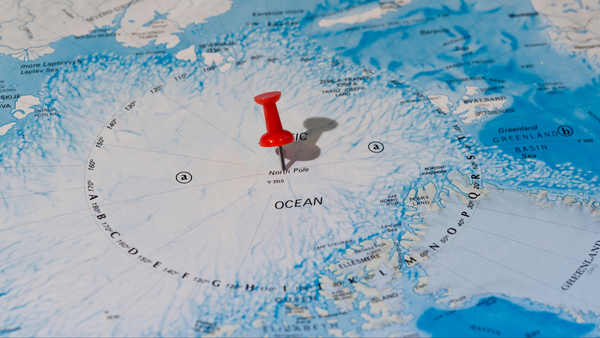
A South Korean container ship left Busan this weekend carrying auto parts, chemicals and hundreds of containers bound for Europe.
Ordinarily, that sentence would not be particularly remarkable.
The route is.
Instead of sailing south toward the traditional Asia-Europe corridor and passing through the Suez Canal, the PanStar Acro is heading north.
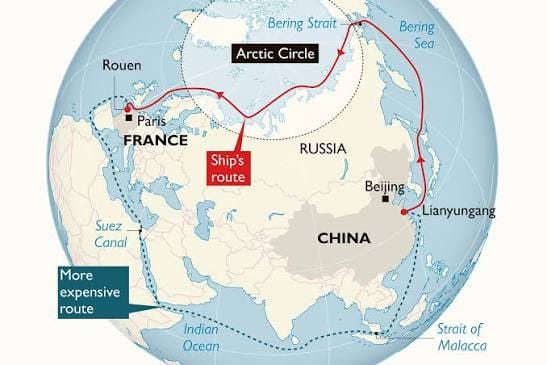
It will travel along Russia’s Kamchatka Peninsula, cross the Bering Sea and enter the Northern Sea Route, the Arctic shipping corridor running along Russia’s northern coast.
The vessel is scheduled to stop in Felixstowe in the United Kingdom, Rotterdam in the Netherlands and Gdańsk in Poland before returning to South Korea. The full voyage is expected to take approximately 40 to 45 days.
It is South Korea’s first commercial trial of the route.
But it is not merely an experiment in shaving days off a shipping schedule.
Behind one Korean container ship is a much larger question:
What happens if the Arctic becomes a normal route for global commerce?
Because then the geography of international trade begins to change.
And with it come Russia, China, sanctions, climate change, Arctic sovereignty and, eventually, Canada.
For South Korea, the commercial argument is straightforward.
Government estimates suggest an Arctic route between Busan and Europe could reduce travel time by roughly 35% compared with the Suez route.
President Lee Jae Myung has made Arctic shipping part of a broader maritime strategy aimed at strengthening Busan’s position as a global logistics hub.
The government wants the current trial to test whether Arctic navigation could eventually become regular commercial service, with officials looking toward 2030 as a potential horizon for routine use.
This is not a project being improvised around one ship.
Earlier this year, South Korea created a public-private Arctic shipping council bringing together 36 businesses, institutions and organizations, including shipping companies, logistics firms and government bodies, specifically to identify the commercial and operational obstacles to regular Arctic navigation.
The PanStar Acro itself is carrying 837 TEU of cargo on the government-backed voyage, including auto parts, chemical products and approximately 100 empty containers. The ship has total capacity of 2,758 TEU.
In other words, Seoul is not simply asking whether a ship can cross the Arctic.
It is asking whether businesses can eventually rely on the route.
Those are very different questions.
South Korea is also not arriving first.
According to data cited by Reuters from Norway’s Centre for High North Logistics, 88 vessels completed 103 Northern Sea Route transits in 2025, compared with 97 transits in 2024 and only 43 in 2022. Most were associated with Russia and China.
China has moved particularly quickly.
Chinese companies began seasonal operations through the route several years ago and in 2026 launched what is being described as a regular commercial service between China and Europe through the Arctic.
That potentially gives Beijing an early advantage in developing shipping schedules, commercial relationships, Arctic logistics and practical experience before other Asian exporters establish themselves.
China has incorporated Arctic connectivity into what it calls the Polar Silk Road, essentially a northern extension of the broader network of infrastructure and trade routes Beijing has spent years building across Eurasia.
The attraction is easy to understand.
A viable northern corridor could substantially shorten some Asia-Europe voyages while reducing dependence on the traditional southern route.
And recent disruptions to global shipping have made governments much more conscious of how much world trade depends on a surprisingly small number of maritime chokepoints.
There is one uncomfortable geopolitical fact running through South Korea’s experiment:
the Northern Sea Route runs along Russia.
Russia administers the route and has built the infrastructure currently required to operate it at scale: ports, search-and-rescue facilities, icebreakers and navigation services.
South Korea therefore had to consult Moscow ahead of the voyage, including over what assistance might be available if the PanStar Acro encountered problems such as heavy ice.
That creates an obvious contradiction.
South Korea has participated in international sanctions imposed on Russia following the invasion of Ukraine.
Yet a strategically valuable new commercial route requires cooperation with the Russian state.
Western diplomats have already raised concerns over precisely this problem. Reuters reported that some object to the Russian permits and coordination required to use the route while Western governments are simultaneously attempting to isolate Moscow economically.
This is where geography begins pushing against sanctions policy.
You can sanction a country.
You cannot sanction away where it is located.
Russia possesses roughly half of the Arctic coastline and has spent decades building a northern maritime infrastructure that other Arctic states simply do not currently match.
If international companies increasingly decide that the shortest commercially useful path between Asian and European markets runs along that coastline, Moscow gains something sanctions cannot easily remove: geographic leverage.
That distinction matters.
For Russia, success does not necessarily require filling the Northern Sea Route exclusively with Russian cargo.
The more foreign companies treat the route as legitimate commercial infrastructure, the more difficult it becomes to isolate Russia from the economic development of the Arctic.
Ships require administration.
They may require icebreaker assistance.
They need navigational information, emergency support, ports and logistical coordination.
And eventually they may require insurance, financing and other services structured around operating inside a Russian-managed corridor.
That does not mean one South Korean trial voyage suddenly undermines sanctions.
It means the long-term commercial logic of Arctic shipping could produce increasingly awkward conversations among governments simultaneously pursuing two objectives: reduce economic dependence on Russia and use the most commercially developed Arctic route.
For Beijing, the Northern Sea Route is about more than saving shipping time.
China imports enormous quantities of energy and exports enormous quantities of manufactured goods.
Its existing trade routes depend heavily on maritime passages that can become vulnerable during military conflict, political disputes or disruption.
A commercially reliable Arctic corridor would give China another option.
Not a complete replacement for existing shipping lanes, but strategic redundancy matters.
It also strengthens the China-Russia relationship in an area where their interests overlap unusually well.
Russia possesses Arctic geography and infrastructure.
China possesses cargo, capital, shipbuilding capacity and enormous trade volumes.
Beijing can therefore help commercialize something Moscow controls geographically.
And Russia can provide China with a northern trade corridor that bypasses some of the infrastructure traditionally dominated by U.S. allies.
That relationship is one reason South Korea entering the route matters.
Seoul is effectively saying: China should not be the only major East Asian trading power building experience here.
None of this Arctic opportunity exists independently of climate change.
The route is becoming increasingly navigable because Arctic sea ice is declining.
And increased shipping can itself contribute to further warming.
Ships emit greenhouse gases and black carbon. When dark particles settle on ice and snow, they reduce the surface’s ability to reflect sunlight, contributing to additional melting.
More traffic also means greater risk of spills and accidents in one of the most environmentally difficult places on Earth to conduct emergency response.
The commercial proposition is therefore built around an extraordinary paradox: global warming is opening a trade route that, if heavily used, could contribute to still more warming.
There are also practical limits.
Arctic navigation remains seasonal and unpredictable.
Ice conditions can change, insurance is more complicated, rescue infrastructure is sparse outside Russian territory, ships may require specialized capabilities.
Businesses depend on predictable delivery dates and a route that is shorter on a map but unreliable on a calendar can quickly lose its economic advantage.
That is why the PanStar Acro voyage matters as an experiment.
South Korea is testing not merely distance, it is testing reliability.
Russia is not the only country sitting on an Arctic shortcut.
Across the Arctic Ocean lies another potential passage:
Canada’s Northwest Passage.
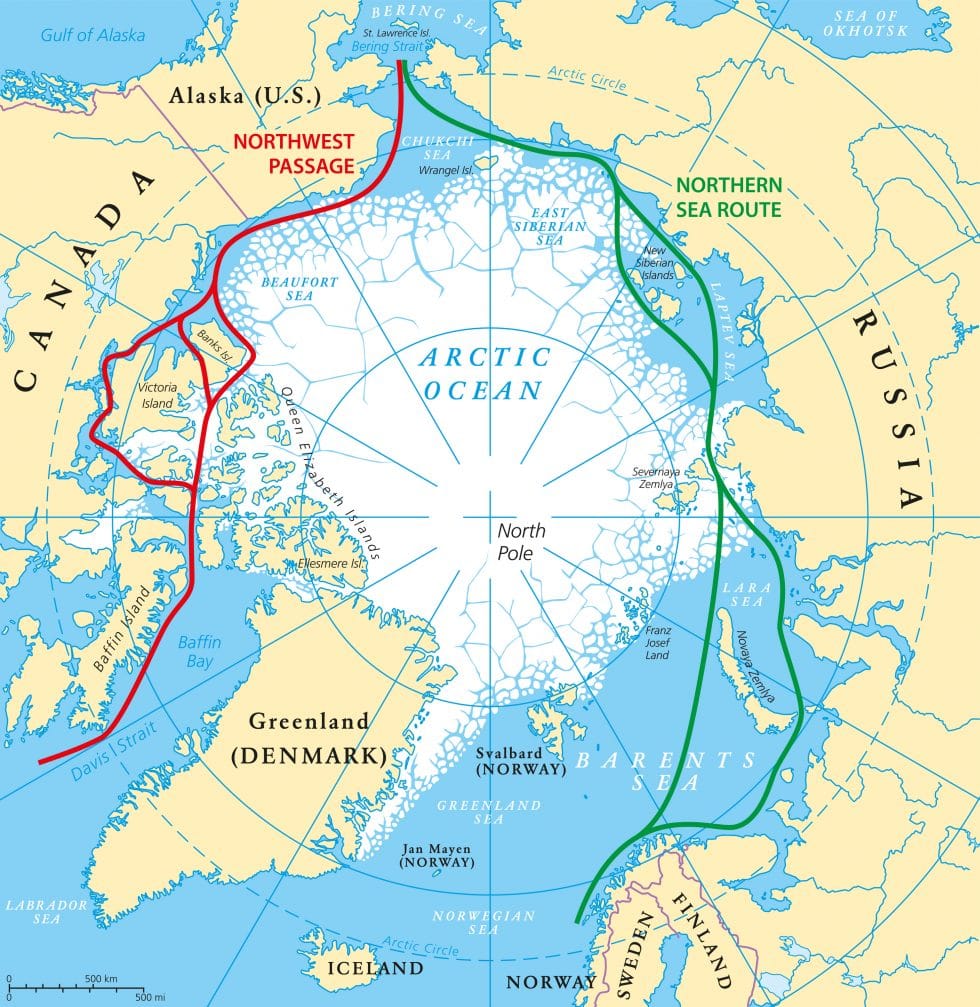
The Northwest Passage winds through the Canadian Arctic Archipelago, connecting the Atlantic and Pacific.
As sea ice retreats, its commercial and strategic importance is also attracting greater attention.
But the Canadian route is considerably less developed than Russia’s Northern Sea Route.
Canada’s own defense assessments acknowledge that, in the near term, Russia’s Northern Sea Route is more attractive for both commercial and military transit. The Northwest Passage remains hazardous and its viability as a major economic trade route is uncertain.
The infrastructure comparison helps explain why.
Russia has developed deep-water ports, search-and-rescue facilities and an extensive icebreaker capability along its Arctic coastline.
Historically, Canada’s Northwest Passage has lacked comparable deep-water port and rescue infrastructure.
But Canada is moving.
Ottawa has expanded military operations throughout the Arctic in 2026, including activities along the Northwest Passage, while developing northern support hubs intended to improve mobility, surveillance and sustained presence.
Nine Canadian Coast Guard icebreakers were scheduled to operate in the Arctic during the 2026 summer season.
And Canada is examining new infrastructure that links Arctic shipping to another increasingly strategic sector: critical minerals.
One project illustrates the possibilities.
The proposed Grays Bay Road and Port Project in Nunavut would create a deep-water Arctic port with potential links to the Northwest Passage and connect it through an all-season road to North American transportation infrastructure.
The Canadian government specifically describes the project as having critical-mineral export potential in the Arctic.
That matters because Canada is simultaneously attempting to expand its role as a secure supplier of minerals needed for defense, batteries, electronics and advanced manufacturing.
So the Canadian Arctic discussion is not merely:
Could container ships eventually travel through the Northwest Passage?
It is also:
Could the Arctic become an export corridor connecting northern Canadian resources directly to global markets?
If so, the value of ports, roads, icebreakers and northern sovereignty increases considerably.
There is another complication.
Canada considers the waterways making up the Northwest Passage to be Canadian internal waters, giving Ottawa the right to regulate passage.
The United States has historically disagreed.
Washington views the Northwest Passage as a strait used for international navigation, which would provide foreign vessels broader transit rights.
That disagreement has been manageable while commercial traffic remains limited.
Imagine how much more important it becomes if the Arctic evolves into a significant international shipping corridor.
Suddenly a decades-old legal disagreement between two countries becomes commercially consequential.
Who sets the rules?
Who can charge or regulate ships?
What environmental standards apply?
Can Canada deny passage?
What happens when Chinese commercial vessels want to use the route?
Those questions become considerably less theoretical once businesses start incorporating Arctic shipping into their normal supply chains.
And Canadian officials are already explicit about the broader strategic concern: Ottawa identifies Russia as the principal military threat in the Arctic and says China’s expanding commercial and strategic activity in the region requires close attention.
This is where the comparison becomes particularly interesting.
Russia’s Northern Sea Route already has substantial infrastructure and growing commercial use, but using it creates sanctions and geopolitical complications.
Canada’s Northwest Passage runs through the territory of a NATO ally, but remains much less commercially developed; and Washington and Ottawa do not fully agree on its legal status.
Russia has geography plus infrastructure.
Canada has geography plus alliance relationships, critical mineral potential and access to the North American economy, but it still needs infrastructure.
China has cargo, capital and a strategic incentive to diversify shipping routes.
South Korea has one of the world's most sophisticated maritime industries and does not want China to establish an uncontested lead.
That is why a single Korean container ship matters.
It is an early participant in a competition that could become much larger.
It is important not to overstate what is happening.
The Northern Sea Route is not about to replace the Suez Canal.
Suez is established, year-round, supported by massive commercial infrastructure and integrated into global shipping schedules.
The Arctic remains difficult, seasonal, environmentally dangerous and politically complicated.
Container shipping also depends heavily on networks.
A vessel does not simply travel from Point A to Point B. Shipping lines need predictable schedules, feeder connections, ports, maintenance, cargo volumes, insurance and crews trained for the route.
A shortcut on a globe is not automatically a profitable shipping network.
But trade routes do not have to replace one another to become strategically important.
Even a meaningful minority of Asia-Europe trade shifting north would create new commercial interests, infrastructure investments and political dependencies.
And once those investments exist, they create constituencies that want the route to remain open.
For centuries, Arctic geography acted as a barrier.
Ice made the shortest path between major markets commercially impractical.
Climate change is gradually altering that assumption.
That does not mean the Arctic suddenly becomes an ocean highway.
It means governments now have to plan for a possibility that barely existed in commercial terms a generation ago.
Russia already built for it.
China has decided it wants to use it.
South Korea has now sent a commercial container ship to test it.
Canada is reinforcing sovereignty, expanding Arctic operations and considering infrastructure that could connect the Northwest Passage with critical mineral development.
And Western governments are discovering an uncomfortable reality: the economic map emerging from climate change does not necessarily align neatly with the geopolitical map they would prefer.
South Korea wants to diversify its trade routes.
But doing so requires Russia.
The West wants to isolate Russia.
But Russia controls the most developed Arctic corridor.
China wants alternatives to vulnerable maritime chokepoints.
The Arctic provides one, in partnership with Moscow.
Canada wants to protect its Arctic sovereignty while developing the North.
But its only neighbor does not fully accept Canada's legal interpretation of the Northwest Passage.
Those tensions are only beginning.
The PanStar Acro is one ship carrying 837 containers.
It may complete its journey and demonstrate that regular South Korean Arctic shipping is commercially viable. It may instead expose the practical limitations that keep the route niche. Either outcome will be useful to Seoul, because this voyage is ultimately not about one shipment from Busan to Europe.
It is about preparing for a world in which the frozen geography at the top of the map is no longer quite so frozen and the countries that understand that change first may get to write the rules for what follows.