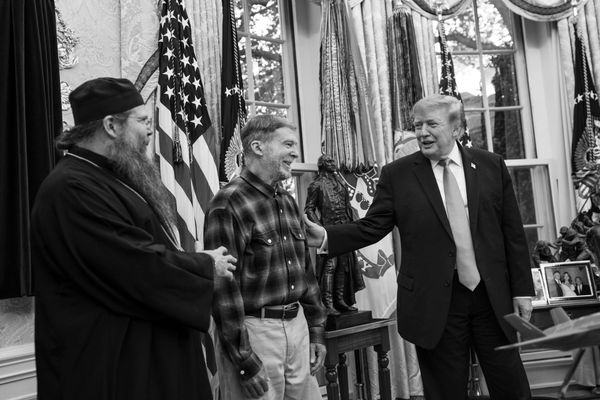
On Friday, President Donald Trump welcomed Stephen Hubbard to the Oval Office.
Hubbard, 74, had spent more than four years in Russian detention after being captured in occupied Ukraine in 2022. Moscow accused him of fighting as a mercenary for Ukraine. His family and lawyers disputed that account, and the United States considered him wrongfully detained.
His release is a genuine diplomatic success. But Friday’s Oval Office appearance quickly became about something much bigger than one prisoner. Trump defended his decision not to increase economic pressure on Moscow while negotiating Hubbard’s release.
“A lot of stupid people said … ‘Why aren’t you putting Russia sanctions and all this’ in the midst of a negotiation to try to get a long-term hostage back from Russia,” Trump said after Hubbard’s release. “If I would have done that, you would not have Mr. Hubbard coming back.”
Hubbard then offered his own "assessment": Russians, he said, “laugh” at sanctions.
Trump’s larger point was unmistakable: he claims withholding economic pressure helped produce Hubbard’s freedom.
The problem with treating this as a one-off hostage negotiation is that Washington had already been easing pressure on Russia long before Hubbard came home.
This started months before Hubbard’s release
In March, the Trump administration issued a 30-day waiver allowing countries to purchase sanctioned Russian oil and petroleum products stranded at sea.
Treasury Secretary Scott Bessent said the measure was intended to stabilize global energy markets after the Iran war disrupted supplies.
Reuters described it at the time as the second significant rollback of Ukraine-war-related U.S. sanctions in little more than a week.
Then Washington extended the waiver.
In April, the administration renewed permission for countries to buy Russian oil and petroleum products already loaded onto vessels, again citing the global energy shock.
The waiver eventually expired, but the policy direction had already become clear: when sanctions conflicted with Washington’s immediate economic or diplomatic priorities, the administration was willing to suspend them.
By August, Democratic senators were publicly questioning why the administration had also stopped regularly imposing new sanctions on companies, banks and other entities helping Russia evade existing restrictions. Reuters reported that the senators said the regular counter-evasion campaign had effectively been paused for 17 months.
Then came October.
The United States became a customer for Russian diesel
As American diesel prices surged, Washington reached an agreement with Moscow to bring Russian diesel into the U.S. market.
Russia initially agreed to supply more than 300,000 metric tons, with additional shipments expected. Russian refiners subsequently increased production, and Reuters reported that a tanker carrying roughly 40,000 tons of Russian diesel was heading for New York in late October.
So far, however, prices have moved in the opposite direction.
U.S. on-highway diesel averaged $6.179 per gallon on October 12, climbed to $6.276 on October 19 and reached $6.352 by October 26, according to the U.S. Energy Information Administration.
Analysts had warned from the beginning that the Russian volumes were relatively small compared with global demand and might not produce sustained price relief.
What the deal unquestionably did accomplish was something geopolitically significant: it reopened the American market to a Russian petroleum product while Moscow’s war in Ukraine continued.
For years, Western sanctions policy was built around reducing Russia’s energy revenue because oil and gas exports help finance the Russian state and its war economy.
Now the United States is not merely declining to impose some additional penalties. It has become a buyer.
Congress tried to increase the pressure. Trump waived it.
On September 18, Trump signed the bipartisan Lindsey O. Graham Sanctioning Russia and Iran Act.
The law authorized sweeping new measures against Russia, including major tariffs on Russian goods and penalties targeting countries buying Russian energy or helping Moscow evade sanctions.
Less than a month later, Trump waived most of its operative Russia provisions.
The October 16 executive order waived the law’s duties, sanctions and restrictions, citing the national interest. The waivers remain in effect until Trump or senior administration officials decide further action is appropriate.
Secretary of State Marco Rubio later said Trump could take as long as 60 days to decide whether to activate additional measures. His reasoning was straightforward: "Washington does not want sanctions to drive Russia away from negotiations".
So Friday’s language in the Oval Office was not the beginning of a new approach, rather Trump explaining an approach Washington has already been pursuing for months.
At the same time, pressure has shifted toward Ukraine
The contrast is increasingly difficult to ignore.
While Washington has repeatedly eased or delayed economic pressure on Russia, it has also pushed Ukraine to reduce attacks on Russian energy infrastructure.
On Friday, Reuters reported that Ukraine had paused strikes against Russian oil refineries after pressure from Trump. Ukrainian long-range strike units were reportedly told in mid-October to finish missions already underway and halt new refinery attacks. Reuters could not independently verify the Wall Street Journal report on which that account was based.
The disagreement had been building for weeks. Ukraine argues that Russian refineries are legitimate economic targets because energy revenue helps fund Moscow’s war and because Russia continues attacking Ukraine’s own energy infrastructure. Trump, nevertheless, has repeatedly pressed Kyiv to stop.
Reuters reported that the dispute over those strikes became one of the central sources of deterioration in relations between Trump and Ukrainian President Volodymyr Zelenskyy.
The result is an unusual imbalance:
Russia is receiving relief from some economic pressure while Ukraine is being asked to reduce pressure of its own.
Also, Russia has not reciprocally stopped attacking Ukrainian energy infrastructure.
This is bigger than one prisoner release
Hubbard’s return is good news. But it came amid a much broader normalization of U.S.-Russia relations.
Trump welcomed Putin on a red carpet in Alaska. Washington has repeatedly eased or waived sanctions, opened the U.S. market to Russian diesel, and discussed future commercial deals with Moscow, including energy and investment projects. Ukraine, meanwhile, has faced U.S. pressure to stop striking Russian refineries and to accept territorial concessions as part of a proposed "peace deal".
Now the pressure is also extending to Russia’s closest allies.
The Trump administration has reportedly urged Lithuania to consider reopening the port of Klaipėda to Belarusian potash exports despite European sanctions, partly to increase fertilizer supply and ease costs for U.S. farmers.
But Canada has long been the dominant supplier of potash to the United States. Belarusian exports would diversify supply at the margins; they would not realistically replace Canada’s role in the U.S. market.
The political significance is therefore larger than the commercial one: Washington is asking a European ally bordering Russia to loosen pressure on Belarus — Russia’s closest wartime partner and the territory from which Russian forces launched their 2022 drive toward Kyiv, including through the Chernobyl and Hostomel axes.
That makes the potash dispute about more than fertilizer. It fits a broader pattern in which Washington is testing ways to reopen economic channels with Russia and Belarus while simultaneously asking Ukraine and European allies to reduce pressure on them.
Not a subscriber yet?