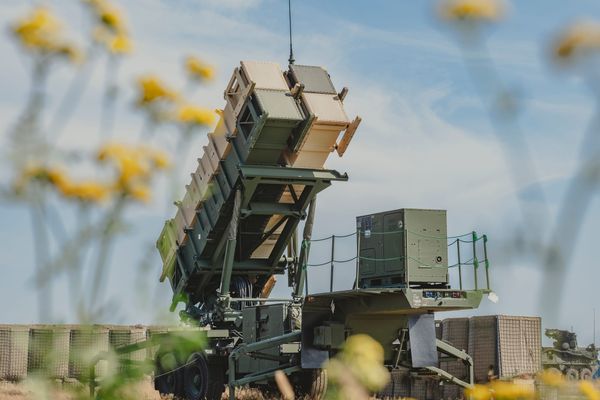
The United States announced Tuesday that Poland has been selected to host a new European maintenance facility for PAC-3 missiles — the interceptors used with the Patriot air-defense system.
If “missile maintenance facility” does not immediately sound like major geopolitical news, consider what happens today when some of these missiles need servicing.
They have to go all the way back to the United States.
Polish officials have previously said that sending PAC-3 missiles to the U.S., servicing them, certifying them and returning them to Europe can take more than a year, and in some cases the broader servicing process has taken up to two years.
The new facility is designed to change that.
First: what exactly is PAC-3?
Patriot is the broader air and missile-defense system. PAC-3 is an interceptor used by it.
Its job is defensive: when an incoming threat such as a ballistic missile is detected, a PAC-3 interceptor can be launched to destroy it before it reaches its target.
That capability has become particularly important as Russia’s war against Ukraine — and recent conflicts in the Middle East — have demonstrated both the destructive power of modern missile attacks and the enormous demand they can place on air-defense systems.
Several European NATO members operate Patriot systems, including Poland, Germany, the Netherlands and Romania. Buying an advanced weapon is only part of possessing a credible military capability. It also has to work when you need it.
So what is actually changing?
Until now, Europe has lacked a dedicated PAC-3 missile maintenance facility of its own.
In July, the United States, Germany, the Netherlands, Poland and Sweden agreed to explore establishing one in Europe. Lockheed Martin, which produces the PAC-3, said the goal was to provide maintenance and sustainment closer to the countries operating the missiles.
Now there is a location: Poland.
The center is expected to require an investment of around 1 billion złoty (approximately $253 million) and Polish officials say it will take at least a dozen or so months before it can become operational. The next 60 days are expected to involve detailed negotiations with Lockheed Martin.
Once completed, Polish officials say it will be the only PAC-3 missile maintenance center outside the United States.
Germany, the Netherlands and Sweden are also expected to play roles in integrating the supply chain.
That puts the infrastructure needed to maintain these interceptors not merely in Europe, but on NATO’s Eastern Flank — much closer to the part of the alliance most immediately exposed to Russia.
In practical terms, missiles requiring maintenance should be able to return to service considerably faster instead of making a transatlantic journey.
In strategic terms, NATO is building more of the infrastructure required to sustain its air defenses directly in Europe.
Does this mean Europe can make its own PAC-3 missiles?
No.
This is an important distinction. Tuesday’s announcement concerns maintenance, repair and sustainment, not a new European PAC-3 production line. That means it can improve the readiness of missiles Europe already possesses, but it does not by itself solve another major problem: Europe and the United States need more interceptors.
Demand has surged while deliveries are already being delayed. A maintenance facility keeps existing weapons operational. A factory produces additional weapons. Those are very different capabilities.
The significance here is that part of the PAC-3 lifecycle that previously depended entirely on facilities in the United States is moving to Europe.
And Poland has made clear that it would like this kind of industrial cooperation to go further.
But can Europeans actually fire these American missiles without U.S. permission?
This is where the answer gets more interesting.
Buying an American weapon does not mean Washington sits behind a virtual launch button. Under the U.S. Foreign Military Sales system, American weapons can be supplied for purposes including legitimate self-defense and participation in collective-security arrangements. Once the weapons are transferred, the recipient government assumes responsibility for their proper use under the agreement governing the sale.
So if Russia attacked Poland, for example, there is no general U.S. Foreign Military Sales rule requiring Poland to obtain fresh authorization from Washington before firing its Polish PAC-3 interceptors to defend itself.
But here, too, the devil is in the details.
A clear, sustained attack is one thing. A sporadic or ambiguous incident is another. Russia’s war against Ukraine has already produced cases in which missiles, drones or debris have entered, or been suspected of entering, NATO airspace, leaving governments to determine what happened, whether the incident was intentional and what response was warranted.
So while the legal framework permits these weapons to be used for legitimate self-defense, the harder question in a real crisis may not be whether Washington technically allows Poland to fire. It may be whether Polish and NATO authorities determine, in that particular moment, that an incident constitutes a threat requiring interception and under whose rules of engagement that decision is made.
In other words, the theoretical authority to defend yourself can be considerably clearer than the decision to use it in an ambiguous real-world situation.
How a particular Patriot battery is commanded can also depend on whether it is operating nationally or as part of a NATO mission, with its own command arrangements and rules of engagement.
But American control has not disappeared.
Recipients of U.S.-origin weapons agree to use them for their authorized purposes. They generally cannot change that end use or transfer the weapons to another country without prior U.S. consent. That distinction matters.
Using a Polish PAC-3 to defend Poland from an attack and deciding to transfer that missile to another country are legally and politically different actions.
Why Poland?
Geography is impossible to ignore.
Poland borders Ukraine, Belarus and Russia’s Kaliningrad exclave. It has also become one of NATO’s biggest defense spenders and a major purchaser of American military equipment. Locating the facility there puts a critical piece of air-defense infrastructure much closer to NATO’s eastern defenses.
That is why Tuesday’s announcement is about more than servicing missiles.
For decades, European defense has depended heavily not only on American weapons, but on the enormous American industrial and logistical system behind them. Moving PAC-3 maintenance to Poland does not end that dependence. Lockheed Martin remains central to the program, and the missiles themselves remain American technology. It does move though one important piece of that system across the Atlantic.
And in a crisis, the difference between owning a missile and having a missile that is certified, operational and ready to launch can be the difference that matters.
Did you know ONEST is making documentaries?
We’re bringing the same curiosity and clarity behind our reporting to Simply Put Documentaries — going beyond the headlines to show how things actually work.
Explore our documentaries and support the work.
Learn about Simply Put.