Who Does the Ocean Belong To?

– 6 min read

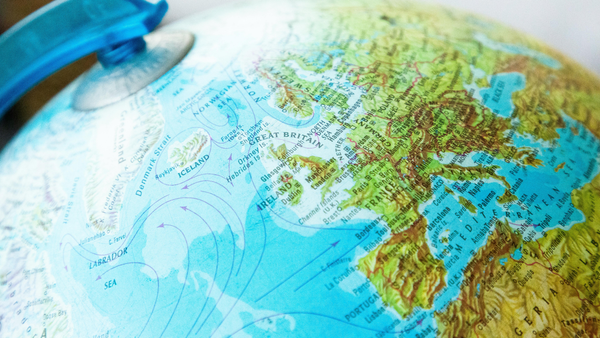
The ocean looks open and borderless. International law sees layers: territorial waters, economic zones, the high seas... and even a different legal regime for the seabed underneath.
Look at a map and the answer seems simple: countries own their land, and the ocean is everything in between.
Legally, it is much more interesting.
A country can exercise sovereignty over waters close to its coast, hold specific economic rights farther out, and still share the wider ocean with the rest of the world. The water itself and the seabed beneath it can even fall under different legal regimes.
So who gets to fish? Who can sail through? Who controls resources beneath the seabed? And what happens when countries disagree?
For Simply Put., I asked Otto Spijkers, Assistant Professor of International and European Law at Leiden University College in The Hague, one seemingly simple question:
Who does the ocean belong to?
His answer took us from a Dutch legal scholar writing in 1609 to fishing quotas, marine protected areas, deep-sea resources and one of the most consequential maritime disputes of the modern era.
The waters closest to a country's coast.
Under the modern law of the sea, a coastal state may claim a territorial sea extending up to 12 nautical miles from its baseline.
Here, the coastal state exercises sovereignty, although foreign vessels retain certain navigation rights.
An area that can extend up to 200 nautical miles from a country's baseline.
A coastal state does not “own” its EEZ in the same way it exercises sovereignty over its territorial sea.
Instead, it has specific sovereign rights over natural resources there, including fisheries and energy resources. Other states retain freedoms including navigation and overflight.
This distinction is central to Spijkers' explanation.
Sovereignty means broad governmental authority over a territory or territorial sea.
Sovereign rights are narrower. They give a coastal state particular rights for particular purposes; such as exploring, exploiting, conserving and managing natural resources within its EEZ or continental shelf.
The seabed and subsoil extending beyond a state's land territory beneath the ocean.
Coastal states have rights over certain natural resources found in their continental shelf, even though the water above it may fall under a different legal regime.
In other words: when talking about the ocean, it sometimes matters whether we mean the water or what is underneath it.
Parts of the ocean beyond national jurisdiction.
No state owns the high seas.
States enjoy freedoms there, including navigation, scientific research and laying submarine cables and pipelines. Fishing is also permitted, but it is subject to international conservation and management rules.
The country in which a ship is registered.
On the high seas, ships generally fall under the jurisdiction of their flag state. That country is responsible for ensuring that vessels flying its flag comply with applicable international obligations.
There is no world government policing every ship at sea.
The United Nations Convention on the Law of the Sea, adopted in 1982 and in force since 1994.
It provides much of the modern legal framework governing territorial seas, exclusive economic zones, continental shelves, the high seas and the international seabed.
The United States is not a party to UNCLOS, although many of its provisions are regarded as reflecting customary international law.
Yes, capital A.
Under UNCLOS, “the Area” means the seabed, ocean floor and subsoil beyond national jurisdiction.
This is where an important distinction appears.
The high seas above it belong to no state.
The Area and its mineral resources, however, are designated the common heritage of humankind.
As Spijkers puts it, instead of belonging to no one, the deep seabed in a sense belongs to all of us.
The international organization established under UNCLOS to organize and regulate mineral-related activities in the Area.
Its role is particularly important as governments and companies debate whether and how deep-seabed mining should proceed.
The United States, because it is not a party to UNCLOS, disputes the applicability of parts of this treaty-based regime to itself.
BBNJ stands for Biodiversity Beyond National Jurisdiction.
The agreement creates additional rules for conserving and sustainably using marine biodiversity in areas beyond national jurisdiction, including a mechanism for establishing marine protected areas on the high seas.
It entered into force in January 2026.
The agreement matters because protecting an ecosystem beyond any country's jurisdiction requires international cooperation. One state cannot simply declare part of the high seas protected and expect every other country to treat that declaration as binding.
Spijkers begins more than four centuries ago.
In 1609, Dutch jurist Hugo Grotius published Mare Liberum (The Free Sea).
Grotius argued that the seas could not be appropriated by states in the way land could. Instead, they should remain open to navigation, trade and fishing.
There was also a commercial interest behind the principle.
Grotius was providing legal advice to the Dutch East India Company, whose interests benefited substantially from an argument favoring open seas and freedom of trade.
The idea nevertheless became enormously influential in the development of the modern doctrine of freedom of the seas.
Before today's clearly defined maritime zones, one historical approach tied control over coastal waters roughly to how far a cannon positioned on shore could fire. Control extended as far as the state could physically defend.
International law has moved on. Today, a country's territorial sea can extend up to 12 nautical miles from its baseline, regardless of how impressive its cannon might be.
Some fish spend very little time worrying about international borders.
Highly migratory species and “straddling stocks” may move between national waters and the high seas. If every country simply exercised unrestricted freedom to fish, some stocks could quickly be depleted.
That is why states cooperate through regional fisheries management organizations, or RFMOs.
One example Spijkers gives is NAFO — the Northwest Atlantic Fisheries Organization. NAFO establishes conservation and management measures for fisheries in the Northwest Atlantic, including rules that apply beyond national waters.
The Ross Sea, near Antarctica, provides another example of what international cooperation looks like at sea.
A country can establish a marine protected area inside waters under its own jurisdiction. The high seas are different. No single state can simply declare part of the open ocean protected and expect every other state to obey.
The Ross Sea Region Marine Protected Area was created through an international framework involving the states concerned with Antarctic marine resources. It restricts most fishing across much of the protected area.
It demonstrates both the possibilities and the limitations of ocean governance: protection works best when the states capable of using the area agree to the same rules.
Spijkers briefly points to the Strait of Hormuz while discussing disputes involving passage through international straits.
It is a useful example because a body of water can be geographically narrow while carrying enormous international importance. International law therefore does not treat every stretch of sea simply according to which countries lie on either side of it. Special rules govern navigation through international straits connecting larger bodies of water.
International law also raises an obvious question:
What happens when a country simply refuses to accept a ruling?
Spijkers points to the South China Sea.
The Philippines initiated arbitration against China under the Law of the Sea Convention. In 2016, the tribunal concluded, among other findings, that China's claims to historic rights over vast areas within its so-called nine-dash line had no legal effect where they were incompatible with rights established by UNCLOS. China rejected the proceedings and has continued to reject the award.
For Spijkers, the case demonstrates both the power and the limits of international law.
The ruling did not disappear just because China rejected it. A decade later, governments, lawyers and diplomats still invoke it. But the international legal system has no global police force capable of simply compelling China to comply. International law can establish rules, shape diplomatic arguments, influence reputation and provide mechanisms for resolving disputes. Enforcement is another question.
The simplest answer is surprisingly elegant.
The high seas belong to no one. The deep seabed beyond national jurisdiction is treated as the common heritage of humankind.
And between the coastline and the high seas lies a layered system of sovereignty, sovereign rights, shared freedoms and international obligations. Which means that asking who owns the ocean requires another question first:
Which part of the ocean are we talking about?