The Daily: UNGA81, Day 3 of 5

– 7 min read

Good evening,
Welcome to Day 3 of 5 of ONEST’s public UNGA81 Daily Briefs.
Today, the week widened.
Ukraine used the General Assembly to argue that the consequences of Russia’s war are spreading well beyond Ukraine itself. The United States and Argentina launched a new economic corridor tying minerals, energy, transport and digital infrastructure together. Canada and the European Union launched a major new ocean-observation alliance. Iran publicly pushed back against Washington while diplomatic contacts continued behind the scenes. And in Washington, President Xi Jinping arrived for a state visit that will put supply chains, critical minerals and the wider U.S.-China relationship directly into focus.
Here’s what mattered.
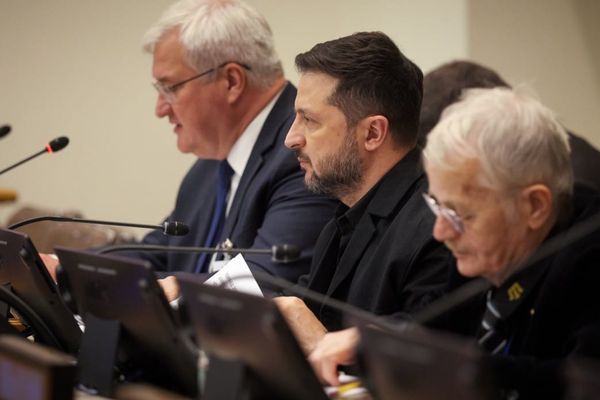
President Volodymyr Zelenskyy used his UN General Assembly address to argue that Russia’s war is no longer simply a war over Ukrainian territory.
He pointed to North Korean troops fighting alongside Russia, warned that Pyongyang is gaining battlefield experience and military benefits in return, and argued that the consequences of the war are spreading outward: toward Europe, the Caucasus, Central Asia and beyond.
His economic argument was equally direct. Ukraine’s target, Zelenskyy said, is not Russia’s oil industry for its own sake, but Russia’s ability to finance and sustain the war.
That distinction matters because it goes directly to one of the biggest debates emerging this week: whether Ukraine’s strikes on Russian energy infrastructure are a legitimate way to cut war revenue, or a source of broader global energy pressure. Zelenskyy’s answer today was unequivocal: Russia’s revenues must remain a target.
He also presented Ukraine’s defense industry as something increasingly exportable, particularly drone technology, interceptor systems and AI-enabled capabilities.
That message was reinforced later in the day.
Ukraine and Australia signed a new long-term security agreement, and Australian Prime Minister Anthony Albanese announced another support package covering energy, protective equipment and humanitarian assistance. The two sides also agreed to work toward a Drone Deal.
And in a separate meeting with Dutch Prime Minister Rob Jetten, Zelenskyy said Ukraine is prepared to refrain from attacks on Russian energy and export infrastructure if Moscow reciprocates.
So Ukraine’s position today had two tracks running at once: keep pressure on Russia’s war economy, while leaving space for a reciprocal energy ceasefire if Russia actually agrees to one.
Secretary of State Marco Rubio addressed that directly today.
He said both Russia and Ukraine have expressed interest in some form of limited ceasefire involving energy, and argued that such an arrangement could reduce both humanitarian pressure inside Ukraine and some of the global economic impact of the war. He also acknowledged why it is difficult.
For Ukraine, energy means the electrical grid and the ability to get through winter. For Russia, it means refineries, oil and gas infrastructure, and therefore revenue. That makes energy a strategic target for both sides.
Rubio’s point was not that an energy ceasefire would end the war, but that it "could become a limited confidence-building measure" and potentially a foundation for something broader.
Yesterday’s Trump-Zelenskyy meeting looked, at first, like another clash over Ukrainian strikes on Russian energy. Today, Washington is trying to turn that same issue into a possible negotiating mechanism.
One of the most significant economic developments of the day came from the United States and Argentina. The two governments launched the Andes-Atlantic Corridor, a new infrastructure and investment initiative designed to connect Argentina’s critical-mineral-rich northwest and its Vaca Muerta energy basin to Atlantic ports and Western markets.
The scope is broad: rail, ports, waterways, pipelines, power infrastructure, digital networks, oil, gas and critical minerals. The United States is positioning its own government financing agencies, including EXIM, the Development Finance Corporation and the U.S. Trade and Development Agency, alongside private capital to support projects. The corridor is expected to target lithium, copper, oil and gas, and the accompanying infrastructure needed to move those resources efficiently. It is also the first Partnership for Global Infrastructure and Investment corridor in the Western Hemisphere.
The U.S. says EXIM has already issued a non-binding indicative term sheet of up to $6 billion for Argentina LNG, part of a roughly $51 billion project tied to Vaca Muerta.
The Andes-Atlantic Corridor now joins the Lobito Corridor, Luzon Economic Corridor, India-Middle East-Europe Economic Corridor and Trans-Caspian route.
This has now become one of the clearest themes of the first three days of UNGA81.
Monday: U.S.-Italy critical minerals cooperation.
Tuesday: Greenland, Arctic access, investment screening and critical infrastructure.
Wednesday: Argentina’s new corridor linking minerals and energy directly to Western markets.
Washington is increasingly treating the physical architecture of trade — ports, pipelines, railways, grids, data networks and mineral-processing capacity — as part of geopolitical strategy.
It is about controlling vulnerability.. and it is happening at the same moment the United States prepares for one of its most consequential diplomatic engagements of the week.
Chinese President Xi Jinping arrived in the United States today ahead of his state visit with President Trump.
The White House has planned a formal arrival ceremony Thursday, followed by meetings and a state dinner.
Rubio defended the engagement today by making a very straightforward argument: the United States and China are too economically and militarily significant not to engage at the highest level. He also made clear that the relationship is defined by major points of friction. Among them: trade, supply chains, critical minerals and military competition. Rubio said supply chain diversification will remain central to U.S. policy and indicated that those issues are expected to feature in discussions with China.
Washington is also simultaneously building alternative supply chain arrangements with Japan, South Korea, Argentina, Europe and others. Xi visit is not happening in isolation; it is rather happening against a backdrop in which the United States is actively trying to reduce dependence in some of the very sectors where China holds significant leverage.
Iranian President Masoud Pezeshkian used his UN address to reject Trump’s accusations that Iran is the principal source of terrorism in the region.
He argued instead that Iran has itself been the victim of terrorism and military attack, defended Iran’s nuclear program as peaceful, and accused the United States and Israel of applying double standards. He also said Iran would not bow to sanctions or pressure, but the public rhetoric tells only part of the story.
Iranian officials have confirmed contact with the United States through Qatari mediation in New York. Rubio said today that he did not want to characterize the talks as a breakthrough, but he did call the fact that conversations occurred significant. He also said the U.S. remains open to a deal.
So, once again, there are two tracks: public confrontation and private negotiation. And Hormuz remains central to both.
Rubio said the southern lane of the Strait is open and argued that U.S. military action is keeping shipping moving, while the United States continues to maintain pressure on Iranian ports. Iran, meanwhile, has presented its own conditions for reopening Hormuz.
This is becoming less a binary question of war or diplomacy and more a negotiation under sustained military and economic pressure.
Canada and the European Union today launched the OceanEye International Alliance for the Global Ocean Observing System.
Prime Minister Mark Carney and European Commission President Ursula von der Leyen co-chaired the launch in New York.
Canada pledged C$82 million over five years, while the broader event secured about $339 million in combined financial and in-kind commitments from participating governments.
Thirty-one members have now joined the alliance.
The money will support ocean monitoring platforms, close data gaps, strengthen coordination hubs and improve the global infrastructure used to collect and share ocean information.
Global ocean observation feeds directly into weather forecasting, maritime safety, shipping, climate prediction, coastal protection and the blue economy. Like the other infrastructure stories this week, the underlying issue is resilience.
If the world depends on a small number of contributors to maintain the observing system, then geopolitical or financial disruption can create information gaps with consequences far beyond climate science.
This is another version of the same UNGA theme: systems we once treated as background infrastructure are now being recognized as strategic assets.
Today’s Diplomatic Note is already live for ONEST members.
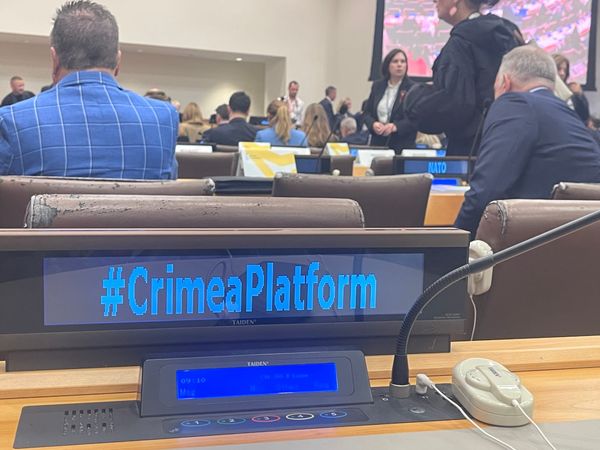
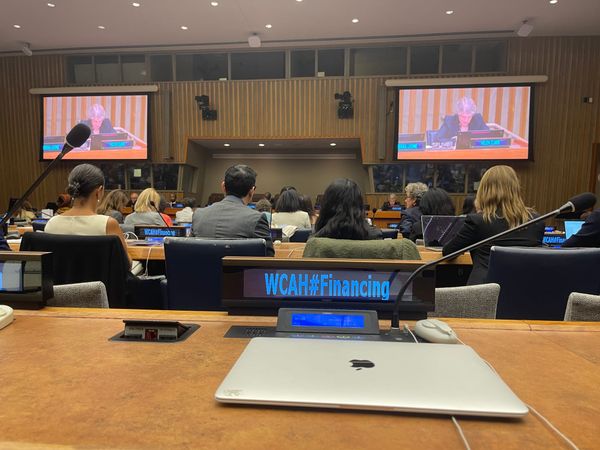
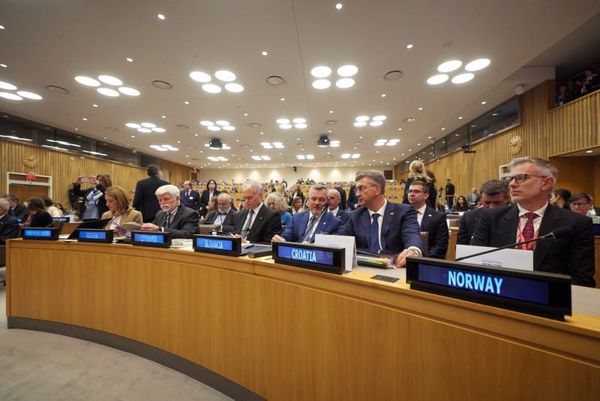
I recorded Observations From Inside the Room after covering several UNGA81 events in person: what stood out, what felt different inside the room than it looked from the outside, and the connections I’m watching as the week develops.
The public Daily gives you the major developments. Diplomatic Notes give you the reporting from inside the rooms where those developments are unfolding.
Become an ONEST member and you’ll unlock today’s note immediately, together with every Diplomatic Note from UNGA81.
Qatar’s emir described the region as being in one of the most dangerous periods in its history. Foreign ministers from Saudi Arabia, Türkiye, Egypt and Pakistan also affirmed Saudi Arabia’s right to defend itself under international law while stressing the importance of maintaining safe navigation.
At the same time, Iran’s conditions for reopening Hormuz were conveyed through diplomatic channels, even as Trump continued to threaten substantially greater military action if negotiations fail.
Iraq, meanwhile, suspended Iranian flights to Baghdad after reported U.S. warnings that airports servicing Iranian carriers could face sanctions.
And in Yemen, the humanitarian consequences continue to deepen: the UN says more people may be displaced as fighting intensifies after more than 130,000 people were already forced from their homes this month.
The broader pattern remains unchanged: diplomacy is moving, but so is the conflict.
A U.S. Air Force investigation concluded that a misaligned internal engine vane caused a Thunderbird F-16 crash last December; the same type of problem implicated in another F-16 crash roughly 20 months earlier.
Separately, the Space Force is exploring a maneuverable spacecraft that could be launched on demand in response to emerging threats.
And South Korea received its first mass-produced KF-21 Boramae fighter, a significant milestone in Seoul’s long-running effort to build and field its own advanced fighter aircraft.
Tomorrow, attention shifts even more heavily toward Washington and Beijing as Trump and Xi move into the formal state visit portion of the week.
Also tomorrow, Canadian Prime Minister Mark Carney will meet Tô Lâm, General Secretary of the Communist Party of Vietnam and President of Vietnam, in Ottawa.
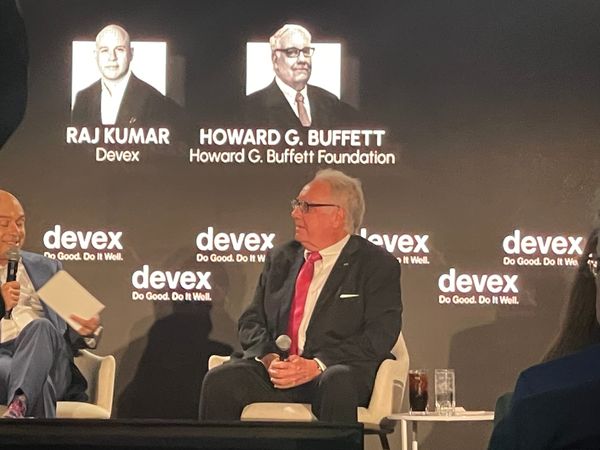
My own day begins at the Ukraine Prosperity Forum hosted by the Howard G. Buffett Foundation, continues at Asia Society, and then moves inside UN Headquarters.
I’ll be watching Ukraine’s economic and security strategy, Indo-Pacific diplomacy, Canada’s wider international positioning, and the continuing UNGA conversations around trade, energy and security.
That’s Day 3 of 5.
See you tomorrow,
Olga
All five UNGA81 editions of The Daily are public this week.
ONEST members get the reporting beyond the public brief: Diplomatic Notes from my interviews, conversations and observations throughout the week, with audio and transcripts where available.
Become an ONEST member and unlock every UNGA81 Diplomatic Note immediately, including today’s Observations From Inside the Room.
Crimea Is Ukraine. What Does It Take to Make That Matter?
From the Crimea Platform and a gathering of first spouses at UNGA, two different answers to the same question: how do people endure a war, and what must other countries do to help end it?