ONEST Brief | August 21, 2026

– 11 min read

Russia is testing NATO’s edges, Ukraine is dealing with both a devastating Russian attack and growing political turbulence at home, Washington is preparing a new economic front against Iran, and China is quietly expanding its room to maneuver from Seoul to artificial intelligence.
Here’s what matters today.
Slovenian President Nataša Pirc Musar is facing growing scrutiny over alleged Russian links around her inner circle.
The controversy began after a car accident revealed she had been traveling with a Russian acquaintance reportedly connected to a former senior Slovenian intelligence official who fled to Russia in the 1990s.
Parliament’s security commission has now called an emergency meeting and requested an intelligence assessment of possible Russian influence around the president. Members of the ruling coalition have also questioned whether she should retain access to classified briefings while the matter is examined.
Pirc Musar’s own past travel to Moscow and St. Petersburg, including shortly before Russia’s full-scale invasion of Ukraine, is also drawing renewed attention.
There is no evidence that Pirc Musar herself engaged in espionage. But the controversy has created a serious counterintelligence issue around the office of an EU and NATO head of state.
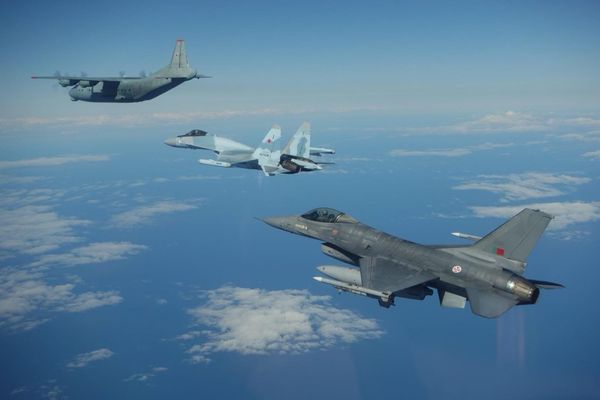
For the third consecutive day, NATO military activity has been visible across its eastern flank: around the Baltic states, Poland, Kaliningrad and farther south.
But while NATO signals readiness, another series of incidents is demonstrating just how difficult the line between deterrence, provocation and escalation is becoming.
Romania scrambled two F-16s after an explosive maritime drone appeared just a few hundred meters from the Neptun Deep gas project in the Black Sea.
One of the jets opened fire and destroyed it.
That location matters.
Neptun Deep is one of Europe’s most important new offshore gas developments and is expected to significantly increase Romania’s role in European energy production.
Romanian President Nicușor Dan blamed Russia and described the incident as part of an intensifying pattern of provocations.
And it wasn't isolated.
Romania had already dealt with another drone entering its airspace during Russia’s massive attack on Ukraine. Earlier this week, another drone was shot down during a NATO air-policing mission.
Now Finland is investigating another potential breach after a Russian aircraft was suspected of violating Finnish airspace.
Put those incidents together and the important story is not one drone or one aircraft.
It is the frequency with which NATO countries are being forced to make real-time decisions about objects entering their territory while Western intelligence agencies continue warning that Russia could eventually test the alliance more directly.
Ukraine's military intelligence says North Korea has now supplied Russia with the KN-30, or Hwasong-11C, a larger variant of the ballistic missiles Pyongyang has already provided for Russia's war against Ukraine.
And the difference is significant.
North Korea claims the KN-30 can carry a warhead weighing up to 2.5 tons.
For comparison, many of the ballistic missiles Russia has been using against Ukraine carry warheads in roughly the 500–700 kilogram range.
That potentially gives Russia a North Korean missile carrying several times the explosive payload of weapons already being used in the war.
Ukrainian intelligence estimates that, as of July, Russia possessed roughly 50 North Korean KN-23, KN-24 and KN-30-family ballistic missiles.
Ukraine also says around 90 North Korean military personnel have deployed to Russia's Voronezh region, where they could service up to six launchers.
There is an important caveat: Russia has not yet been confirmed to have fired a KN-30 at Ukraine, and independent analysts caution that North Korea's claimed 2.5-ton warhead capacity may be overstated.
But the transfer itself matters.
North Korea is no longer simply replenishing Russia's existing missile stocks.
It is potentially giving Moscow a heavier strike capability than Russia has previously fielded from North Korean supplies, deepening Pyongyang's direct role in Russia's war and putting even greater pressure on Ukraine's already stretched air defenses.
The alliance continues adjusting forces across the region.
Belgium formally assumed responsibility for NATO air-defense operations from Keflavik in Iceland as part of the alliance's expanded vigilance in the Arctic.
Command of Standing NATO Maritime Group One has also transferred from a British-led staff to a French-led team in Reykjavík.
And in Latvia, 650 participants from 24 countries tested how multinational forces can detect, integrate against and defeat increasingly complicated drone threats.
And the problem is not limited to Europe.
NORTHCOM Deputy Commander Lt. Gen. Joseph Jarrard has acknowledged that the United States itself is not currently equipped to defend against a major drone-swarm attack on U.S. territory.
“We are ill-equipped right now to handle something like that… We’re seeing it used on a daily basis around the world, and we’ve got to figure out how to mitigate that threat, but we’re not there yet.”
Jarrard said the U.S. does not yet have sufficient sensors everywhere a swarm could strike or enough systems capable of defeating one once detected.
That makes the broader NATO problem much sharper:
the alliance is not only preparing for Russian aircraft, missiles and conventional forces. It is racing to build defenses against massed drones; a threat that neither Europe nor the United States can yet reliably stop at scale.
And thus, the common denominator is increasingly obvious:
NATO is reorganizing for a security environment where drones, infrastructure attacks, airspace incursions, industrial capacity and Arctic access are no longer separate issues.
They are becoming parts of the same deterrence problem.
August 21 is a day of mourning in Kyiv following Russia's massive missile and drone assault a day earlier.
At least 16 people have been killed and dozens injured so far.
Residential buildings, industrial facilities, warehouses, hospitals, vehicles, a school and a shop were among the sites damaged.
And once again, President Volodymyr Zelenskyy's message to Ukraine's partners came down to air defense.
Ukraine needs Patriot interceptors.
And Zelenskyy stressed that Kyiv is not simply asking to be given them.
Ukraine is prepared to buy them.
The problem is supply.
That distinction matters because the question increasingly isn't whether Ukraine is willing to pay for Western weapons.
It is whether partners, particularly the United States, are prepared and able to make the weapons available.
Former Defense Minister Mykhailo Fedorov has become one of the most visible figures in Ukraine's growing internal political debate.
Fedorov, dismissed in July, has publicly called for Ukraine to develop a mechanism for holding elections during wartime.
The Kremlin immediately seized on that debate, arguing that the “Kyiv regime is not homogeneous.”
Fedorov is also preparing to travel to the United States.
Officially, the purpose of the trip is to raise money for new defense-technology projects and ventures following his departure from government.
Reuters reports that Fedorov remains in contact with Elon Musk over Starlink but says no meeting with Musk has been formally scheduled.
Independent journalists inside Ukraine, however, are reporting that a meeting between Fedorov and Musk is expected during the trip.
The possibility is notable given Fedorov's long relationship with Musk and SpaceX, his central role in bringing Starlink into Ukraine after Russia's full-scale invasion, and his effort now to build a new political and defense-tech profile outside Zelenskyy's government.
The Atlantic reports that Ukraine had been developing an operation code-named “M&Ms.”
The idea was extraordinary.
Ukraine would launch potentially up to 1,000 small autonomous drones in a single night toward Moscow's airports, attempting to overwhelm Russian defenses and keep civilian aviation out of the Russian capital.
The ultimate target wasn't simply aircraft or runways.
It was Russia's elite.
Officials, oligarchs and wealthy Russians still depend on Moscow's international airports to reach hubs such as Istanbul and Dubai.
Prolonged shutdowns were intended to make the effects of the war impossible for that group to avoid and potentially create another source of pressure on Vladimir Putin.
The technological element is even more significant:
The drones were being designed to navigate autonomously using AI-powered map matching.
Instead of relying continuously on a radio or internet connection that Russian electronic warfare could jam, each drone could carry stored maps and images of its intended route and target.
Its camera would then compare what it saw below with the imagery stored onboard and navigate accordingly.
That also created the central danger.
Zelenskyy reportedly worried that an autonomous drone could accidentally strike a civilian aircraft.
Officials involved in the plan proposed warning airlines in advance so aircraft could leave before the swarm arrived.
One Ukrainian presidential official denied that such a plan existed.
Planning stopped after Fedorov was dismissed in July.
That's what makes this story bigger than one canceled Ukrainian operation.
It shows where warfare is heading:
autonomous weapons that may no longer require an uninterrupted communications link or a human pilot making every navigational decision.
Polish Prime Minister Donald Tusk delivered perhaps today's sharpest European quote.
Speaking about Germany's pursuit of suspects in the sabotage of the Nord Stream pipelines, Tusk argued that Germany, which supported construction of the pipelines despite years of warnings from Poland and other Eastern European countries, was focusing on the wrong historical responsibility.
“Those who should be ashamed are not the ones who stopped Nord Stream 2, but those who built it.”
His larger argument matters.
The dispute over Nord Stream is no longer only about who destroyed the pipelines.
It is also about who bears responsibility for constructing an energy relationship that left Europe deeply dependent on Russia in the first place.
And that debate isn't entirely historical.
EU countries still bought roughly €1.5 billion in Russian fossil fuels in July, with the bloc remaining the largest buyer of Russian LNG and pipeline gas.
France, Belgium, Spain and the Netherlands led LNG imports.
The U.S. Army created a 600-soldier drone assault battalion in Europe specifically to learn from Ukraine's war.
Then Ukrainian drone operators played the opposing force in an exercise.. and defeated a U.S. brigade.
Now the Army plans to phase out the battalion after one major exercise in Germany.
That comes as Washington simultaneously pushes hard to expand America's drone-industrial base.
Nearly 100 industry representatives and government officials gathered at the White House on August 20 for its first Drone Dominance event.
The Pentagon is also building a new organization to accelerate prototypes for defeating drones using airborne lasers, continuous-wave lasers and high-power microwaves.
So the United States is essentially working both ends of the drone problem at once:
How do we manufacture them at scale and how do we stop somebody else's?
There is another unusual national security concern emerging as well:
Researchers say about 150 Polymarket accounts made roughly $8 million placing military and defense-related bets and almost always betting correctly.
The researchers suspect some accounts may be linked to people with access to non-public military information.
That doesn't prove insider trading.
But prediction markets create an uncomfortable new intelligence problem:
if people with privileged access begin betting on military events before they happen, the market itself can become an intelligence signal.
The future aircraft carrier CVN-81 was supposed to become the USS Doris Miller, honoring the Black sailor celebrated for his actions during the attack on Pearl Harbor.
Now reports say the Navy is looking at renaming the carrier, with internal discussions including the possibility of naming it after President Donald Trump.
The Navy is reportedly considering naming another warship after Miller instead and recommending him for the Medal of Honor.
No final decision has been announced.
Treasury Secretary Scott Bessent has followed President Trump's announcement of upcoming “crushing sanctions” against anyone trading with Iran.
Iranian Foreign Minister Abbas Araghchi dismissed what he called Washington's “economic D-Day” as another empty threat.
But Monday's announcement could be far more consequential than another round of sanctions directly targeting Iranian institutions.
The key issue is whether Washington is preparing to use secondary sanctions much more aggressively against companies, banks or countries that continue doing business with Iran.
Because eventually, this becomes a China story.
China remains Iran's most important economic lifeline and the dominant buyer of Iranian oil.
So the real significance of Monday's announcement will be in the details:
who Washington targets, what penalties it imposes on third parties that continue trading with Iran, and how directly the administration is prepared to confront Chinese companies and financial institutions.
If Washington escalates there, Beijing will face its own decision over how far it is willing to retaliate.
Yesterday, I published a deeper analysis of how China has continued its trade with Iran despite sanctions and the wider Middle East conflict. This is today's recommended read.
North Korea launched another barrage of ballistic missiles toward the sea on August 20, according to South Korea's military.
The launches came a day after North Korea shrugged off a U.S. decision to scale back elements of military drills with South Korea in an apparent attempt to reopen diplomatic space.
At almost exactly the same moment, Chinese Foreign Minister Wang Yi was in Seoul promoting improved relations between Beijing and South Korea.
Wang said China-South Korea relations had entered a track of “improvement and development.”
That contrast is worth watching.
Washington is trying to reopen communication with North Korea. Beijing is simultaneously improving its relationship with South Korea. And Pyongyang is reminding both capitals that it can still disrupt the agenda whenever it chooses.
Elsewhere, two former organizers of Hong Kong's annual Tiananmen Square vigils were convicted of inciting subversion under the national security law.
And China's economic problems are becoming harder to ignore.
Fixed-asset investment fell sharply this year, with weakness across infrastructure, property and parts of manufacturing.
That slowdown may not be purely economic.
China is entering a 2026-27 cycle of provincial and local leadership transitions ahead of the 2027 Party Congress.
Leadership changes can make local officials more reluctant to approve projects or commit resources when they don't know where they will be posted next.
Add the property downturn, local government debt and weak private investment, and China's investment slump may increasingly tell us as much about political incentives as about economic demand.
Canada, France, Germany, Italy, the Netherlands, Norway and the United Kingdom have jointly condemned Israel's decision to publish construction tenders for the E1 settlement project.
Their warning was unusually explicit.
The governments said E1 would undermine the territorial continuity of a future Palestinian state and warned businesses against bidding for the contracts because of potential legal and reputational consequences.
Canada is also criticizing Israel's decision not to pursue criminal proceedings over the 2024 strike that killed seven World Central Kitchen workers, including Canadian citizen Jacob Flickinger.
Foreign Minister Anita Anand called the decision unacceptable and said the families still lack the accountability they have sought for more than two years.
Elsewhere in the region, the United Arab Emirates has suspended trade and financial dealings with Iran after accusing Tehran of targeting Emirati ships with a missile.
France is expelling two Iranian diplomats as tensions with Tehran rise.
Lebanon has handed an Assad-era Syrian general over to Damascus in the first transfer of its kind since Bashar al-Assad's fall.
And Türkiye is moving deeper into Syria's energy sector, with its state oil company and private firms preparing seismic surveys and exploration.
That last development is particularly important because energy, military access and political influence in post-Assad Syria are increasingly becoming intertwined.
The U.S. State Department has approved a possible $4.5 billion Foreign Military Sale to Qatar for up to four KC-46A aerial refueling aircraft and related equipment.
The package includes up to eight PW4062 turbofan engines, 10 AN/ALR-69A radar-warning receivers, 15 Guardian Laser Transmitter Assemblies for large-aircraft infrared countermeasure systems, and eight LAIRCM processor replacements.
The significance goes beyond four tankers.
Aerial refueling extends the range and persistence of Qatar's combat aircraft and strengthens its ability to operate alongside U.S. and allied forces over much greater distances.
And it comes as Washington is simultaneously relying heavily on Gulf partners while confronting Iran and trying to reshape the region's security architecture.
The $4.5 billion figure represents the maximum estimated value of the potential package. The final amount could be lower depending on Qatar's ultimate requirements and any agreement that is actually signed.
Across today's stories, the same pattern keeps appearing in different forms.
Russia is probing the physical boundaries of NATO.
Ukraine has been experimenting with autonomous warfare designed to bypass traditional defenses.
The United States is racing to build drones while simultaneously developing lasers and microwaves to destroy them.
Washington is preparing to test how far economic coercion can reach beyond Iran and into China's trade networks.
And Beijing is positioning itself carefully around all of it: improving ties with Seoul, maintaining economic links with Tehran and watching Washington stretch military and economic resources across several theaters.
The competition is no longer simply over territory or individual weapons systems.
It is increasingly about who can build the networks, technology, industrial capacity and political relationships needed to keep operating when the old assumptions stop working.