Nvidia’s crisis is bigger than its CEO
The questions reach from access to the president to access to advanced chips and into an economy increasingly exposed to AI investment.

– 6 min read

The questions reach from access to the president to access to advanced chips and into an economy increasingly exposed to AI investment.
Jensen Huang resigned as Nvidia’s chief executive on November 12, leaving finance chief Colette Kress in interim charge of one of the most consequential companies in the global economy.
The circumstances have attracted plenty of attention to his private life. The public-interest question is what access to Huang could buy.
He had access to the president. His company supplied technology Washington was trying to keep beyond China’s military reach. He was also a prominent advocate for easing restrictions on selling that technology to China.
In a Bloomberg interview recorded in October, Huang described China as “not our enemy” and U.S. chip policy as a “mistake.” He accompanied Trump to Beijing in May as Nvidia sought permission to sell powerful processors into the Chinese market.
This is an interview filmed by Bloomberg less than a month ago. pic.twitter.com/vvIIdfYGlb
— Olga Nesterova (@onestpress) November 9, 2026
That advocacy now sits alongside allegations that Alice Huang, a former executive at Singapore-based Nvidia partner Megaspeed, was a Chinese intelligence asset. China denies the allegation. Investigators must establish what she obtained and whether she influenced him.
Nvidia’s board has said it had no reason to believe national security or company secrets were compromised. That is the company’s stated position, not the investigation’s conclusion.
The commercial stakes were already drawing scrutiny. The New York Times reported that Megaspeed’s Malaysian affiliate bought at least $4.8 billion in advanced equipment containing Nvidia technology between June 2024 and February 2026. U.S. investigators suspected some chips were being diverted to China.
A separate Times investigation published November 7 exposed problems with Washington’s screening of approved Chinese recipients. Reporters visited the listed offices of two firms cleared to handle Nvidia’s H200 chips, New Matrix and Maginfra, and found apparently empty premises. New Matrix’s owners had ties to the blacklisted investment firm Wise Road; analysts linked Maginfra to Inspur, blacklisted for its work with China’s military.
The Times also identified ownership connections between other approved recipients and Chinese military suppliers. Approval to assemble chips into servers did not resolve the central question: who would ultimately use them?
These findings did not establish that those chips reached the Chinese military, but did expose serious gaps in the assurances surrounding who could obtain them. Megaspeed’s suspected diversion and the H200 licensing findings are separate strands of the same security problem: permission to sell sensitive technology is only as credible as the ability to identify its recipients and enforce its final use.
Nvidia has denied finding evidence of diversion through Megaspeed, which says it has cooperated with inspections. Those assurances now have to be weighed against the specific warning signs documented by investigators and reporters.
On Wall Street, Nvidia shares fell 14% at Thursday’s opening before recovering to about 4% lower around midday, according to AP.
The question for everyone else is how far a crisis at Nvidia could travel.
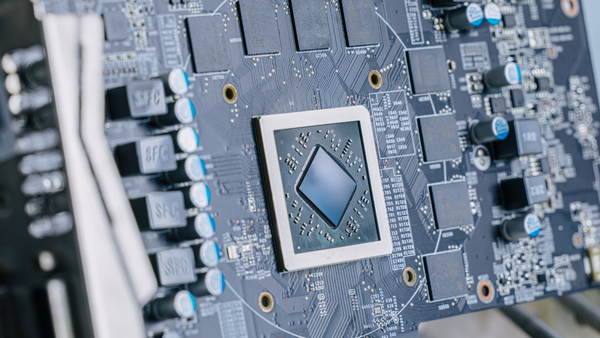
Nvidia designs the processors that do much of the heavy computational work behind modern AI. Its GPUs handle many calculations simultaneously, making them useful for training models and running them once trained.