LIMITED-TIME OFFER: ONEST annual membership is 50% off.
$99.50 instead of $199/year.
Offer ends Friday, November 6, at noon ET. No code needed.
Become paid member
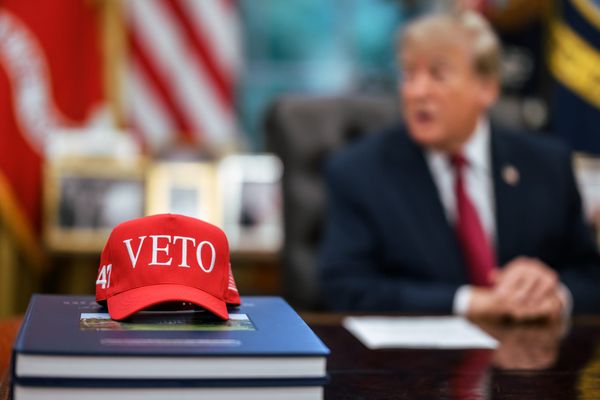
President Donald Trump confirmed Thursday that he met Vladimir Putin's envoy at the White House, did not meet the Ukrainian delegation visiting the same day, and was discussing what he described as a "major agreement" that could involve all of Europe.
He declined to disclose what he discussed with the Russian representative, Kirill Dmitriev.
Trump also questioned the federal law prohibiting Russian petroleum imports and suggested that Ukraine bore comparable responsibility for civilian deaths in the war Russia started.
The remarks came during an Oval Office appearance ostensibly devoted to protecting the historic status of the Oval Office and Cabinet Room.
A private meeting with Putin's envoy
Asked whether he met Dmitriev, Trump confirmed that he had.
Asked what they discussed, he replied:
“I can't tell you what I discussed.”
He nevertheless predicted a major agreement extending beyond Ukraine, potentially involving all of Europe.
The president provided no terms, timetable or indication that Ukraine and European governments had accepted any proposal. He also acknowledged that he had not met the Ukrainian officials who were at the White House.
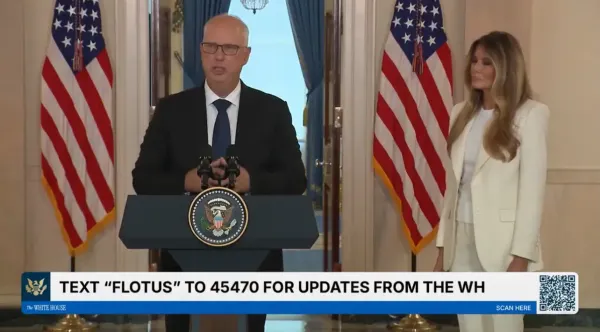
Dmitriev attended an event honoring First Lady Melania Trump's involvement in a limited humanitarian ceasefire in Russian-occupied Ukrainian territory.
Earlier Thursday, ONEST reported on the Russian delegation's participation in that event, including the presentation of Russia's humanitarian role despite its continuing occupation of Ukrainian territory.
Trump says Ukrainians are killing Russian civilians, too
Asked about Russia's continued attacks on Ukrainian civilians, Trump said he had raised the issue with Putin.
He then introduced a comparison.
“I always bring it up and I also bring it up the other way because the other way they kill too, you know.”
He added:
“Russia is losing civilians also.”
The comparison obscures a fundamental fact: Russia invaded Ukraine, and Russian forces have systematically attacked Ukrainian civilians throughout the war.
The United Nations and international human rights organizations have documented repeated Russian strikes on residential buildings, hospitals, schools and essential civilian infrastructure.
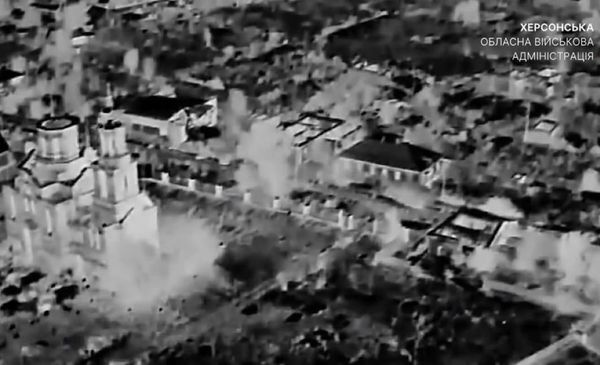
In occupied parts of Ukraine, Russian drone operators have also deliberately targeted civilians going about their daily lives.
In Kherson, the practice has become known as a “human safari”: Russian drones pursue pedestrians, cyclists, motorists and emergency responders, sometimes striking people in broad daylight. A United Nations commission of inquiry concluded that Russian drone attacks against civilians in Kherson constituted crimes against humanity, including murder. These are not simply civilian casualties occurring near military operations. Investigators have documented attacks in which civilians themselves were the targets.
Russia launched its full scale invasion in February 2022, following its occupation of Crimea and intervention in eastern Ukraine beginning in 2014.
Ukraine is defending itself against that invasion.
Trump's reference to Russian civilian casualties does not answer the question he was asked: why Russia continues to attack Ukrainian civilians, and what Putin is doing to stop it. Nor does it change who started the war, whose forces occupy Ukrainian territory, or which government bears responsibility for the invasion.
The Russian oil ban was not simply Biden's decision
Trump was also asked about a tanker crossing the Atlantic carrying Russian diesel fuel and the federal law prohibiting imports of Russian petroleum products.
He appeared "unfamiliar" with the law's provisions. Told that President Joe Biden had signed it, Trump replied:
“That probably makes it a pretty bad law. I'll take a look at it.”
The law in question is the Ending Importation of Russian Oil Act, signed on April 8, 2022. It was not merely a Biden administration policy. The legislation passed the Senate unanimously, 100-0, and the House by 413-9 in its final vote.
Congress enacted it in response to Russia's invasion of Ukraine.
The law does not allow the president simply to disregard the prohibition because he disagrees with his predecessor. It establishes conditions for lifting the import ban, including a Russian withdrawal agreement accepted by Ukraine, an end to hostilities, assurances concerning NATO security, and recognition of Ukraine's right to choose its government. The president must certify those conditions to Congress, which has an opportunity to block termination of the prohibition.
The distinction matters because the Trump administration has pursued arrangements to bring Russian diesel into the American market.
The Financial Times and Associated Press reported Thursday that two tankers initially expected to deliver Russian diesel to the United States had changed course.
💡
The administration maintains that its temporary sanctions exemption is lawful. Critics argue that an exemption cannot override the congressional import ban. The legal dispute has not been resolved by a court.
Trump alleges voter fraud in Alaska
The president also accused unnamed individuals of election fraud in Alaska's unresolved Senate race. His complaint concerned a second candidate named Daniel Sullivan, whose name resembles that of incumbent Republican Senator Dan S. Sullivan. Trump argued that votes cast for the other Sullivan should effectively count toward the incumbent's total. But the two men were legally distinct candidates on the ballot. The second candidate, Daniel J. Sullivan Jr., initially faced disqualification after state election officials concluded that his candidacy was intended to confuse voters. State courts subsequently allowed him onto the ballot, where he appeared without a party affiliation and was distinguished from the Republican incumbent. The Justice Department sought to delay certification of the election if the incumbent lost, arguing that the presence of the second Sullivan could have confused voters. A federal judge rejected that request on November 1.
The election remains unresolved, with Democrat Mary Peltola narrowly leading and additional ballots still to be counted. Alaska's ranked-choice system may also require further tabulation.
Trump's claim that the election was fraudulent is not an established finding. Nor can votes legally cast for one candidate simply be reassigned to another because the president believes voters intended something different.
Hegseth defended, Iran war minimized
Trump also defended Defense Secretary Pete Hegseth amid speculation about his possible departure from the administration.
He praised Hegseth's performance and suggested that opposition to him came partly from military leaders he described as "politically objectionable".
No departure has been announced.
Asked about the conflict with Iran, Trump questioned whether it should still be called a war, comparing its casualty figures with those of Vietnam and Russia's invasion of Ukraine. He said 18 Americans had been killed and suggested that "the absence of recent deaths made the designation uncertain".
The legal classification of an armed conflict does not depend solely on how many Americans have been killed, or whether fatalities have occurred recently. International humanitarian law generally turns on the existence and nature of hostilities between states, not the terminology preferred by a president.
The questions left unanswered
Trump left the Oval Office without disclosing the substance of his meeting with Dmitriev or explaining how Ukraine would participate in the agreement he predicted. He did not explain how his administration would reconcile Russian fuel imports with the conditions Congress established in 2022. His comments on civilian casualties offered no accounting of Russia's responsibility for invading Ukraine. The proposed agreement remains undefined. The oil law remains in force. The invasion continues.
Sources: White House pool report, November 5, 2026; Congressional Research Service; Public Law 117-109; Associated Press; Reuters; UN Human Rights Monitoring Mission in Ukraine; Alaska court and election records.