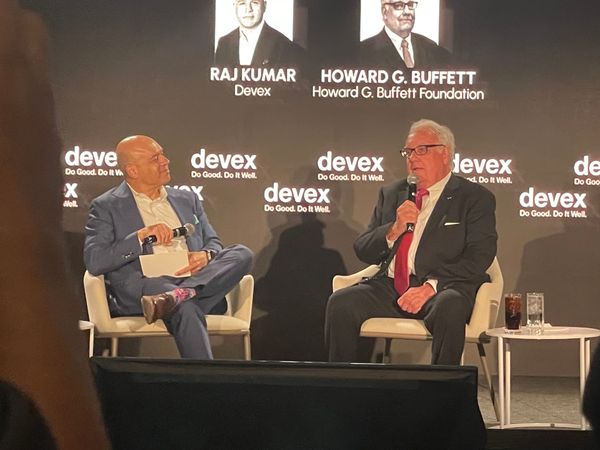
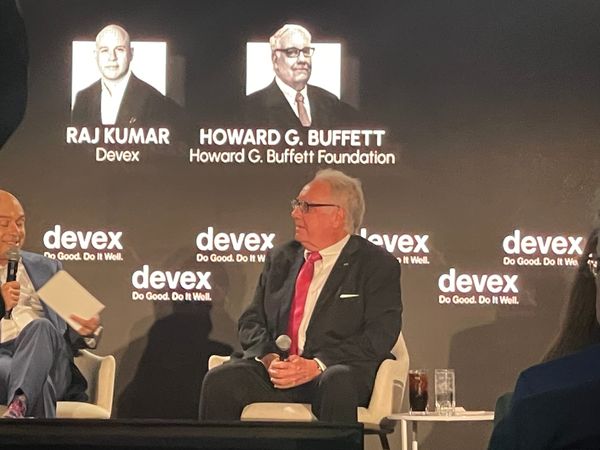
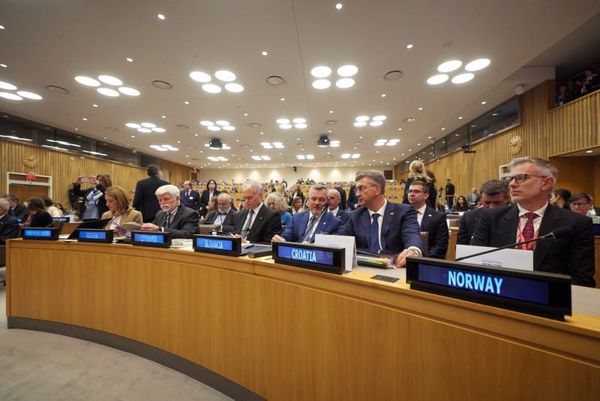
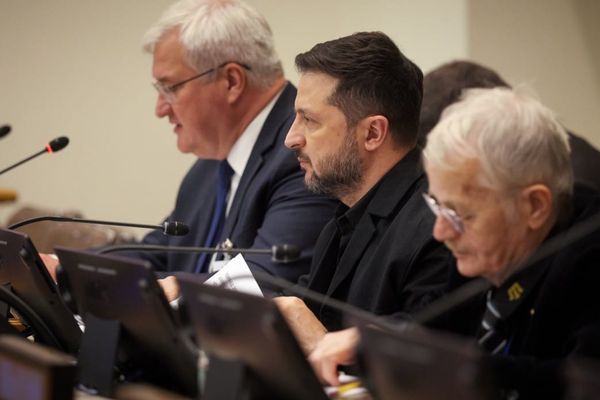
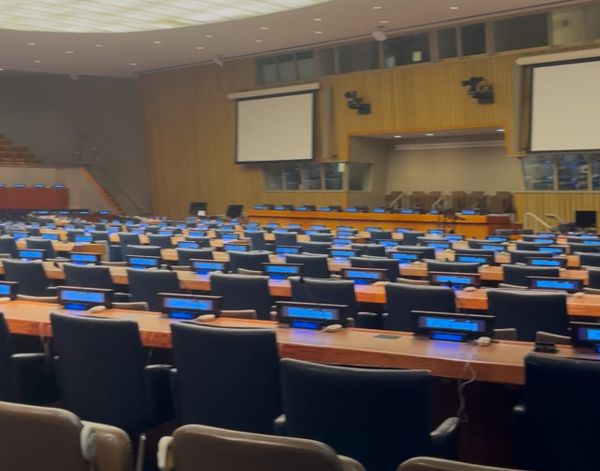
Howard Buffett opened one of the more consequential conversations I attended during UNGA week with a line that cut through the usual language of aid and philanthropy.
“For me, it wasn’t a choice,” he said of supporting Ukraine.
Buffett, farmer, photographer, philanthropist and, as of this month, the new non-executive chairman of Berkshire Hathaway, has made Ukraine one of the defining commitments of the Howard G. Buffett Foundation since Russia launched its full-scale invasion in February 2022.
The scale is unusual for a private foundation. By September 2026, the foundation’s commitments to Ukraine had reached approximately $1.1 billion, spanning agriculture, demining, humanitarian food assistance, infrastructure, medical care, prosthetics, reconstruction and documentation of war crimes.
And Buffett says he has personally traveled to Ukraine 25 times since the invasion began.
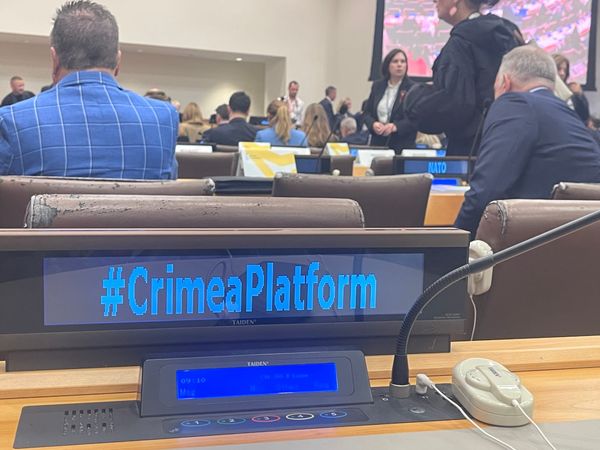
This morning, inside the Ukraine Prosperity Forum in New York, those numbers became something more interesting: a window into how Buffett thinks about the limits of philanthropy, the role of the United States and Europe, and what supporting Ukraine says about democratic values themselves.
ONEST gives you the context behind the headline — from inside the rooms where some of those headlines are made.
“You can either help or be a witness”
Buffett was unusually direct about why Ukraine has become such a priority for him.
“You can either help or be a witness,” he said. “I don’t want to be a witness to someone committing war crimes every day; someone who aims to defeat a population by starving them and letting them freeze.”
He argued that Western governments have often framed support for Ukraine too cautiously.
He criticized former President Joe Biden’s formulation that the United States would stand with Ukraine “as long as it takes,” arguing that the message should instead have been that the West would stand with Ukraine until Russia was defeated.
It illustrates how he sees the war: not primarily as a dispute to be managed, but as a test of whether democratic countries are prepared to defend the principles they claim to hold.
“Ukraine is the place where we get to show if we still have the democratic values — the basic principles that made our country the leader of the free world — that we are willing to fight for,” Buffett said. “It’s actually about our values.”
He also questioned the logic of negotiating with Vladimir Putin, recalling something his father once told him: “You cannot make a good deal with a bad guy.”
Buffett then added: “If you look up a bad guy, you see Putin. So how do these negotiations go?”
More than $1 billion
The size of Buffett’s Ukraine commitment matters. The scope matters more.
The Howard G. Buffett Foundation says its work in Ukraine includes direct food aid, assistance to displaced people and schools, farm machinery and agricultural support, generators and windows for damaged infrastructure, prosthetics and medical care, humanitarian demining, purchases of Ukrainian grain for food-insecure countries, and support for documenting possible war crimes and crimes against humanity.
A few numbers show how broad that footprint has become.
The foundation invested $15.3 million in construction and equipment for the Superhumans Center in Lviv and initially provided another $2 million to support prosthetics. Superhumans provides prosthetics, reconstructive surgery, rehabilitation and psychological support to civilians and veterans injured in the war.
Through its Victory Harvest agricultural program, the foundation had invested more than $53 million in agricultural machinery by the end of 2024. Its donated fleet included 70 combines and 94 tractors, which Ukrainian farmers had used to plant more than 544,000 acres and harvest more than 527,000 acres, much of it in frontline Kharkiv and Kherson regions. Foundation equipment was struck by missiles or landmines in 11 separate incidents in 2024 alone.
Its partnership with Ukrainian Railways produced the Food Train, capable of making up to 10,000 meals a day and operating autonomously for seven days. By March 2025, it had served more than 1.5 million meals in frontline and de-occupied communities.
The foundation also committed $32.7 million to central production kitchens serving Ukrainian schoolchildren in Kharkiv and Odesa, after financing the flagship kitchen in Bucha. By the end of 2024, that Bucha facility had already prepared more than 700,000 meals.
Buffett’s support has extended into reconstruction as well. His foundation has participated in rebuilding infrastructure in Bucha and Irpin, including police facilities and community projects, and in 2026 financed a new barrier-free sports and rehabilitation center in Kyiv for veterans, amputees, injured railway employees and others with disabilities.
And Buffett said this morning that the foundation has sent approximately $50 million worth of generators to Ukraine.
Those investments are still humble next to the scale of the destruction. The latest joint assessment by the Government of Ukraine, World Bank, European Commission and United Nations estimates that Ukraine will require almost $588 billion in reconstruction and recovery over the next decade.
Agriculture is becoming more dangerous
The foundation’s food-support work has also operated at extraordinary scale. Buffett said today that its efforts have helped deliver roughly 650 million meals in Ukraine.
When that figure came up, he chuckled — then turned serious about how dangerous even basic food distribution has become in frontline areas.
“People don’t have access to any type of food distribution unless it is a human-based distribution,” he said, adding that those efforts themselves can be targeted.
For Buffett, a farmer himself, agriculture has remained one of the most personal parts of the work.
“We want to see agriculture come back,” he said.
But he warned that operating farms in Ukraine is becoming increasingly dangerous.
“They have destroyed three combines in the last month alone,” he said. “You’ll see more farmers going out of production, unfortunately.”
Humanitarian demining, he added, “has been big for us” and remains critical to bringing farmland back into production.
The foundation’s own records illustrate why. Russia’s invasion left agricultural land mined, damaged or inaccessible, while farm equipment, storage facilities and transportation infrastructure have repeatedly been attacked. The foundation’s agricultural program was designed not simply to provide aid but to keep Ukrainian farmers operating while the war continues.
That matters far beyond Ukraine.
Later in the forum, former Ukrainian ambassador to the United States Oksana Markarova noted that Ukraine continues to feed hundreds of millions of people worldwide even during the war; a reminder that Ukraine’s agricultural survival is also a global food-security issue.
The human infrastructure
Buffett repeatedly returned to another form of reconstruction: people.
“You have to invest in the youth,” he said, “and you have to develop the next generation of leadership.”
That philosophy helps explain why his foundation’s work has moved beyond emergency humanitarian support into rehabilitation, medical care and institutional capacity.
Superhumans is one example. So are investments in school nutrition, adaptive sports, local infrastructure and programs aimed at restoring communities rather than simply keeping them alive.
Ukraine’s challenge is no longer only surviving the war. It is maintaining enough economic, human and institutional capacity to emerge from it.
The fortune behind the foundation
There was another reason Buffett’s remarks felt particularly significant this week.
Howard Buffett has just succeeded his father as non-executive chairman of Berkshire Hathaway, while Greg Abel remains CEO and runs the company’s operations. Warren Buffett is now chairman emeritus.
Howard’s role at Berkshire is largely one of stewardship, preserving the culture his father built. The family is confronting an even larger question outside Berkshire: what happens to Warren Buffett’s fortune.
Howard confirmed this morning that his father intends for his remaining wealth — roughly $140 billion, plus future growth — to be distributed philanthropically by his three children by 2034.
That timeline has also been reported publicly: Warren Buffett has charged Howard, Susie and Peter Buffett with distributing his remaining fortune to charitable causes.
That makes his Ukraine work particularly interesting. The question is no longer simply how much money a Buffett foundation can donate. It is what kind of problems the family believes private wealth should attempt to solve and how directly it should intervene when governments cannot or will not move quickly enough.
Ukraine provides one answer.
The room itself
For all the numbers, Buffett did not come across like someone particularly interested in performing philanthropy.
At one point he joked about why anyone would come to New York during UNGA week when they could be home harvesting corn.
He still farms.
Then quite loud NYPD noise outside the venue visibly startled him. For a moment, he thought it sounded like a drone in Ukraine. The moderator reassured him that it was only New York. Buffett laughed and reminded the room that he was not from New York.
It was a small moment, but one that revealed something about 25 trips into a country at war that a grant total cannot.
“You cannot come to New York this week and not make Ukraine the priority”
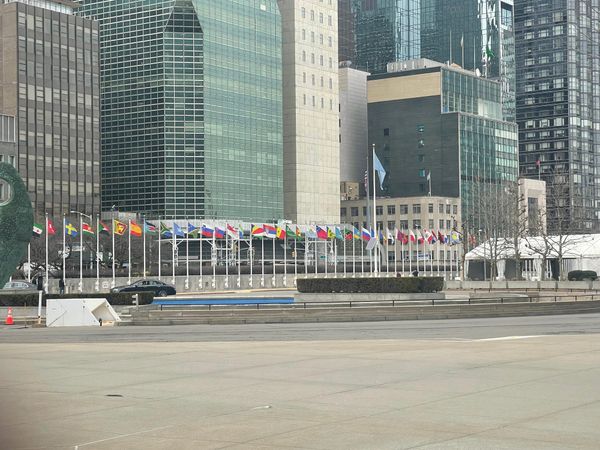
Buffett eventually brought the conversation back to UNGA week itself.
“You cannot come to New York this week and not make Ukraine the priority of the discussion,” he said.
Yet Ukraine is competing for attention with wars elsewhere, economic uncertainty, changing alliances and governments increasingly focused inward.
Former World Food Programme Executive Director David Beasley, who spoke during the following session, offered his own assessment of American power:
“America is great when we are good,” he said. “But when we are not being good, we are not that great.”
Beasley also recalled being in Ukraine when Russia launched a missile strike and later raising it with Russian Foreign Minister Sergey Lavrov. According to Beasley, Lavrov laughed off the episode.
The point running through both conversations was not simply that Ukraine needs more money. It was that money follows political choices and political choices reflect priorities.
The harder questions around reconstruction
That becomes particularly important when the conversation turns from philanthropy to investment.
Ukraine’s nearly $588 billion reconstruction requirement cannot be financed through foundations and humanitarian aid alone. It will require governments, multilateral institutions and enormous amounts of private capital.
That brings governance into the discussion.
Asked about corruption and whether recent high-profile investigations could frighten investors, Markarova emphasized Ukraine’s unity and argued that corruption challenges exist in many countries, particularly during wartime.
That is one part of the picture.
Another is that Ukraine’s anti-corruption institutions have continued investigating senior officials and individuals within President Volodymyr Zelenskyy’s broader political orbit. Recent cases have contributed to resignations, public protests and renewed scrutiny of government accountability.
For investors considering reconstruction projects worth billions of dollars, those questions will not disappear simply because Ukraine is fighting a war.
Nor should they.
Supporting Ukraine and scrutinizing how Ukraine governs itself are not mutually exclusive positions.
That distinction may become increasingly important as emergency assistance gradually gives way to reconstruction capital.
The money already sitting in Belgium
Markarova also returned to another enormous pool of capital: frozen Russian state assets.
EU countries have immobilized about €210 billion in Russian central-bank assets, with roughly €185 billion held at Euroclear in Belgium. Belgium continues to oppose outright confiscation or broader use of the principal because of legal and financial risks, while several other European governments have pushed for more aggressive action.
Markarova argued that sufficient legal foundations exist to act and described the remaining obstacle primarily as political will. Belgium disputes that characterization, maintaining that significant legal and systemic risks remain.
That disagreement encapsulates one of the central problems surrounding Ukraine’s reconstruction: there is no shortage of money theoretically connected to the war. There is a shortage of agreement about who can use it, how, and under what legal authority.
Howard Buffett’s answer is much simpler
Buffett does not run a government.
He does not need consensus among 27 EU countries.
He does not need a parliamentary appropriation.
That allows him to act differently.
Perhaps that is why his philosophy sounds so uncomplicated: “You can either help or be a witness.”
More than four years into the full-scale invasion, Howard Buffett has chosen the former, repeatedly, personally and at a scale that has made his foundation one of the most consequential private actors operating in Ukraine.
The more interesting question now is what comes next.
Warren Buffett’s fortune is entering its final philanthropic chapter. Howard Buffett has taken on a new stewardship role at Berkshire. Ukraine faces a reconstruction bill approaching $600 billion.
And if the last four years tell us anything about Howard Buffett’s priorities, Ukraine is unlikely to disappear from that story.
By the numbers: Howard G. Buffett Foundation in Ukraine
As of September 2026:
- ~$1.1 billion committed to Ukraine since 2022.
- 25 visits to Ukraine since the full-scale invasion, according to Buffett at the forum.
- $53+ million in agricultural machinery reported by the foundation by the end of 2024.
- 70 combines + 94 tractors provided through the Victory Harvest program.
- 544,447 acres planted and 527,001 acres harvested using foundation-donated machinery by the end of 2024.
- 11 missile/landmine incidents involving foundation-provided farm machinery in 2024.
- $15.3 million toward construction/equipment for Superhumans in Lviv, plus early prosthetics funding.
- 1.5+ million meals delivered by the Food Train by March 2025.
- Up to 10,000 meals per day capacity aboard the Food Train.
- $32.7 million committed to school-kitchen projects in Kharkiv and Odesa, in addition to the Bucha facility.
- 700,000+ meals produced by the Bucha kitchen by the end of 2024.
- ~$50 million in generators, according to Buffett’s remarks today.
- Support also includes humanitarian demining, reconstruction, grain purchases, prosthetics, medical care, infrastructure restoration, support for displaced Ukrainians, and documentation of alleged war crimes and crimes against humanity.