America Votes, Trump Moves on Israel Aid, and Ukraine Prepares for New Peace Talks

– 3 min read

Here are five geopolitical developments worth knowing today.
The first polls began closing Tuesday evening, but as of publication there is not yet a national result worth interpreting.
Republicans entered Election Day with extremely narrow congressional majorities: 219 members caucusing with Republicans in the House and a 53-47 advantage in the Senate. Democrats need a net gain of three House seats and four Senate seats to take both chambers.
More than 59 million Americans voted before Election Day, and early voter polling points to the economy, cost of living and concerns about presidential power among the election’s major issues.
Tomorrow, ONEST will look at the full results — what changed, what didn’t, and what they mean for the final two years of the Trump presidency.
President Trump said Tuesday that he and Israeli Prime Minister Benjamin Netanyahu had agreed that U.S. aid to Israel would end after 2026.
The United States would continue selling weapons to Israel and could provide assistance when necessary, Trump said. But the announcement is significant because the current U.S.-Israel memorandum of understanding runs through September 2028.
Trump also explicitly framed the decision in domestic political terms, arguing that ending the aid would remove an issue Democrats have used against Republicans. The White House and Netanyahu’s office had not provided additional details by Tuesday.
Ukraine says team-level negotiations involving Ukraine, the United States and Russia are scheduled for November 10-11 in Abu Dhabi — the first direct Ukraine-Russia talks since February.
The agenda is expected to include security guarantees, a possible ceasefire covering energy infrastructure and arrangements in the Black Sea.
German Chancellor Friedrich Merz said Russia must demonstrate that it is serious about negotiations, while Zelenskyy stressed that Europe must remain part of any settlement.
The talks come while fighting continues. Russia launched another major missile-and-drone assault against Ukraine’s energy system Tuesday, hitting facilities across multiple regions.
U.S. forces struck Iran’s Qeshm Island Monday in what American officials described as defensive operations intended to prevent attacks on commercial shipping through the Strait of Hormuz.
The strikes were not publicly announced at the time.
That matters because Washington and Tehran are simultaneously exploring a diplomatic deal over the Strait. Trump has publicly played down the likelihood of renewed major fighting, while Iran has said an agreement could be implemented quickly if Washington accepts its conditions.
So both tracks are continuing at once: negotiation and military pressure.
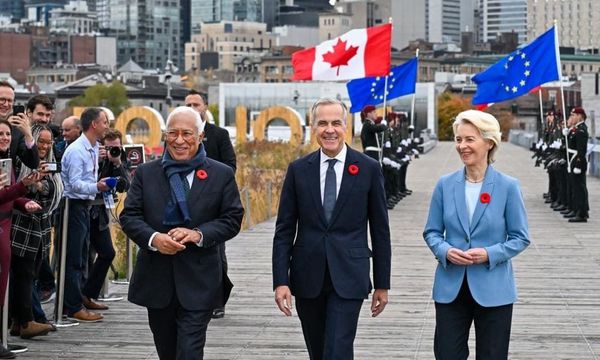
Prime Minister Mark Carney used his first Commonwealth Heads of Government Meeting to push Canada’s broader strategy of reducing dependence on traditional economic relationships and building new ones.
Canada announced more than $70 million in new investments focused on infrastructure, disaster preparedness, climate resilience and emergency response across Commonwealth countries, particularly in the Caribbean.
Carney also met Australian Prime Minister Anthony Albanese to discuss cooperation in energy, critical minerals, defense, AI and trade, while talks with Guyana focused on energy, mining, infrastructure and a possible investment-protection agreement.
China-Russia-U.S.: Moscow says discussions are underway about a possible meeting between Xi Jinping, Vladimir Putin and Donald Trump during the November 18-19 APEC summit in Shenzhen.
Australia: The Reserve Bank raised its cash rate by 25 basis points to 4.85%, an 18-year high, although its statement suggested the tightening cycle may be nearing its end.
United Kingdom: Britain’s cybersecurity chief warned that AI-powered attacks against critical infrastructure are likely by 2028 as both criminal groups and states expand their use of artificial intelligence.
U.S. midterms: The first meaningful congressional picture will develop tonight, but some close Senate and House races may take days to resolve. Tomorrow, we’ll look at the results rather than the election-night noise.
Ukraine: U.S., NATO, European and Ukrainian officials meet in Brussels Wednesday to discuss security guarantees and recovery ahead of the November 10-11 talks with Russia.
Iran: Watch whether negotiations over Hormuz continue after the Qeshm strikes or whether the military track begins overtaking diplomacy.
That’s what mattered today.
— Olga