The Daily: UNGA81, Day 5 of 5

– 6 min read

Good evening,
Welcome to Day 5 of 5 of ONEST’s public UNGA81 Daily Briefs.
This is the last one.
Over five days, the same themes kept resurfacing in very different rooms: war, energy, trade, critical infrastructure, health security, supply chains, technology and the increasingly difficult question of what international cooperation still looks like when countries are simultaneously trying to reduce their dependence on one another.
Today, UNGA turned to pandemic preparedness. Ukraine continued working the diplomatic track toward a possible partial ceasefire. Xi Jinping concluded his state visit to Washington. And almost simultaneously, events in the South China Sea provided a useful reminder of how far summit language about “stability” can sit from what is happening on the water.
Here’s what mattered.
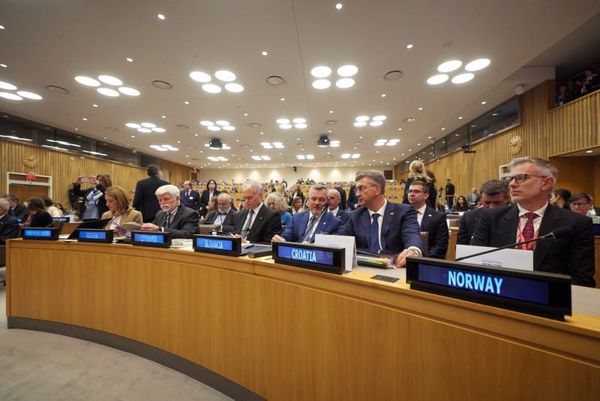
The United Nations today held its second high-level meeting on pandemic prevention, preparedness and response, three years after the first meeting in 2023.
The political message was straightforward: pandemic preparedness cannot disappear from government agendas simply because COVID-19 is no longer the crisis dominating them.
WHO says COVID was associated with more than 20 million excess deaths between 2020 and 2023 and erased more than $10 trillion from the global economy. Governments today recommitted to stronger surveillance, more resilient health systems, better access to vaccines, diagnostics and treatments, and sustained financing between crises, not only after one begins.
There has been progress.
Since COVID, countries have adopted amendments to the International Health Regulations and the WHO Pandemic Agreement, and new systems have been created around epidemic intelligence, vaccine manufacturing, pathogen sharing and emergency response.
But one important piece remains unfinished.
Governments are still negotiating the Pathogen Access and Benefit-Sharing system, or PABS: essentially the rules governing how pathogens with pandemic potential are shared for research and how vaccines, medicines, diagnostics and other benefits developed from them are subsequently shared.
WHO says completing that annex is necessary before countries can move fully into national consideration of the Pandemic Agreement.
This is actually the central political problem COVID exposed: when the next outbreak comes, will countries share the information and biological material needed to develop countermeasures and will the countries supplying them have meaningful access to the products that result?
The science is only part of pandemic preparedness. Trust is infrastructure too.
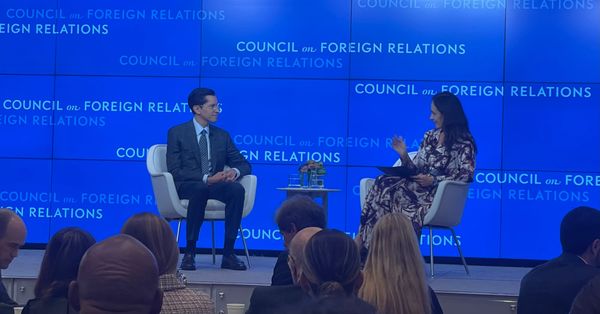
President Volodymyr Zelenskyy continued his New York diplomacy with a meeting involving leaders and representatives from major American think tanks.
The discussion focused on negotiations, winter preparation and air defense.
Zelenskyy said Ukraine is prepared for substantive negotiations with Russia mediated by the United States and suggested that even a limited step — a meeting, partial ceasefire or energy ceasefire — could begin a process of de-escalation.
That fits the position Ukraine has been articulating throughout the week. Kyiv is not proposing simply to stop strikes on Russian energy infrastructure unilaterally.
It is proposing reciprocity: Russia stops attacks on Ukraine’s energy system, and Ukraine stops attacks on Russian energy and export infrastructure.
Today Zelenskyy also warned that Russia is increasingly targeting infrastructure that extends beyond the battlefield, including data centers, railways, logistics, internet and mobile communications.
That makes the winter question larger than electricity: it is about whether a modern state can continue functioning under sustained attacks on the systems civilians rely upon every day.
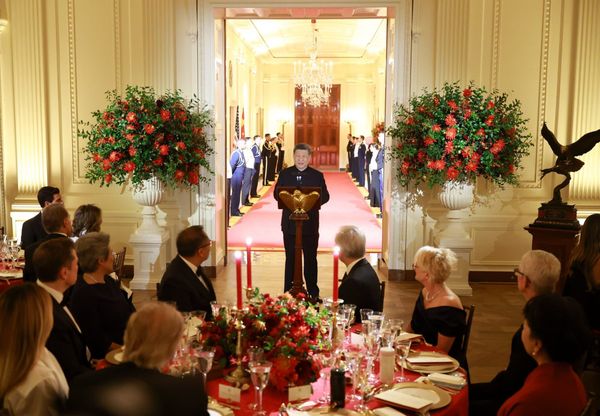
Xi Jinping departed the United States today after a state visit built heavily around the message that Washington and Beijing are trying to stabilize their relationship.
The Chinese readout says Trump and Xi discussed trade, artificial intelligence, Taiwan, Ukraine, the Middle East and the Korean Peninsula, and agreed to continue economic talks. Beijing again emphasized what it calls a relationship of “constructive strategic stability.”
The two leaders also agreed to support one another’s upcoming regional summit diplomacy: China’s hosting of APEC and the U.S. hosting of the G20.
The relationship between the United States and China touches virtually every major issue we have followed this week and the underlying disagreements remain substantial. The visit was an effort to maintain stability despite persistent tensions over technology, trade, Taiwan and Iran.
Daniel Russel, a former U.S. Assistant Secretary of State for East Asian and Pacific Affairs, put the problem particularly well: there was an enormous amount of pageantry surrounding roughly 90 minutes of substantive talks.
There was also a striking development on the U.S. side this week: the Air Force is eliminating the civilian positions at its China Aerospace Studies Institute, its premier open-source research center focused on Chinese military aviation, space, cyber and missile forces. The institute’s director said the civilian jobs become unfunded October 1 and warned that unless the team finds a new home inside the government, the center could ultimately close. The Air Force says the mission will continue, but experts quoted by Air & Space Forces Magazine warned that losing the institute would weaken one of Washington’s few institutional efforts devoted specifically to understanding Chinese military development from open sources.
But we did get two pandas.
The timing here is striking.
While Beijing was emphasizing a more stable relationship with Washington, the Philippines says Chinese vessels interfered with a Philippine resupply mission to the BRP Sierra Madre at Second Thomas Shoal on September 24.
According to the Philippine military, eight Chinese navy and coast-guard vessels were involved, and the mission was temporarily suspended for safety reasons.
The broader dispute is longstanding: Beijing claims much of the South China Sea, while Manila relies on the 2016 arbitration ruling rejecting the legal basis for China’s expansive maritime claims in areas covered by the case.
What makes yesterday’s episode particularly useful is the contrast:
At the summit level: strategic stability.
At sea: continued friction over access, maritime claims and military presence.
The Chinese readout also confirmed mutual support between Trump and Xi for upcoming regional summits.
That matters because Southeast Asian governments are watching the relationship from a very different vantage point. They want a functioning U.S.-China relationship, but they also do not want regional questions (trade, maritime security, technology, the South China Sea) reduced to decisions negotiated solely between Washington and Beijing.
The Philippines, which is preparing to host ASEAN-related meetings later this year, has continued publicly emphasizing both dialogue with China and the defense of its own national interests.
The Second Thomas Shoal incident shows why that balancing act remains difficult. Stability between two great powers does not automatically mean stability for the countries operating between them.
Another unusual diplomatic problem surfaced today.
South Korean President Lee Jae Myung publicly criticized Zelenskyy for disclosing that Ukraine had transferred two captured North Korean soldiers to South Korea.
Lee said Seoul and Kyiv had agreed that the transfer would remain confidential because of its diplomatic and security sensitivity.
Zelenskyy had revealed the transfer during his UN General Assembly speech earlier this week. The episode illustrates something Zelenskyy himself has spent this week arguing: Russia’s war is no longer geographically contained. North Korean personnel are fighting alongside Russia. Their capture creates questions for Seoul. Chinese support for Russia is part of Washington-Beijing discussions. European security increasingly intersects with Indo-Pacific security. The categories are becoming harder to separate.
At the beginning of this week, we were talking about critical minerals between Italy and the United States.
Then Greenland.
Then Argentina’s new economic corridor.
Then Canada and Vietnam.
Then U.S.-China supply chains.
At the same time:
Hormuz disrupted energy flows.
Countries sought alternative routes.
Europe talked strategic autonomy.
Ukraine talked about protecting its grid.
The UN talked about health system resilience.
And today, pandemic preparedness came down to whether global systems can still function when the next crisis arrives.
These are different stories, but they share one underlying question:
How much vulnerability is a country willing to tolerate?
Dependence on one supplier. One shipping lane. One military partner. One energy source. One data system. One manufacturing base. One country for medicines or critical minerals.
That is what I will take away from UNGA81.
The vocabulary of this week was diplomacy, yet the underlying subject was resilience.
A rare September nor’easter is strengthening along the U.S. East Coast, bringing the risk of coastal flooding, heavy rain, strong winds and significant travel disruption across parts of the Northeast this weekend. The exact track remains important, particularly for New York and New England.
Haiti’s prime minister told the General Assembly that the country has reached a “watershed moment” in its fight against gang violence and called for sustained international support for security institutions.
And NATO’s top military commander said the United States intends to continue providing critical capabilities to the alliance, but in a more limited form as European allies assume greater responsibility for European defense.
For five days, I made The Daily public so you could see how ONEST covers a week of news.
If you’re already an ONEST member, keep an eye out this weekend for a new WHO Diplomatic Note and an ONEST Voices interview with Dr. Alain Labrique, WHO’s Director of Digital Health and Innovation — and if you missed it, the Mexico foreign policy Diplomatic Note is already live.
If you’ve been considering joining, this is a good moment to do it: explore the monthly or annual membership options and unlock the full archive.
See you Monday,
Olga