ONEST Middle East Brief

– 3 min read

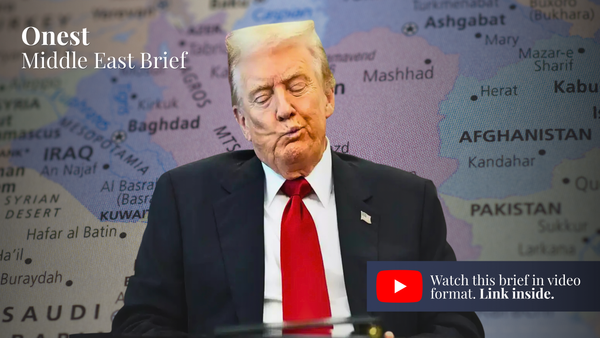
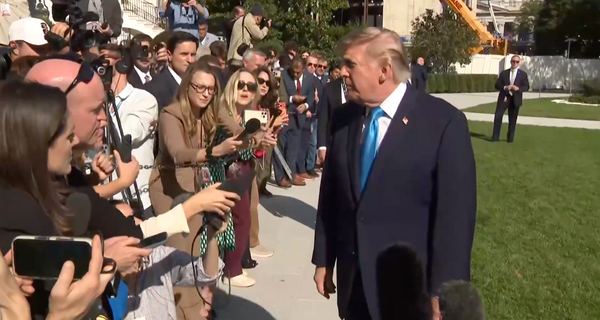
Over the weekend, President Donald Trump announced that the United States had canceled a planned military strike against Iran after, according to him, requests from Iran and several Middle Eastern countries to give diplomacy a chance.
Trump said the goal remains twofold:
Subsequent reporting indicated that Saudi Crown Prince Mohammed bin Salman (MBS) was among the regional leaders urging Washington to give diplomacy a chance before another round of military action.
By Monday, however, Iran publicly contradicted Trump's announcement.
Iranian officials said there are no negotiations with the United States, while Foreign Minister Abbas Araghchi arrived in Iraq, reiterating that Tehran is not engaged in direct talks with Washington.
Instead, Iran says discussions are taking place with Oman, describing them as regional consultations rather than U.S.-Iran negotiations.
Hours later, President Trump pushed back directly.
In a series of posts, he said Iranian leaders had requested meetings, claimed discussions were already underway, and described the current moment as Iran's "last chance" to reach an agreement.
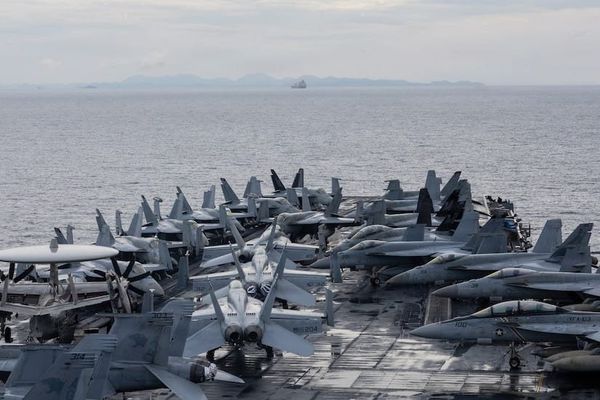
Trump also argued that the United States effectively controls access to the Strait of Hormuz through its naval presence and reiterated that Iran would never be allowed to develop a nuclear weapon.
At this point, Washington and Tehran are presenting two fundamentally different versions of the same events.
The Strait of Hormuz remains the central point of disagreement.
Before the conflict, commercial shipping moved through internationally recognized routes. Despite Trump's announcement, shipping has not yet returned to normal.
Iranian officials say discussions with Oman are focused on establishing a temporary shipping corridor, while ensuring that Iran retains control over security arrangements in the waterway.
Tehran also argues that the future of Hormuz is not an issue to negotiate with the United States, but a regional matter involving neighboring countries.
In practice, Iran appears determined to ensure that any reopening of the strait happens under an arrangement it can present as its own decision — not as a concession secured through U.S. military pressure.
That reflects a broader difference in strategy.
President Trump is seeking a rapid diplomatic breakthrough following the conflict.
Iran, by contrast, appears to be treating Hormuz — and wider regional pressure — as leverage in what it views as a longer negotiation process.
Despite the conflicting narratives, financial markets have already responded.
Oil prices fell sharply after President Trump announced the strike had been canceled, reflecting investor expectations that tensions may ease — even though Iran continues to deny that direct negotiations are taking place.
The reaction highlights how diplomatic messaging alone can move global markets before any agreement is actually reached.
Despite President Trump's announcement of progress toward a ceasefire, Israeli military operations continued in Gaza. Israeli officials also expressed serious concerns regarding reported Hamas disarmament proposals, suggesting significant hurdles remain before any agreement can be implemented.
The United Nations said it is "deeply concerned" by continued Israeli demolitions in southern Lebanon despite the ceasefire. Overnight, further large explosions were reported as Israeli forces carried out additional demolitions near the border.
Two Saudi oil tankers successfully crossed the Bab el-Mandeb Strait over the weekend, while traffic through the Strait of Hormuz remained slower than normal.
Officials clarified that reports of a U.S. military withdrawal from Iraq's Kurdistan Region reflected a previously planned force adjustment rather than an emergency redeployment.
Türkiye and Iraq signed a one-year agreement extending operation of their cross-border crude oil pipeline, preserving an important export route outside the Persian Gulf.
The Houthis denied reports that they plan to charge commercial vessels transiting the Bab el-Mandeb Strait, saying passage remains free.
A magnitude 5.6 earthquake near Suez was felt across several countries in the region.
At least 35 people were reportedly killed in a drone strike on a tribal court in North Darfur, highlighting that Sudan's civil war continues alongside the broader regional tensions.
The coming days will determine whether Washington and Tehran move toward genuine diplomacy — or continue exchanging competing public narratives.
The key questions remain:
For now, the biggest divide is not military — it is diplomatic.
Washington says negotiations are already underway.
Tehran insists they are not.
And until those two narratives begin to converge, the Strait of Hormuz remains not only a strategic chokepoint, but also the clearest symbol of the ongoing contest over who gets to define the outcome of this conflict.
Get briefs like this delivered daily — free.